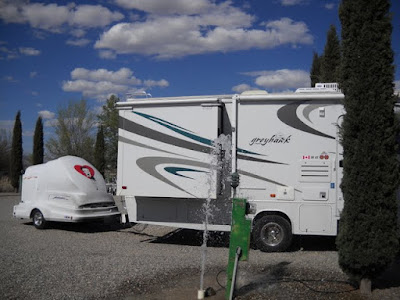
Monday we drove 35 miles from Willcox to the Chiricahua National Monument. The roadside was carpeted with poppies. We have been in southern Arizona since mid-October and we are used to the desert and the mountains of the desert. Were we ever surprised when we got to the monument! The rocks aren't the volcanic brown of most of those we have seen and we were surrounded by juniper, pine, oak and fir trees. The rocks are rhyolite--superheated ash particles from the Turkey Creek Volcano and melted together, forming layers of gray rock. It is called both an island in the sky and, in the words of the Apache, the Land of Standing Up Rocks. When the ranger in the visitor center suggested the Echo Canyon, Hailstone, Ed Riggs trails loop she said we would be up-close with the rocks. She was right.Here you see the pine trees and standing up rocks.
 And here we begin to get up close and personal.
 Around every curve we saw more standing up rocks.
 A short way down the train, we came to an area called the Grottoes. Here are two photos from that area.
 The lichen on the rocks really is this green. In fact, it is described as neon green.
 We saw piles of rock, narrow slots in the rock, and balanced rocks.

 We were really glad the trail didn't lead through this slot.
 How is this for a window with a view?
 In places we had a great view over the surrounding, hazy landscape.
 Here is another balanced rock.
 I wish I could remember what this formation is called.
 I was glad this rock didn't fall over on John.
 Here is a final view of the trees that remind us of the Colorado mountains.
Saturday we went hiking in the Sonoita Creek Natural Area next to Patagonia Lake. That required stopping at the state park's entrance station for a permit to go into the natural area. There is no charge for that permit.We hike a loop of the Sonoita Creek Trail, Cottonwood Trail and Blackhawk Canyon Trail, about 2.75 miles total. We have never seen as many Ocotilla as we found growing near Patagonia Lake. It is almost a forest of the pretty cacti. In places there were lots of pink flowers at the base of the Ocotilla.
 We were glad to see quite a few poppies blooming, as well as mountains in the background.
 As we hiked down to Sonoita Creek, we came to a forest of large trees. In places they were very dense.
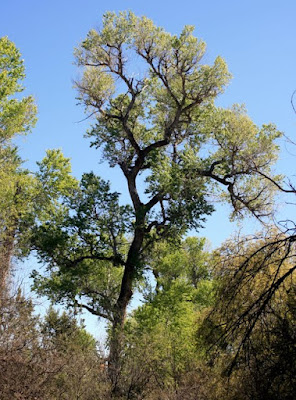
 We came on some of the biggest cottonwood trees we had ever seen. This isn't the largest, but I was able to get far enough away to be able to see the top of it.
 We crossed Spillway Creek, which only had a little bit of flowing water. Patagonia Lake is full, but they aren't releasing water right now. The water flows over solid rock.
 There is an area where they indicate a waterfall, but, with so little water, it was hard to tell.At the top, we crossed the spillway. Here is John tiptoeing around the puddles.
 We left Patagonia Lake on Sunday to spend two nights in Willcox.
Thursday was history and research day. We plan to return to Casa Grande Ruins next winter and in our tours we talk about Padre Francisco Kino and Juan Batista de Anza. Just a little north and east of where we are staying we visited the Tubac Presidio where Anza was captain and the San Cayetano de Tumacacori, one of the missions established by Kino. Tubac has been maintained as an Arizona State Historic Park, the state’s first state park. Unfortunately, it is one of a number of state parks that have lost their funding due to the current budget crisis in the state. Fortunately, local supports have raised the funds to keep the park open with volunteers. It is a wonderful historic site. Tubac was a Spanish fort (presidio) established in 1752 after a Pima Indian revolt to control the Pimas and protect the frontier from the Apaches and Seris. It was maintained till 1821, under Spanish then Mexican control. Anza was the second captain there. His greatest claim to fame was leading a group of settlers to California where they established the town of San Francisco. On the way there, he visited Casa Grande Ruins and priests with the expedition recorded information about the ruins. Only these few adobe bricks remain of the original Presidio.  However, archaeologists who excavated the site in 1974 returned and prepared an underground archaeological display of portions of the original foundation, walls, and plaza floor.
  A group of displays shows how cooking, leather work and carpentry shops might have looked during the years of Spanish control.
 This park was so informative. We wanted to go on to visit Tumacacori, which is only a couple of miles down the road, even though our brains were already full of information. We didn’t spend much time at the National Historical Park, but it was interesting to see a model of the original church area
 and the ruins of the church.
 It was established in 1691 by Fr. Kino, a Jesuit priest from Spain who came to New Spain (Mexico) in 1887. He also established missions as far north as present-day Tucson. In 1694, 1697 and 1699 he visited Casa Grande Ruins and when he wrote about that first visit in his diary, he was the first European to leave a written record of the ruins. We will have to return to Tumacacori to learn more. But it was a very interesting day. Along the way we enjoyed looking at the shops in the town of Tubac, which has boutiques and numerous artist galleries. It is a fun little town, but it would be hard to add one of these metal sculptures to what we carry in our RV basement.
When you live full-time in about 350 square feet, having the outdoors as part of your home is important. The weather in Arizona is usually good enough to enjoy being outdoors. But what we have been missing in both Mesa and Casa Grande Ruins was being in touch with nature. On Tuesday we came to Patagonia Lake State Park in southeast Arizona and here we can really enjoy God’s creation. We both enjoy seeing and listening to birds. But we are learning what it means to be birders. We knew that bird watching was a major activity here. Someone has spent a lot of time nailing quarter and half oranges to the trees. Here is a house finch enjoying that fruit. Tuesday afternoon we walked the campground and I was carrying my camera. One woman said, “We know where you’re going. The word is out.” Our thought was “what word?” But we smiled and walked on. Wednesday we were walking toward the birding trail when a birder left the trail. On his way by he said, “The Trogon is right next to the trail.” We stopped him and asked for an explanation. It seems the Trogon is a colorful semi-tropical bird that occasionally visits this park during mating season. When we asked him to describe the bird, he did, then said if you see it and aren’t a serious birders, we are really lucky. We walked slowly and quietly down the trail, passing others going both ways, doing the same thing. Everyone had binoculars and most people had cameras. This is a serious bird photographer.
 This is John looking for birds in the marsh. We have decided this activity (or is it inactivity?) isn’t something we will do very often. Might I say b o r i n g?
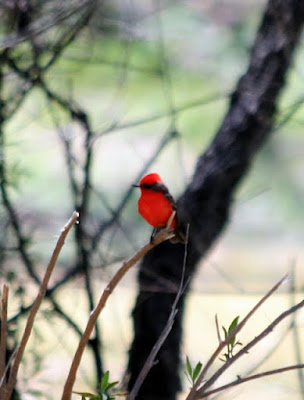
  We didn’t see the Trogon, but we did see and hear lots of birds, including the American Goldfinch, which we saw frequently last year in Montana. I got a picture of the Vermillion Flycatcher. This was a new sighting for us. Isn’t it beautiful?
 Tuesday evening we had walked to the marina and saw lots of Turkey Vultures. Look at the red head.
 Starlings are everywhere. Look at all of them lined up on the electric wires.
 The park also has deer.
  And cows.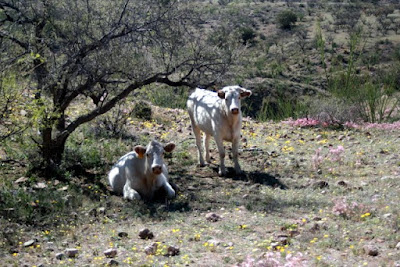
Happy Easter everyone.
We were sooo busy last week. Our son Eric flew down to visit us for two days of his spring break.

On Monday we drove to St. Anthony Greek Orthodox Monastery. It is such a beautiful place, and so peaceful, even though this is Holy Week and there were many pilgrims and other visitors. Eric took what seemed like a million pictures.We took quite a few, but not as many as he did because we had visited last year. Here is a link to the blog I posted then.
On Tuesday we drove to the Boyce Thompson Arboretum, one of the Arizona State Parks. As I have shown in several blogs, the desert is very green this spring because of all the rain we have received. Now the wild flowers are blooming along the highways and many of the plants and trees at the Arboretum were in bloom.
Aren’t these poppies great?

The lupine are also blooming.

The pink flowers remind us of the fireweed we saw in Alaska, though we don’t know if it is really the same flower.

I took lots of pictures at the arboretum, but I didn’t write down the names of any of the plants. So here are some of those I took. Click on the photo and you will see the whole album.
We worked an extra shift at Casa Grande Ruins Wednesday morning to help with 56 children from the Santa Rosa School on the Tohono O'Odham who are in kindergarten through second grade. We don’t have a lot of experience teaching grade school students, but we had lots of help leading the children through the Junior Ranger activities.

And we had a good time. These three girls took turns wearing John's hat.

On Thursday we were hit by a tsunami of junior high students, probably 250.

Between those students and other visitors, the Ruins had a total of 7 tours. It was quite an experience…the most difficult day we’ve ever experienced as volunteers.
We have finished our three-month volunteer assignment. In a couple of days we will be off to be tourists for nine months. I’ll share lots of interesting sights as we travel along.