Showing posts with label archaeology. Show all posts

Sunday, July 07, 2019

Big Horn Basin

The Big Horn Basin is a plateau and basin area in northwest Wyoming, about 100 miles wide.  Ten years ago, in 2009, we spent two months volunteering at 7th Ranch in Garryowen, Montana.  When we experienced a long stretch of really hot weather, one of the owners, Sandy, suggested we head south to the Big Horn Mountains in Wyoming on our days off to cool down.  We would drive south to near Sheridan, then head west and enjoy the cooler weather.  At the time, we had no idea that the Big Horn Basin is a major archaeology and paleontology site.

This year we are heading south from Washington, Oregon and Montana through Wyoming to Colorado where we will visit family for nearly two months. After 4 nights in Billings, we spent two nights in Worland.  There we found the Washakie Museum, just down the road from our RV park.  We decided to check it out.

This mastodon statue is a landmark in town--our RV park said to go through town to the Mastodon then look for signs to the park--and it also marks the museum entrance.


Inside we found numerous exhibits of the bones and other fossil remains discovered by paleontologists and archaeologists in the basin.  Dr. George Frison found incredible specimens of the animals that lived there 15,000 years ago.  (He has been given the Society for American Archaeology's Lifetime Achievement Award, the Paleoarchaeologist of the Century Award, and was elected to the Nation Academy of Sciences,  according to Wikipedia.)   Also found was evidence of early human occupation from when the mastodons were hunted,  going forward to the Native Americans that lived in the area and the European settlers who came to raise cattle and sheep.

This is the bird-like foot of the Deinonychus, a dinosaur that shows a link between birds and dinosaurs.


These are some of the bones of mastodons who were driven over a cliff to allow the natives to kill them for food, hides and bones, which they used as tools.


We didn't realize there are lots of petroglyphs in the basin.  The display shown here in part, included lighted examples of the petroglyphs.  We could touch a button next to a description (here a hunter with a shield) to see what it looked like.  Very good idea.


Once settlers discovered that the basin was a good place to raise cows, they came in droves.  This display says that in January 1878 there were no cattle in Big Horn Basin, but by the year's end there was one herd.  Between 1879 and 1882 so many were brought that the number was too large to count.

Next came sheep and the predictable conflict between cattle barons and sheep herders.  This is an example of a sheep herders wagon.  That was interesting since we have seen numerous wagons from afar over the years.


We learned about raising sugar beets in Wyoming, with the Holly Sugar Company of Colorado getting the crop started here.

Since we are Colorado residents and lived most of our life in that state, it was good to learn more about our neighbor to the north. We often pass through here in our RV travels.

Monday, March 07, 2011

Archeology Finds

I've never been very interested in archeology, per se. From what I have seen and read over the years, being an archeologist means digging in dirt on hot, sunny days or looking carefully at things in a laboratory. Both sound b-o-r-i-n-g.

However, finding really old things is exciting and that has happened to John and me twice this year here at Casa Grande Ruins National Monument. In January, we were walking in a part of the Monument that is not open to the public when John almost stepped on this.


It is a three-quarter ax head that is more than 650 years old. You can see how large it is from the set of keys next to it. We immediately took a picture of it, made careful note of where it was, and went to talk to the chief ranger. She called the chief archeologist and he sent one of his staff to return to the site with John. She told John it had probably been dug out of the ground from a hole by a coyote or badger. We found it near a trash mound, where it had probably been buried for 100s or years.

Everyone was really impressed with the find, but there are so many of this type of object in museums, no one wants them anymore. Therefore, after measurements and more photographs, it was buried again. (All artifacts on National Park land are protected and may not be collected and taken home.)

Finding something that large is very unusual, but to see broken pieces of pottery here at the Monument is not unusual. This area was the first ever historical area protected in the United States, by order of the US Congress in 1889 and President Benjamin Harrison in 1892. That has means that pot hunters and artifact collectors have been very restricted for over 100 years. When you look at a small hill here, you can see pieces of pottery reflecting light easily.


Up close, this is part of what I saw very near the area in the last photo.


In past years, when areas of the Monument were cleaned or digging was done for buildings or other construction, pottery shards were gathered up and put in this pile with rocks that were also picked up.


All of these scenes are from areas where the public does not visit. A small area of the National Monument is open to the public and thousands of people walk through the compound surrounding the four-story building we call Casa Grande Ruins.


The area around the building has been back-filled with clean soil to make sure water drains away from the buildings after rain storms. All of this traffic and fill dirt made the discovery last week of a pottery shard really unusual.

Friday, after one of my tours, a young woman walked up to me and asked me to come see something she and her friend had found right in the public area. I was amazed when I looked at it.


This is a piece of black on white Salado polychrome pottery, probably from the 1300s or 1400s. It must have worked its way up through the fill dirt over the past years, to be seen by those visitors. Again, one of the archeologists came to look at it. And again, they left it where is was found. Hopefully, no one will decide to pick it up and put it in their pocket. Instead, we hope it will remain for others to see and appreciate.

You can be sure I praised the two people who found it and left it where it was. That is exactly what we want our visitors to do.

Monday, April 12, 2010

History and Reserch

Thursday was history and research day. We plan to return to Casa Grande Ruins next winter and in our tours we talk about Padre Francisco Kino and Juan Batista de Anza. Just a little north and east of where we are staying we visited the Tubac Presidio where Anza was captain and the San Cayetano de Tumacacori, one of the missions established by Kino.

Tubac has been maintained as an Arizona State Historic Park, the state’s first state park. Unfortunately, it is one of a number of state parks that have lost their funding due to the current budget crisis in the state. Fortunately, local supports have raised the funds to keep the park open with volunteers.

It is a wonderful historic site. Tubac was a Spanish fort (presidio) established in 1752 after a Pima Indian revolt to control the Pimas and protect the frontier from the Apaches and Seris. It was maintained till 1821, under Spanish then Mexican control. Anza was the second captain there. His greatest claim to fame was leading a group of settlers to California where they established the town of San Francisco. On the way there, he visited Casa Grande Ruins and priests with the expedition recorded information about the ruins.

Only these few adobe bricks remain of the original Presidio.


However, archaeologists who excavated the site in 1974 returned and prepared an underground archaeological display of portions of the original foundation, walls, and plaza floor.


A group of displays shows how cooking, leather work and carpentry shops might have looked during the years of Spanish control.


This park was so informative. We wanted to go on to visit Tumacacori, which is only a couple of miles down the road, even though our brains were already full of information. We didn’t spend much time at the National Historical Park, but it was interesting to see a model of the original church area


and the ruins of the church.


It was established in 1691 by Fr. Kino, a Jesuit priest from Spain who came to New Spain (Mexico) in 1887. He also established missions as far north as present-day Tucson. In 1694, 1697 and 1699 he visited Casa Grande Ruins and when he wrote about that first visit in his diary, he was the first European to leave a written record of the ruins.

We will have to return to Tumacacori to learn more. But it was a very interesting day. Along the way we enjoyed looking at the shops in the town of Tubac, which has boutiques and numerous artist galleries. It is a fun little town, but it would be hard to add one of these metal sculptures to what we carry in our RV basement.

Friday, January 08, 2010

Archaeology Today

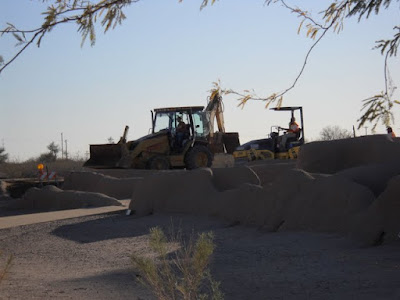
My old idea of how archaeologists do fieldwork included digging with a trowel, cleaning away the last bits of dirt with a small paint brush and sifting the dirt through a fine mesh screen. They may very well still do that, but they also work on a much larger scale. An archaeology firm is doing some fill work within the mud-walled complex around Casa Grande. Look at the tools they are using!


They began the work days--or weeks--before we arrived on Monday. Today the theory is that keeping artifacts in their original place and covering them back up with dirt is the best way to take care of them and the site. Here they aren't actually burying the ancient community, but they are filling in between the buildings with sterile soil. This helps stabilize the building walls, as well as correcting the slope of the surface where visitors walk to enable the periodic rains to run off without doing damage to the site. Apparently the first step in the work was a detailed survey to determine how much dirt to fill in at each point in the complex. We aren't sure what everything will look like until the work is complete.

One of the archaeologists on the crew is also a flintknapper. That is the ancient process of making stone tools. I had never watched anyone flintknap before. Alan was so excited about both the various stones he has to be made into tools and the process itself. It was hard not to get excited, just listening to him.

First he showed us several different pieces of stone, from Montana, Colorado, Wyoming, Australia and other places. Some of the stone he collected himself, such as while working on a pipeline project in Wyoming. Others he bought at the annual Tucson Gem and Mineral Show.

Here he is holding a hammer stone in his right hand and a fairly large piece of stone from Knife River in his left.


He worked on this stone for over 30 minutes. At his feet you can see some other stones he could work with, as well as some of his tools, which are either pieces of stone or of the antlers of deer and elk.


He chipped away at the stone, removing both large and small pieces of rock. He uses his knee as a work surface.


Finally, from a piece of stone slightly smaller than his fist, this is the spear point he made. Isn't that incredible?