This spring, per our usual schedule, we stayed in Gold Canyon through Easter so we could worship at our winter church home, Epiphany Episcopal Church in Tempe.
John assisted at all of the services during this most holy week of the church year, beginning on Palm Sunday. The service began in the Parish Hall then we processed with palms to the church where John censed the altar.
Thursday we marked the Last Supper when Jesus washed his disciples' feet and instituted the celebration of Holy Eucharist. Our Good Friday worship was marked with an empty altar and an empty cross.
Saturday night we began our Easter Vigil in the dark as we remembered the disciples waiting together in fear after Jesus' crucifixion before the first light of Easter is kindled.
The church is no longer bare but full of gold drapery and white flowers.
Easter Sunday the church was packed with worshiping Christians and three young children were baptized.
Even the Arizona desert flowers celebrate Easter. Each spring this beautiful flowers bloom--for only one day. I call them Easter lily cactus.
Then we were off on our summer travels.
Showing posts with label Easter. Show all posts
Friday, April 21, 2017
Friday, March 18, 2016
Desert Blooms
It has been an unseasonably warm end to winter here in the Phoenix valley. That means plants are blooming everywhere. Look at this Palo Verde tree with it's yellow flowers, plus the yellow flowering bush and lots of green vegetation.
The bougainvillea plants, which I don't think are native to this region, are profuse this spring. They may bloom all summer, I don't know. (We have never been here in the summer.) I know we see them when we arrive in October.
The cactus plants are also beginning to bloom. The first two photos below were taken earlier in the week on one of our walks around the neighborhood.
This photo was taken yesterday. I call this the Easter Lily Cactus, though I know it has a Latin name. Isn't is beautiful? Hopefully, some of these plants will still be blooming in a week when Easter comes.
The bougainvillea plants, which I don't think are native to this region, are profuse this spring. They may bloom all summer, I don't know. (We have never been here in the summer.) I know we see them when we arrive in October.
The cactus plants are also beginning to bloom. The first two photos below were taken earlier in the week on one of our walks around the neighborhood.
This photo was taken yesterday. I call this the Easter Lily Cactus, though I know it has a Latin name. Isn't is beautiful? Hopefully, some of these plants will still be blooming in a week when Easter comes.
Monday, April 21, 2014
A New Experience
Does anyone know what the apparatus is?

We sure didn't. Not until we visited friends from church, Len and Pauline, for lunch Sunday after the Easter services. This couple has spent many years living in Lebanon, Syria, Cyprus and Switzerland, where they were helping Christians develop children's ministries and doing outreach in their communities. After all those years, their family's favorite meal is raclett from Switzerland.
The machine above is a raclett machine, which melts the tangy Swiss cheese of the same name. You can see part of a wheel of the cheese in the picture. It is melted by the heating element in the black section above the cheese. The melted cheese is then scraped off onto potatoes, pickled onions and pickles and served with bread. You can read more about raclett in this Wikipedia article.

We had Riesling wine with the meal. Dessert was poached pears with a Swiss chocolate sauce and accompanied by a middle-eastern filled cookie.

The meal was followed by coffee, brewed in an espresso machine. We had our choice of several different types of coffee, each in small foil cups much like Keurig coffee but smaller and stronger.
We have eaten cheese fondue before, but this was a new experience and we thoroughly enjoyed the meal. It was matched by the great time we had learning about Len and Pauline's fascinating life. We also were impressed with the marvelous porcelain painting that Pauline does.
The lunch was an interesting and quiet way to spend the afternoon following the Saturday evening Easter Vigil and Sunday Easter worship services. The decorations at Epiphany for this feast were certainly beautiful.

We sure didn't. Not until we visited friends from church, Len and Pauline, for lunch Sunday after the Easter services. This couple has spent many years living in Lebanon, Syria, Cyprus and Switzerland, where they were helping Christians develop children's ministries and doing outreach in their communities. After all those years, their family's favorite meal is raclett from Switzerland.
The machine above is a raclett machine, which melts the tangy Swiss cheese of the same name. You can see part of a wheel of the cheese in the picture. It is melted by the heating element in the black section above the cheese. The melted cheese is then scraped off onto potatoes, pickled onions and pickles and served with bread. You can read more about raclett in this Wikipedia article.
We had Riesling wine with the meal. Dessert was poached pears with a Swiss chocolate sauce and accompanied by a middle-eastern filled cookie.
The meal was followed by coffee, brewed in an espresso machine. We had our choice of several different types of coffee, each in small foil cups much like Keurig coffee but smaller and stronger.
We have eaten cheese fondue before, but this was a new experience and we thoroughly enjoyed the meal. It was matched by the great time we had learning about Len and Pauline's fascinating life. We also were impressed with the marvelous porcelain painting that Pauline does.
The lunch was an interesting and quiet way to spend the afternoon following the Saturday evening Easter Vigil and Sunday Easter worship services. The decorations at Epiphany for this feast were certainly beautiful.
Sunday, April 20, 2014
Happy Easter
I want to wish everyone a Happy Easter. Today is when all Christians celebrate the resurrection of our Lord and Savior Jesus Christ. (Most years, the Eastern Orthodox Church celebrates Easter on a different Sunday than Western Christians, but this year we all celebrate the holy day today.)
May you know the peace of joy that Easter brings.
Pink and white Easter cactus flowers.


May you know the peace of joy that Easter brings.
Pink and white Easter cactus flowers.
Sunday, April 06, 2014
Hitch-Itch
We're getting hitch-itch. No, really we already have hitch-itch. It is time to get on the road again. Since May 1 last year, we have spent just over four months at Mueller State Park in Colorado and we will have been here at Valle del Oro in Arizona for six months when we leave the 22nd. That isn't enough travel for folks who choose to have wheels under our house.
We are looking forward to spending Holy Week and Easter here and participating in the worship at Epiphany Episcopal Church in Tempe. John will be celebrating, preaching or assisting at several services that week and I will be one of the readers of the Passion Narrative on Palm Sunday.
But, then we will be back on the road again. We will make our way east to a Mobile Suites rally in Tennessee in June, then do genealogy research in Ohio and have some minor repairs done on our RV at the factory in Indiana during the first part of July. This schedule will give us lots of time to explore along the way. When we leave the factory, we plan to head north through Michigan and then west through Wisconsin, Minnesota, North and South Dakota before going south through Wyoming to Colorado, where we will spend September. Several years ago, we made a whirlwind trip through those northern states and this time we want to do more leisurely exploring.
From mid-March on, snowbirds have been escaping their winter haunts in Arizona (and other southern locations, I am sure) to return to their homes up north. In one way, we are enjoying the quiet here at our resort. There is less traffic--by car, golf cart or bike--that we have experienced since Christmas. Lots of sites are empty and park models are buttoned up for the summer. We have better views out our front window. The first couple of times we spent time in an Arizona resort in spring or fall, I made note that we liked the parks because they were largely deserted. And now, we have become part of that community and it is sad, in a way, to see the community break up for the summer.
We are looking forward to spending Holy Week and Easter here and participating in the worship at Epiphany Episcopal Church in Tempe. John will be celebrating, preaching or assisting at several services that week and I will be one of the readers of the Passion Narrative on Palm Sunday.
But, then we will be back on the road again. We will make our way east to a Mobile Suites rally in Tennessee in June, then do genealogy research in Ohio and have some minor repairs done on our RV at the factory in Indiana during the first part of July. This schedule will give us lots of time to explore along the way. When we leave the factory, we plan to head north through Michigan and then west through Wisconsin, Minnesota, North and South Dakota before going south through Wyoming to Colorado, where we will spend September. Several years ago, we made a whirlwind trip through those northern states and this time we want to do more leisurely exploring.
From mid-March on, snowbirds have been escaping their winter haunts in Arizona (and other southern locations, I am sure) to return to their homes up north. In one way, we are enjoying the quiet here at our resort. There is less traffic--by car, golf cart or bike--that we have experienced since Christmas. Lots of sites are empty and park models are buttoned up for the summer. We have better views out our front window. The first couple of times we spent time in an Arizona resort in spring or fall, I made note that we liked the parks because they were largely deserted. And now, we have become part of that community and it is sad, in a way, to see the community break up for the summer.
Sunday, April 08, 2012
Easter Weekend
Saturday we had an Eggstravaganza at Santa Ana National Wildlife Refuge. There were several activities for children, including the opportunity to feel real animal pelts.

Snakes are always a hit, at least with some people (not me).


Turtles are fun to touch, too.

There was a butterfly walk.

A craft table.

Of course, someone had to hide the eggs for the Easter Egg hunt.

Here we learned about a local custom we had never heard of before: cascarones. These are real eggshells, usually filled with confetti. Since the confetti is harmful to wildlife, as well as very difficult to clean up, Texas state parks and wildlife refuges ban the confetti-filled eggs and encourage the use of birdseed. Here is the Wikipedia explanation of cascarones:
Cascarones or confetti eggs are festive, hollowed-out chicken eggs filled with confetti or small toys. They are rumored to have originated in China and brought to Europe by Marco Polo.[1] In Italy they were first used as a courting ritual, filled with perfume and then capped with wax. Men would throw them at women they found attractive. The custom then traveled to Spain and was later brought to Mexico in the mid-1800s by Emperor Maximilian’s wife. It was in Mexico that the perfumed powder was replaced with confetti.[2]
In Spanish, cáscara means eggshell. Cascarones are similar to the Easter eggs popular in many other countries. They are mostly used in Mexico during Carnival, but in US and Mexico border the cultures combined making them a popular Easter tradition.
Decorated, confetti-filled cascarones may be thrown or crushed over the recipient's head to shower him or her with confetti. In addition to Easter, cascarones have become popular for occasions including birthdays, Halloween, Cinco de Mayo, Dieciséis, Day of the Dead, and weddings (wedding cascarones can be filled with birdseed). Like many popular traditions in Mexico, cascarones are increasingly popular in the southwestern United States.[3]
Having a cascarón broken over one's head is said to bring good luck.
In order to Make Cascarones one just uses a pin or knife to break a hole on the end of the egg, and pour the egg out. The shell must then be cleaned out. Decorate it as desired and let dry. Then fill with confetti or a small toy. Apply glue around the outside of the hole and cover with tissue paper.[4]
These are the eggs that were hidden for children at Santa Ana.

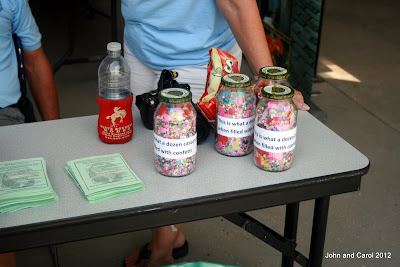
This photo shows several jars, each filled with the amount of confetti that would be used in one dozen cascarones.
Here everyone is heading over to the egg hunt.

Look at these girls running.

Watching the children hunt for eggs were Ocelot and the Blue Goose. The ocelot is an endangered species and a special concern and project for our sister refuge, Laguna Atascosa along the Gulf of Mexico. The blue goose is the symbol of the National Refuge System.

In addition to our shift at the refuge yesterday, we marked the holiday weekend with Stations of the Cross and Good Friday services and Easter Holy Eucharist at St. John's Episcopal Church in nearby McAllen, where we have been attending during our time in the Valley.
On another note, we see new farm crops all the time here. This week this field of Texas sweet onions was harvested. Look at all those bags of onions!

In the Great Plains, farmers expect their corn crop to be knee high by the 4th of July. Down here, some fields of corn are already knee high--and it just the first week of April.
Snakes are always a hit, at least with some people (not me).
Turtles are fun to touch, too.
There was a butterfly walk.
A craft table.
Of course, someone had to hide the eggs for the Easter Egg hunt.
Here we learned about a local custom we had never heard of before: cascarones. These are real eggshells, usually filled with confetti. Since the confetti is harmful to wildlife, as well as very difficult to clean up, Texas state parks and wildlife refuges ban the confetti-filled eggs and encourage the use of birdseed. Here is the Wikipedia explanation of cascarones:
Cascarones or confetti eggs are festive, hollowed-out chicken eggs filled with confetti or small toys. They are rumored to have originated in China and brought to Europe by Marco Polo.[1] In Italy they were first used as a courting ritual, filled with perfume and then capped with wax. Men would throw them at women they found attractive. The custom then traveled to Spain and was later brought to Mexico in the mid-1800s by Emperor Maximilian’s wife. It was in Mexico that the perfumed powder was replaced with confetti.[2]
In Spanish, cáscara means eggshell. Cascarones are similar to the Easter eggs popular in many other countries. They are mostly used in Mexico during Carnival, but in US and Mexico border the cultures combined making them a popular Easter tradition.
Decorated, confetti-filled cascarones may be thrown or crushed over the recipient's head to shower him or her with confetti. In addition to Easter, cascarones have become popular for occasions including birthdays, Halloween, Cinco de Mayo, Dieciséis, Day of the Dead, and weddings (wedding cascarones can be filled with birdseed). Like many popular traditions in Mexico, cascarones are increasingly popular in the southwestern United States.[3]
Having a cascarón broken over one's head is said to bring good luck.
In order to Make Cascarones one just uses a pin or knife to break a hole on the end of the egg, and pour the egg out. The shell must then be cleaned out. Decorate it as desired and let dry. Then fill with confetti or a small toy. Apply glue around the outside of the hole and cover with tissue paper.[4]
These are the eggs that were hidden for children at Santa Ana.
This photo shows several jars, each filled with the amount of confetti that would be used in one dozen cascarones.
Here everyone is heading over to the egg hunt.
Look at these girls running.
Watching the children hunt for eggs were Ocelot and the Blue Goose. The ocelot is an endangered species and a special concern and project for our sister refuge, Laguna Atascosa along the Gulf of Mexico. The blue goose is the symbol of the National Refuge System.
In addition to our shift at the refuge yesterday, we marked the holiday weekend with Stations of the Cross and Good Friday services and Easter Holy Eucharist at St. John's Episcopal Church in nearby McAllen, where we have been attending during our time in the Valley.
On another note, we see new farm crops all the time here. This week this field of Texas sweet onions was harvested. Look at all those bags of onions!
In the Great Plains, farmers expect their corn crop to be knee high by the 4th of July. Down here, some fields of corn are already knee high--and it just the first week of April.
Subscribe to:
Posts (Atom)