Showing posts with label Texas. Show all posts

Thursday, May 06, 2021

El Paso

    El Paso was our first stop in Texas.  Actually, we stayed in Anthony, Texas, at the Road Host RV Park.  Is used to be the KOA.

    There is a Camping World store right down the road, so, of course, we had to go shopping.  We bought a new Winegard  TV antenna.  Getting that set up took some time.  We also had a clothes hook in the back seat of our Chevy truck replaced.  The clothing rod kept falling off!

    Yesterday we visited the Centennial Museum and Gardens in town.  We expected the gardens would be a good place to walk.  That didn't turn out to be true.  They were only the few gardens surrounding the museum building.  We learned that the plants of the Chihuahua desert are quite similar to those in the Sonoran desert in Arizona.  

    The museum, however, was interesting.  We both enjoyed the "Tiny Tunnels, Big Connections" exhibit about ants.  


We learned that ants are close relatives of the wasp.  

These are photos of any colonies.  The top left shows ants building a nest in gel.  Below that we see honey pot ants hanging upside down in their nest.  The bottom right photos shows the queen ant on ant larvae.

 Some birds are called ant followers.  When large numbers of ants move from one place to another they can even be seen by birds flying above.  Those birds are known as ant followers.  They know that the insects fleeing from the marching ants are good food.  So they follow the ants and get a meal.  The scarlet tanager is one of those ant followers.


One section showed the geology of the area.


The oldest fossil found in the El Paso area is colenia frequens in a marble deposit 1 to 2 billion years old.


 These children's sandals are made from turtle flippers by the Seri people who lived along the northeast coast of the Gulf of California.

This is a feather skirt, made of untanned pelican skins by the Seri Indians.  They usually sewed together 6 hides for skirts for both men and women. This one was made about 1890.


We have all seen pictures or movies of early carts using cart wheels like this.  They were used in Mexico and the southwestern United States in the early 20th century.


While walking around outside the museum we saw what looked like an oriental building.  Why, here in El Paso?


We learned that the building was a gift to the people of the United States from the Kingdom of Bhutan.  In 2008 it was entrusted to the University of Texas in El Paso.

I think this beaded cat is stunning.  Read the description in the following photo.


I have heard stories about the Chinese laundries.  These photos show items found in downtown El Paso.  The Chinese were brought to the United States to work laying the Southern Pacific Railroad during the 1800s.  In 1881, when the line was finished some of those workers settled in El Paso.  The large bottles in the exhibit contained bluing used in the laundries. Numerous buttons were also found.


w


Tuesday, January 22, 2019

We have been on the move and busy since leaving Fort Stockton, Texas. On our trip back to Gold Canyon we stayed in Anthony, Texas, right outside of El Paso, and Willcox, Arizona. Once here there were doctors' appointments, exercise, laundry, church and a new Dish Network Hopper installation. It is getting so a new TV setup is as complex as a new computer with all the frustrations and adjustments to a new system.


Now it is time to deal with the damage we sustained in the hail storm here last October. Sunday we took the trailer to Lazy Days in Tucson (a 100 mile drive) and spent the night on the huge and nice KOA here. Since we were to deliver our Airstream to the repair shop at 8 am, we decided not to get up and leave at 6 am to get there.


The park is nice and might be a good location to spend the winter.

Today we have a new ride.


Quite a difference from our heavy-duty 3/4 ton pickup. But it is fairly comfortable and we fit in with all our neighbors. It seems almost everybody today drives a small SUV.


We will have the car for about a week but we don't get the trailer back for a month or more. Glad we didn't plan to go anywhere in February.

Soon our house windows will be wrapped in plastic so the painters can repair and repaint the hail damage to it. At least we don't have to move out!

Monday, January 07, 2019

Moving West

Thursday we turned our truck to the west, beginning our journey back to Gold Canyon from Houston. First stop was San Antonio. For years we have been staying at Blazing Star when in San Antonio. We had stayed there before going to Houston the week before. But we decided to check out the San Antonio KOA. It is large, with gravel roads and pads. They have children's bikes for rent. The sites are a little wider than at Blazing Star. The KOA isn't as refined but it feels so comfortable, reminding us of the way we traveled the first years of RVing. Actually both campgrounds in San Antonio are good, it just depends on what you are interested in.


Our next stop was Junction, Texas, about 120 miles to the west. We have stayed there several times and enjoyed the Llano South and Llano North campgrounds. We decided to vary our routine and went to a small park, Pecan Valley RV. With only 12 sites and located several miles out of town next to a pecan orchard, it has a very different feel from either of the Llano campgrounds.  The park has pretty good WIFI.  We had discovered before that we can't get Verizon service for phone or internet on our phones in Junction.  The camp hosts at Pecan Valley informed us that Kimball Country, where Junction is located, has no Verizon service at all.  The sites are large and it would be a great place to chill out for a while if we were tired of traveling and not interested in sightseeing. I always try to take a photo of our campsites and we took quite a few pictures at Pecan Valley.


Sunday we moved west again, to Fort Stockton. In case you had never traveled across the center of the country, especially in Texas, you may not realize the distances involved. For travelers like us, we choose to drive about 200 miles, more or less, if at all possible. That means in this state we stay in the same towns on each trip. We were in Fort Stockton for one night in mid-December. The Fort Stockton RV Park is large and old. Many of the sites are occupied long-term by oil drilling employees. But they had a café serving good chicken fried steak and pretty good wifi. It is a little run down but familiar.

Tomorrow we head west again, returning to the El Paso area, and then probably either Benson or Willcox before returning to Gold Canyon.

Wednesday, January 02, 2019

A Great Way tp End and Start a Year

We came to Houston to see where our granddaughter Kylie is attending university and swimming on the Couger women's swim team.  Kylie's parents and brother--our son Eric, wife Liz, and our grandson John--were here, too. We hadn't seen any of them in months so it was a special way to bring 2018 to an end and begin 2019.

On New Year's Eve, we met Eric, Liz and John for a BBQ lunch.


After some good conversation and catching up on each other, they headed down to Galveston where they are staying for a few days.

New Year's Day we met them on the University of Houston campus and drove to Kylie's apartment so she could show us around campus.


The campus is decorated with lots of modern art. Here is one building with what looks to me like polished graffiti, but what do I know?


One art work Kylie really likes is this serpentine piece. It is lit at night and the words projected on the surrounding concrete.


We ended our visit with lunch at Kylie's favorite taco place downtown. The food was really good and we again had a good visit. Finally, we needed to get back to our RV, Kylie needed to get back to her room and the others headed back to Galveston.


It was good to them.  We don't know when we will be together again.


Sunday, December 30, 2018

Beautiful Places

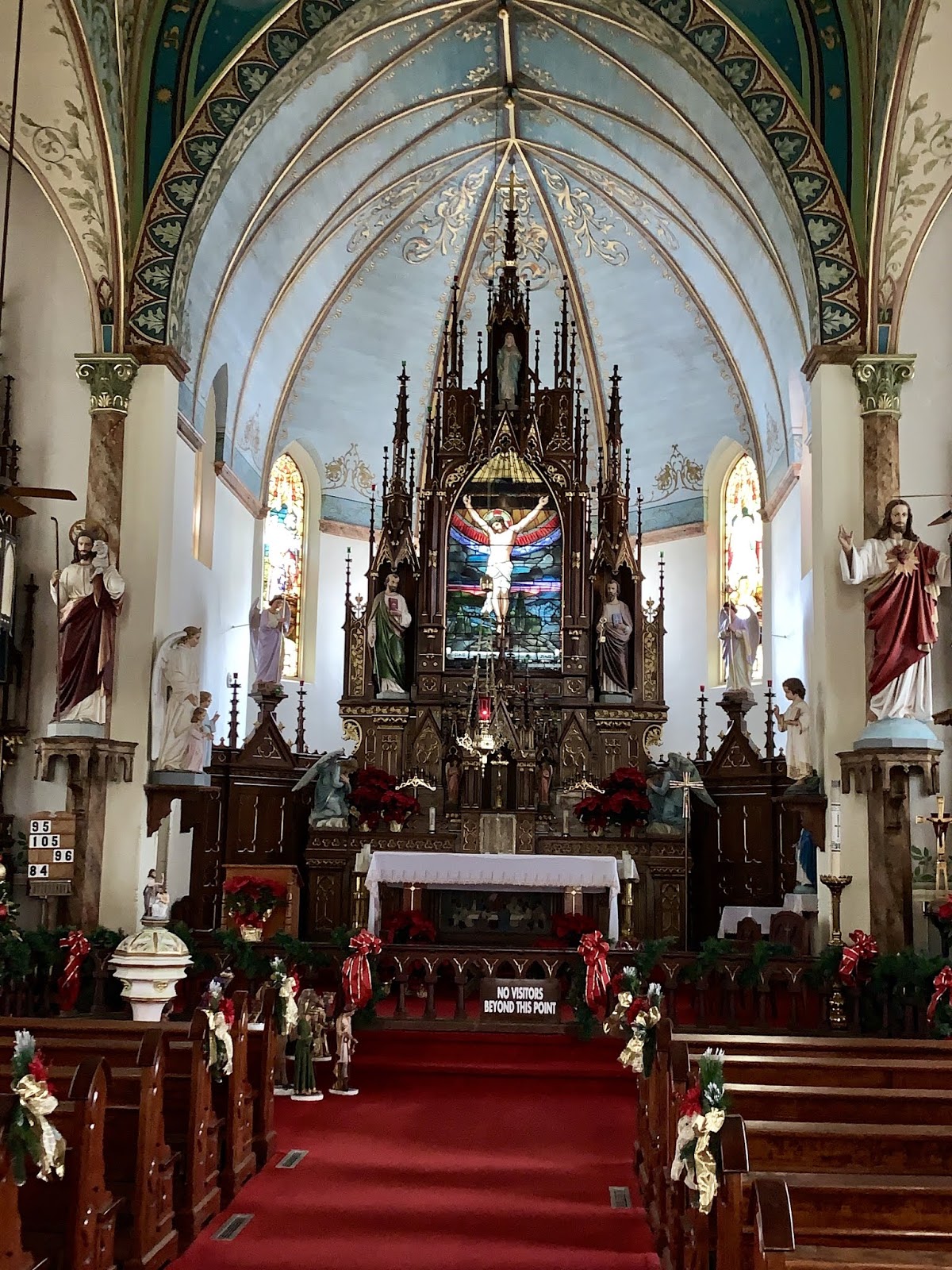
When I was looking for someplace to stop between San Antonio and Houston, I found Schulenburg, a small town right off I-10. I think what attracted me to it was a mention of the painted churches in the area. Am I ever glad we toured them yesterday. Such beautiful places, art done to honor the God the people have worshiped here for over 150 years!

Only a short drive from the RV park brought us to St. Mary's Roman Catholic Church in High Hill. German and Czech immigrants fleeing the Austrian Empire celebrated the religious freedom they found in Texas by building churches with painted interiors designed after European cathedrals.


The ceiling painting was one of the first thing that caught my eye.


The sanctuary is a contrast of light and dark.


The sounding board above the pulpit and the pulpit are distinct in each church.


Next, we visited St. John the Baptist in Ammansville.


There is a totally different feel here.


The white ribs in the ceiling highlight the curves.


Look at the detailed painting and stencil work here.


At Dubina we found St. Cyril and St. Methodius, another stunning worship facility.


Notice the ivy leaves outlining the sanctuary.


Again, the detail in the painting is amazing.

Each of the churches had detailed images of the Stations of the Cross.  Here are 3 stations in the Dubina church.


St. Mary's Church of the Assumption in Praha was the last inspirational painted church we saw.


This is the pulpit and sounding board to project the pastor's voice.


Look at the painting of the Last Supper on the high altar.


Angels hover above the altar.

Friday, December 28, 2018

German History in Texas

Over our years of traveling in Texas, we knew there were many German immigrants who settled here in the mid- to late-1800s. We are staying in Schulenburg and today visited their history museum. Between 1844 and 1847 thousands of Germans immigrated to Texas, escaping the Austro-Hungarian Empire. It was the largest colonization in Texas history. Many of them settled around Schulenburg. The local history museum provides an excellent description of the history of this area. It focuses on death, early pioneers, military, merchants, religion and the fire department, as well as other subjects.


In the section on death in the museum told about the families that have owned and operated the local funeral home as well as how customs around death vary from culture to culture. John grew up in a funeral home and we owned it for about 9 years. But we still learned something. At least in this area, a group of women were flower bearers, carrying the flowers displayed at the funeral to the cemetery where burial occurred. Choosing those women was as important for a family as choosing the men who served as pallbearers. All were selected from among friends and associates of the person who died. We had never heard of this custom.


The section on religion covered the establishment of churches in the community.


The volunteer fire department in Schulenburg was formed in 1873. This fire "truck" had a human- powered pump to spray water on a fire. It was used in addition to bucket brigades. I wonder how many fires they were able to extinguish.


Of course, merchants were among the early settlers in the town. Those businesses were what attracted other people to settle nearby and served the needs of the population. Just look at the prices seen on this display. The museum docent knew they were real signs from the dry goods merchant in town but she didn't know what year they were from. The prices are certainly not what we see today.


These are costumes belonging to some of the German/Czech settlers around Schulenburg.


In the 1920s the leaders in Schulenburg convinced the Carnation Milk Company to build their first milk processing plant in Schulenburg. This blanket was worn by a dairy cow that came by plane from Oconomowoc, Wisconsin, for the groundbreaking ceremony.  There was a huge celebration in Schulenburg. Since we once lived in Oconomowoc, we were most interested in this bit of local history.  The reference to flying cow had another connection, as well.  The Schulenburg schools mascot is the flying shorthorn.


Both the Boy Scouts and Girl Scouts organizations were popular here. There was even a Girl Scout band.


Sausage making was and is popular to Czech and German people. These two machines show a sausage hand-stuffer and a more mechanized version.


This is a Crosley IcyBall. As unlikely as it looks and sounds, this contraption would freeze water into ice. It was used before most rural areas in Texas had electricity to freeze food (and ice).

We enjoyed reading about all the interesting items and history on display in the museum.

Just down the street was the Polka Music Museum. Whoever heard the like? Polka music is still popular here. As we were looking around the museum, a local man came in and asked the woman staffing the front desk what polka band she was going to go hear on New Year's Eve.


When I think of polka music, I first think of accordions. These were on display in the museum.


I don't necessarily think of the tuba or saxophone, but obviously they are also used in polka bands.


The display included a number of local polka bands. Some of the band names were interesting. The one that most got my attention was Oma and Oompahs. I think that means grandma and the grandpas, but I'm not positive.