Sunday, August 14, 2016

Stunning, Incredible, Spectacular

That is all we had to say after driving the Going to the Sun Road in Glacier National Park. And we are from Colorado and very familiar with Trail Ridge Road in Rocky Mountain National Park. Maybe it is because this is new and different scenery, I don't know. But it is wonderful.

It had been 23 years since our first visit to Glacier. That time we didn't drive this road. So it was number one on our agenda for this visit. Here in West Glacier where we are staying, the elevation is 3220 and the highest peak, Heaven's Peak, is 8987 ft. Grand Lake, Colorado, at the west entrance to Rocky Mountain NP is 8369 and 12,183 ft. But the Glacier mountains are certainly beautiful, even if they aren't as high.

The Going to the Sun road was built in the 1930s by the CCC--Civilian Conservation Corps.

As the name of Glacier suggests, there are glaciers and snow fields that produce a lot of waterfalls.


The mountains are beautiful.


The crowds were large and the parking crowded at the view points. And in places the road was very narrow.


There are two large lakes in McDonald and St. Mary. This is a view of McDonald. The water in the lakes and rivers is incredibly clear.  Artist Charles M. Russell and his wife built a cabin on Lake McDonald, called Bull Head Lodge, where many visiting artists spent time painting the beauties of Glacier National Park.


This eye-catching island is in the middle of St. Mary's Lake.


This is the only wildlife we saw.


These open-topped buses are used for tours of the park along the Going to the Sun road.


These lights hang in the lobby of the Lake McDonald Lodge, built in 1913.


Glacier on the northern edge of Montana and just across the border in Canada is Waterton Lakes National Park.  The two parks are an International Peace Park World Heritage Site.   You can read about our visit to Waterton Lakes in 2012 here.

Saturday, August 13, 2016

Montana Landsdape

As we drove north toward Glacier National Park we passed through the beautiful Montana farm and ranch country before reaching the mountains. There are great expanses of grass and wheat.


All that wheat has to be stored somewhere.


The sky began filling with clouds.


The mountains were striking, especially under that ominous dark cloud.


Then the fog came in.


Then came the rain.


The day we arrived outside Glacier it was cloudy and rainy. Since then we have had sunshine and beautiful scenery.

Thursday, August 11, 2016

Our four days in Great Falls, Montana, were filled with walks in Gibson Park and along the Missouri River and visits to two museums. Sometimes we get our 10,000 steps a day walking around our RV park. It is always nice when the towns we are visiting have developed walking and biking trails. We found trails in Butte and Great Falls that made our daily walks very enjoyable.

Paris Gibson helped found Great Falls and a park in downtown, near the Missouri River, is named in his honor. We walked there twice. There is a lake with lots of birds which attract people who feed the birds, which in turn attract more birds.


There is a beautiful garden, built by the CCC in the 1930s, in the park.


There was also a skateboard park nearby. I'm glad they hadn't been thought of when our two boys were growing up. If they had gone to one, I would have had a heart attack, I'm afraid.


The Great Falls History Museum had very well-done displays, mainly of artifacts from the early 20th Century. That means it included items from out childhood. We remembered some of the telephones on display.


As a teenager, John worked in a grocery store that kept customer accounts in a system like this.


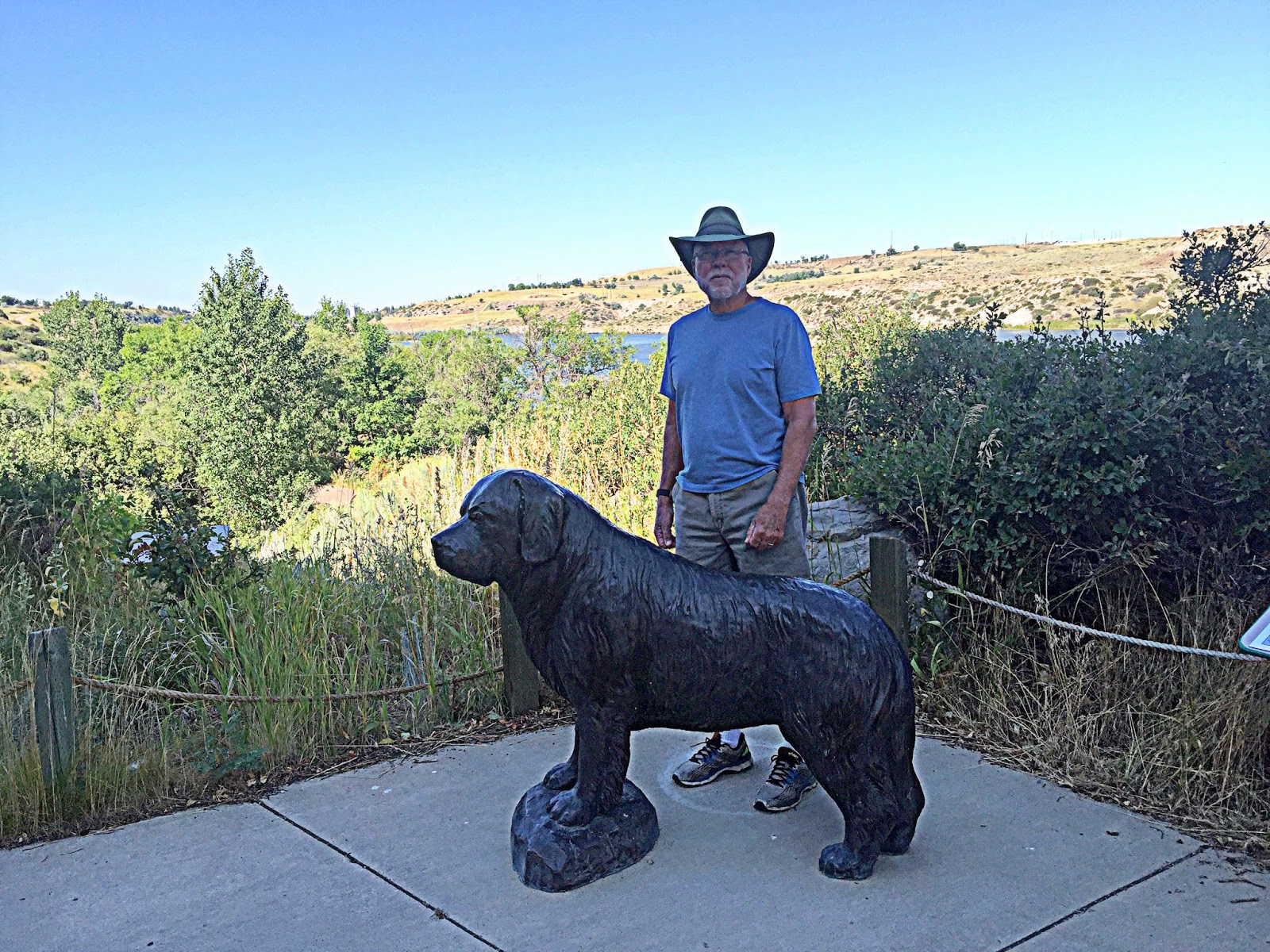
We also visited the Lewis and Clark Interpretive Center. What a great museum. Here you can see a statue of the Newfoundland dog Seaman that traveled with the Corps of Discovery. You can see the Missouri River in the background.


Can you imagine canoeing up the Missouri wearing a uniform like this?


Portaging the dug-out canoes around the great falls they found here was arduous work.


I was amazed to find the Native Americans had sunglasses. They cut slits in shells to protect their eyes from the sun.


We love the art of Charles M. Russell. He lived and worked here and we visited his museum. Photos weren't allowed inside but here is a picture of the retaining wall around his home and studio. He used the skull outline in his signature.

Saturday, August 06, 2016

Mines and Thomas Edison

I've been around mines and mining towns all my life. My earliest memory, from the age of 2 or 3, is  taking a bath in the kitchen sink of my grandmother's apartment in Victor, Colorado. My mother was raised in Victor and nearby Goldfield and my grandfather was a gold miner there. About once a year my mother and I would visit my grandmother there until 1949 when she moved to Denver near where we lived. The image of mine headframes was fixed in my memory.

Butte, Montana, is also a mining town. Whereas Victor is nearly a ghost town--except for the casinos--Butte is a well preserved, clean, attractive city filled with evidence of the mining history.


Between 1864 and 1875 placer mining or gold panning was used to collect gold. By 1875 that ore was exhausted but before the town was abandoned, silver was discovered and the underground mining period began. They brought up not only silver but also copper, lead, zinc and manganese. Underground mining is very dangerous and one mine fire led to the deaths of 168 miners. In 1955 they began open pit mining of copper.

The Berkeley Pit mine is still in limited operation.


We didn't get a good photo of the huge open pit, but here is a link to a photo I found on the internet.


We were able to get a good view of the water that has accumulated in the pit. It is a very pretty view but the water is terrible polluted. Efforts are being made to treat and clean the water.


So, what has Thomas Edison got to do with all this?  As you know, he developed the electric light bulb and he found that copper makes excellent wire to conduct electricity.  The demand for copper for wire spurred the mining of copper.  Also, my last blog was about the Milwaukee Road trail.  The section of the Milwaukee Road rail line near Butte was one of the first sections of railroad to be electrified.  Edison came to Butte to view that project.

The city of Butte has done a good job of maintaining the historic buildings and reusing them in creative ways.


All those mine headframes supported pulleys that brought people and ore in and out of the mines. The pulleys were run by engines houses in engine houses like this. Today the building houses the Butte Senior Center.


Some of the old buildings have great signs painted on the sides.


Not everything is preserved in excellent condition. Look at this old door.


Many of the miners in Butte in the late 19th century were Irish Catholics. That heritage is reflected in this Butte welcome center.


How many of you know what this flower is called? It must grow about a mile above sea level because I remember lots of them near my Denver home.


It's a holly hock.

One last note on Butte. We get our TV through Dish Network and every time we move some distance I have to call and have our service address changed so we get local stations. When we arrived in Butte I called to do that. When I gave the customer service rep the zip code, he said,"Your're in a town named but?" No, we're not. I had to tell him how to pronounce "Butte."