From Portland, we traveled on east to Kennewick, Washington, then Clarkston at Hells Canyon Snake River. On our way we drove through beautiful country.
A painted barn
A fence decorated with wheels
A blooming field of canola
And lots of grain elevators--at least that is what they are called in our part of the country.
And finally, the Snake River, which provides the border between Washington and Idaho, at least in this area.
We enjoyed this view out the front door side of our trailer. In the river you can see a barge being pushed on the river. The Snake begins in Wyoming and flows eventually into the Columbia River.
This dugout canoe was along the river's edge.
We could watch this riverboat. If you look closely, you can see small boats between the shore and the large white boat. We watched them speed by us then discovered they were getting ready to take riverboat passengers on a tour of Hells Canyon--a stretch of white water near Clarkston.
One day we drove into town and walked along a riverside trail. We saw the riverboat coming in.
The hills across the river were brown.
This is a view of our trail. It was very well maintained.
Here is a flock of Canada geese along the trail.
Showing posts with label riverboat. Show all posts
Tuesday, June 25, 2019
Thursday, May 22, 2014
What a Name
Can you imagine staying in a place named Toad Suck? Well, that's where we are now.

Despite the name, it's really a very pretty location, right on the Arkansas River within sight of the Toad Suck Ferry and Murray Locks and Dam.
This is our view from the back (driver's) side of the RV.


But why the name? The first river crossing here was in 1823, when a postal route to Hot Springs was established. A skiff large enough for just the operator and a horse and rider was propelled back and forth by a pole. Near the skiff crossing a tavern was located on the west side of the river sometime between 1830 and 1850. It was a favorite gathering place for steamboat roustabouts, passengers and local folks. Heavy drinking at the tavern caused a traveler to remark, "Those fellows suck at a bottle till they swell up like toads!" So the name of Toad Suck came into being and remains today. The ferry was replaced in 1956 by a highway bridge. Nearby Conway, Arkansas, celebrates Toad Suck Days in early May.
The headwaters of the Arkansas River are near Leadville in our home state of Colorado. Several membeers of our family live in Canon City, Colorado, on the Arkansas. The river flows through Colorado, Kansas, Oklahoma and Arkansas before emptying into the Mississippi in southeastern Arkansas.
The water has been smooth in the evening and early in the morning. Here, you can see the dam with the highway bridge above. The lock is on the far side of the river.
This morning, for the first time, we saw a tug boat and barges go through the lock. Here is the Brother Wilson tug, sitting in the lock, waiting for the water level to go down (or maybe the lower portion of the lock is filling with water) so the boat and barges can move below the dam.

The lock rises or lowers 16 feet. When the tug is ready to push the barges forward, it starts putting out smoke.

Here is is, going by the dam.

Here are the tug and barges emerging from the lock, at least 45 minutes after the previous photo was taken.

The whole process is very time consuming and must be very boring for the tugboat captain. I think it took way over an hour from the time we first saw the boat in the lock and the siren sounded, indicating the water level in the lock would be changing, to the time when the entire packet came out the other end.
Here is another view of the boat and barges.

We have stayed in a COE campground on the Mississippi near Davenport, Iowa, a couple of times and watched lots of barge traffic. But this is the first time to be right next to a lock and dam. It is very interesting.
The underside of the bridge is lined with mud swallow nests. Every time a vehicle crosses the bridge, a large number of cliff swallows fly out, then settle in again.

We are always looking for interesting or unusual RVs and vehicles as we travel. Look at this tow vehicle that is in the campground this week. They found a way to make it from parts of several trucks and a 5th wheel hitch.
Despite the name, it's really a very pretty location, right on the Arkansas River within sight of the Toad Suck Ferry and Murray Locks and Dam.
This is our view from the back (driver's) side of the RV.
But why the name? The first river crossing here was in 1823, when a postal route to Hot Springs was established. A skiff large enough for just the operator and a horse and rider was propelled back and forth by a pole. Near the skiff crossing a tavern was located on the west side of the river sometime between 1830 and 1850. It was a favorite gathering place for steamboat roustabouts, passengers and local folks. Heavy drinking at the tavern caused a traveler to remark, "Those fellows suck at a bottle till they swell up like toads!" So the name of Toad Suck came into being and remains today. The ferry was replaced in 1956 by a highway bridge. Nearby Conway, Arkansas, celebrates Toad Suck Days in early May.
The headwaters of the Arkansas River are near Leadville in our home state of Colorado. Several membeers of our family live in Canon City, Colorado, on the Arkansas. The river flows through Colorado, Kansas, Oklahoma and Arkansas before emptying into the Mississippi in southeastern Arkansas.
The water has been smooth in the evening and early in the morning. Here, you can see the dam with the highway bridge above. The lock is on the far side of the river.
This morning, for the first time, we saw a tug boat and barges go through the lock. Here is the Brother Wilson tug, sitting in the lock, waiting for the water level to go down (or maybe the lower portion of the lock is filling with water) so the boat and barges can move below the dam.
The lock rises or lowers 16 feet. When the tug is ready to push the barges forward, it starts putting out smoke.
Here is is, going by the dam.
Here are the tug and barges emerging from the lock, at least 45 minutes after the previous photo was taken.
The whole process is very time consuming and must be very boring for the tugboat captain. I think it took way over an hour from the time we first saw the boat in the lock and the siren sounded, indicating the water level in the lock would be changing, to the time when the entire packet came out the other end.
Here is another view of the boat and barges.
We have stayed in a COE campground on the Mississippi near Davenport, Iowa, a couple of times and watched lots of barge traffic. But this is the first time to be right next to a lock and dam. It is very interesting.
The underside of the bridge is lined with mud swallow nests. Every time a vehicle crosses the bridge, a large number of cliff swallows fly out, then settle in again.
We are always looking for interesting or unusual RVs and vehicles as we travel. Look at this tow vehicle that is in the campground this week. They found a way to make it from parts of several trucks and a 5th wheel hitch.
Sunday, July 08, 2012
Alaska -- Day 53
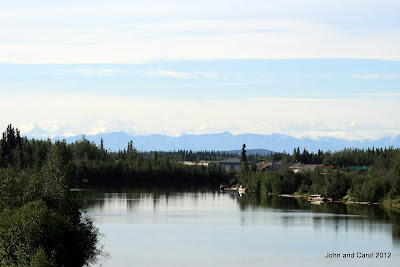
We have great scenery as we drove from Fairbanks to Cantwell, a small town south of Denali National Park.

We crossed the Tanana River a couple of times and drove through the Tenana Valley.

At one crossing, we saw this river boat and several barges for carrying freight up and down the river. Since the Tanana flows into the Yukon River north of here, freight can be shipped a long distance to and from this part of Alaska.

Buried somewhere in these clouds is Denali, "the high one," Mt. McKinley. We hope to get a better view of the 20,320 ft mountain, but, just in case we don't, or you have never seen it, check out the photo at the top of the blog. That is what we saw 8 years ago when we visited Alaska. Because of cloudy, rainy summers, visitors have only a 30 to 40 % chance of see North America's highest mountain.

Everything wasn't roses today, however. About an hour from Fairbanks, our Pressure Pro tir pressure monitoring system started beeping, telling us one of the truck tires, which should have 80 psi, was only registering 69 psi. As soon as we saw a
parking area, we pulled off and John used one of our generators and a small air compressor to refill the tire. We are so glad we are equipped to deal with situations like this.

As soon as we were set up at our RV site, John asked where we could get the tire checked. They sent us maybe 1/4 mile down the road, where Ken helped us.

We had our doubts when we pulled into his yard. There was "stuff" and junk and old rusty things everywhere. But we left with a new valve stem. Hopefully, it keeps the tire solid till we get to a Chevy dealer in Anchorage.

This is the view out our front window (at least it was until another rig pulled in). See that orange line? We were told we could drive across it, but not park with our wheels on it. Seems that is the water line and, if we parked on it, our neighbors wouldn't have any water. It is certainly something we have never seen before.

We crossed the Tanana River a couple of times and drove through the Tenana Valley.
At one crossing, we saw this river boat and several barges for carrying freight up and down the river. Since the Tanana flows into the Yukon River north of here, freight can be shipped a long distance to and from this part of Alaska.
Buried somewhere in these clouds is Denali, "the high one," Mt. McKinley. We hope to get a better view of the 20,320 ft mountain, but, just in case we don't, or you have never seen it, check out the photo at the top of the blog. That is what we saw 8 years ago when we visited Alaska. Because of cloudy, rainy summers, visitors have only a 30 to 40 % chance of see North America's highest mountain.
Everything wasn't roses today, however. About an hour from Fairbanks, our Pressure Pro tir pressure monitoring system started beeping, telling us one of the truck tires, which should have 80 psi, was only registering 69 psi. As soon as we saw a
parking area, we pulled off and John used one of our generators and a small air compressor to refill the tire. We are so glad we are equipped to deal with situations like this.
As soon as we were set up at our RV site, John asked where we could get the tire checked. They sent us maybe 1/4 mile down the road, where Ken helped us.
We had our doubts when we pulled into his yard. There was "stuff" and junk and old rusty things everywhere. But we left with a new valve stem. Hopefully, it keeps the tire solid till we get to a Chevy dealer in Anchorage.
This is the view out our front window (at least it was until another rig pulled in). See that orange line? We were told we could drive across it, but not park with our wheels on it. Seems that is the water line and, if we parked on it, our neighbors wouldn't have any water. It is certainly something we have never seen before.
Labels:
Alaska,
riverboat,
RV park,
scenery,
truck problems
Thursday, July 05, 2012
Alaska -- Day 50
Today we tried Fairbank's most popular tourist attraction, the Riverboat Discovery. She is the third in a line of Binkley family riverboats named Discovery. We were on Discovery III.

When everybody says, "you must do this," we often wonder. But, since our Toursaver book has a buy one-get one free coupon, we gave it a try. The coupon book cost $100. A ticket on the boat cost $54.95. That means we have recouped $55 of our $100. So it was worth it. And the trip today was worth it. First off, we watched a float plane take off from the river. In the background, you see Discovery I, Binkley's first sternwheeler.

Then he made a great landing.

The three-hour tour took us down the Chena (pronounced Cheena) River to where it meets the Tanana River. Discovery III is a flat-bottomed boat that only needs 39" of water. Today the Chena was beautiful and smooth.
We stopped beside the sled dog kennels of Susan Butcher, who won the Iditarod Dog Sled Race four times, quite an accomplishment for a woman in a man's sport. Sled dog racing is Alaska's most important and/or popular sport. Susan died in 2006 from leukemia, but her husband, Dave Monson, still raises dogs there. John and I didn't think we would be interested in sled dogs. But we saw month-old puppies learning to trust their handlers and a team of dogs so eager to pull that they leaped and jumped when they heard Dave's voice. It was amazing to see how much they wanted to run. They pulled him, riding on a motor-less ATV. Total weight over 600 pounds. In a race, the sled and driver weigh much less than that, maybe 205 pounds. In this photo, handlers are getting the dogs ready to pull.

Here you see the dogs right before Dave released the ATV and took the brake off. Boy did they move out!

The water in the Tanana River is fed by glaciers. When it mixes with the water of Chena, you see the fine silt the glacier scours off the ground "bloom" out as the two rivers mix. It is really pretty amazing.

This is another picture of the Chena, looking back upstream, away from the Tanana.

We were able to get off the boat for an hour-long stop at Chena Village, a re-creation of an original Chena Athabascan Indian Village of the early 1900s. It is similar to those that the first Binkley steamboat captain, Charlie, and others would have seen during the gold rush in the late 1800s and early 1900s.
We saw a fish wheel, which helped the Athabascans take lots of salmon from the river without a fishing pole. It turns with the river current, scooping up salmon during the annual runs upriver.

This is Hanna, a native Eskimo-Athabascan (I think) who is a college student in Fairbanks and works both on the Discovery III and as an interpreter at Chena Village. She is explaining how they would fillet the salmon, then hang them here till they stop dripping fluids. You see drip-dry salmon fillets.

Here you can see how they fillet is sliced through to the skin, exposing more of the flesh to the smoke.

The next stage was to smoke the salmon over alder fires to preserve it. The first run of the summer is Chum salmon, which they consider an inferior fish. It is dried and used mainly for dog food. Given the great number of sled dogs in Alaska, this is an important use of fish.
After learning some western ways from the Russian explorers who came to Alaska before the gold rush, the natives started moving to fish camps in the summer to harvest the salmon. Previously, they had lived a nomadic lifestyle. They used birch-bark canoes like this one to travel.

Here you can see inside a tent at the fish camp, with pine boughs on the ground and a mosquito net over the sleeping area.

We also learned about the importance of animal hides and fur in the life of the Eskimos and other natives. Nothing was wasted. The flesh was eaten, the fur and hide used for clothing and shelter. Even the antlers were sliced and used as buttons. Tails are used for decoration. Look at this beautiful parka. I think it is called a sun parka because of the halo of fur around the woman's face when the hood is up. They used linx fur (I think) around the face because it has an oily surface that prevents the wearer's breath from making frost on the hood.

They keep some reindeer at Chena Village. Did you know that caribou are called reindeer when they are domesticated? If you look closely, you can see the front reindeer has a very smooth coat. The others in the picture are still shedding their winter coat and look kind of ratty.

I'm not sure if it is because the long winters here encourage the residents to enjoy what grows in the summer, or because the many hours of sunlight each day, but we see hanging flower baskets and pots of flowers everywhere. Here is a basket on the landing where we boarded Discovery III.
When everybody says, "you must do this," we often wonder. But, since our Toursaver book has a buy one-get one free coupon, we gave it a try. The coupon book cost $100. A ticket on the boat cost $54.95. That means we have recouped $55 of our $100. So it was worth it. And the trip today was worth it. First off, we watched a float plane take off from the river. In the background, you see Discovery I, Binkley's first sternwheeler.
Then he made a great landing.
The three-hour tour took us down the Chena (pronounced Cheena) River to where it meets the Tanana River. Discovery III is a flat-bottomed boat that only needs 39" of water. Today the Chena was beautiful and smooth.
We stopped beside the sled dog kennels of Susan Butcher, who won the Iditarod Dog Sled Race four times, quite an accomplishment for a woman in a man's sport. Sled dog racing is Alaska's most important and/or popular sport. Susan died in 2006 from leukemia, but her husband, Dave Monson, still raises dogs there. John and I didn't think we would be interested in sled dogs. But we saw month-old puppies learning to trust their handlers and a team of dogs so eager to pull that they leaped and jumped when they heard Dave's voice. It was amazing to see how much they wanted to run. They pulled him, riding on a motor-less ATV. Total weight over 600 pounds. In a race, the sled and driver weigh much less than that, maybe 205 pounds. In this photo, handlers are getting the dogs ready to pull.
Here you see the dogs right before Dave released the ATV and took the brake off. Boy did they move out!
The water in the Tanana River is fed by glaciers. When it mixes with the water of Chena, you see the fine silt the glacier scours off the ground "bloom" out as the two rivers mix. It is really pretty amazing.
This is another picture of the Chena, looking back upstream, away from the Tanana.
We were able to get off the boat for an hour-long stop at Chena Village, a re-creation of an original Chena Athabascan Indian Village of the early 1900s. It is similar to those that the first Binkley steamboat captain, Charlie, and others would have seen during the gold rush in the late 1800s and early 1900s.
We saw a fish wheel, which helped the Athabascans take lots of salmon from the river without a fishing pole. It turns with the river current, scooping up salmon during the annual runs upriver.
This is Hanna, a native Eskimo-Athabascan (I think) who is a college student in Fairbanks and works both on the Discovery III and as an interpreter at Chena Village. She is explaining how they would fillet the salmon, then hang them here till they stop dripping fluids. You see drip-dry salmon fillets.
Here you can see how they fillet is sliced through to the skin, exposing more of the flesh to the smoke.
The next stage was to smoke the salmon over alder fires to preserve it. The first run of the summer is Chum salmon, which they consider an inferior fish. It is dried and used mainly for dog food. Given the great number of sled dogs in Alaska, this is an important use of fish.
After learning some western ways from the Russian explorers who came to Alaska before the gold rush, the natives started moving to fish camps in the summer to harvest the salmon. Previously, they had lived a nomadic lifestyle. They used birch-bark canoes like this one to travel.
Here you can see inside a tent at the fish camp, with pine boughs on the ground and a mosquito net over the sleeping area.
We also learned about the importance of animal hides and fur in the life of the Eskimos and other natives. Nothing was wasted. The flesh was eaten, the fur and hide used for clothing and shelter. Even the antlers were sliced and used as buttons. Tails are used for decoration. Look at this beautiful parka. I think it is called a sun parka because of the halo of fur around the woman's face when the hood is up. They used linx fur (I think) around the face because it has an oily surface that prevents the wearer's breath from making frost on the hood.
They keep some reindeer at Chena Village. Did you know that caribou are called reindeer when they are domesticated? If you look closely, you can see the front reindeer has a very smooth coat. The others in the picture are still shedding their winter coat and look kind of ratty.
I'm not sure if it is because the long winters here encourage the residents to enjoy what grows in the summer, or because the many hours of sunlight each day, but we see hanging flower baskets and pots of flowers everywhere. Here is a basket on the landing where we boarded Discovery III.
Subscribe to:
Posts (Atom)