Showing posts with label cemetery. Show all posts

Friday, May 15, 2015

The Power of Advertising

You have probably heard of Wall Drug in South Dakota. Why? Because there are signs all along I-90 as you approach Wall, announcing free ice water if you stop at Wall Drug. Today, Wall is a major destination for travelers. Almost the same thing can be said for Winslow, AZ. Why do we know about it? Most of us have heard, and can repeat, at least a couple of lines from the song, Take It Easy. "Standin on the Corner in Winslow, Arizona, watching all the girls go by." That may be the only song I know from the Eagles (I'm not much of a pop music person), but even I know that line. And each year thousands of people have their picture taken at Standin on the Corner Park. Even John.


The corner is on famous Route 66.


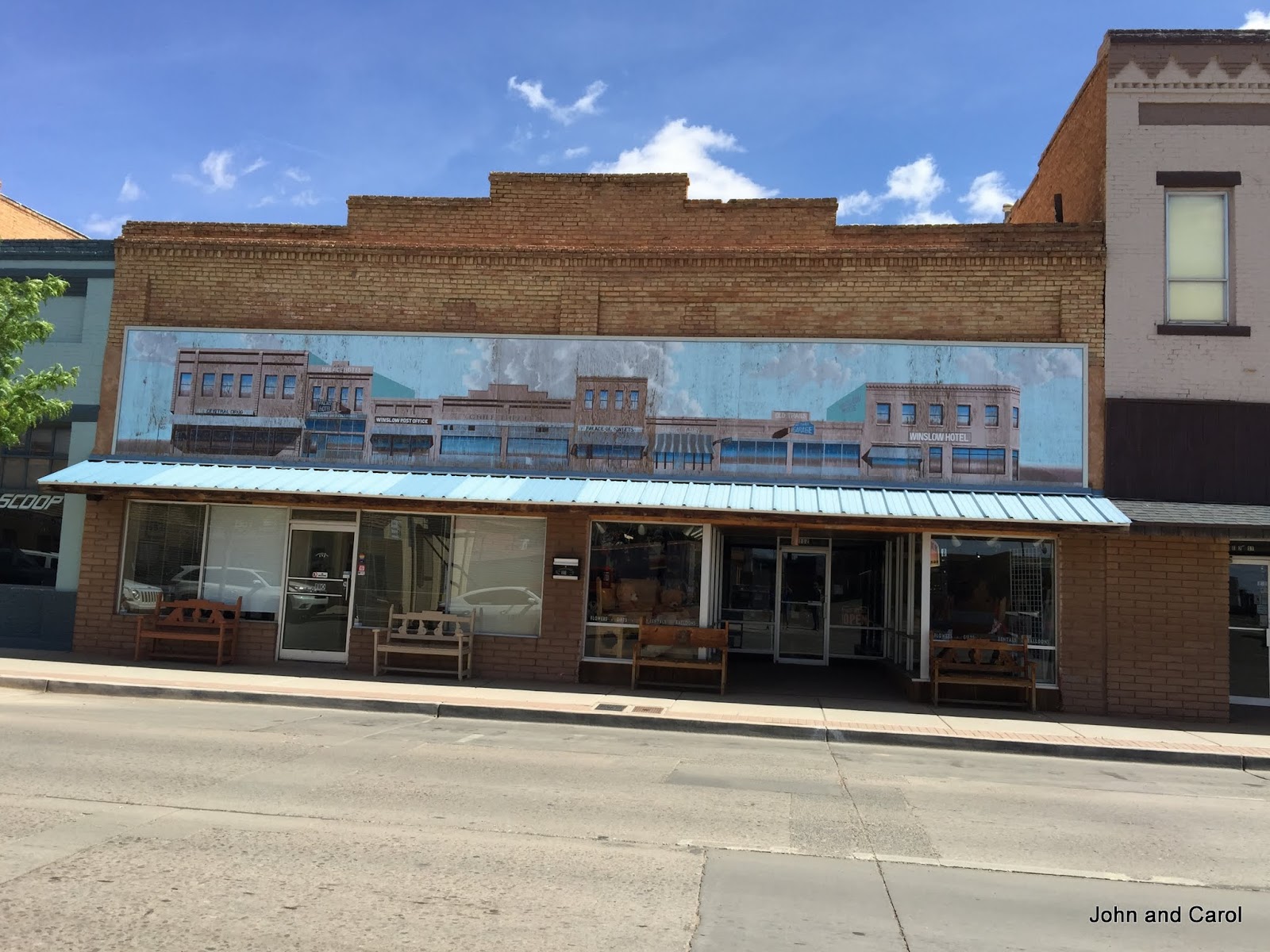
Winslow is a fun town to visit and we have spent five days at nearby Homolovi Ruins State Park. The town has a number of murals.


There was a cute statue? decoration? in front of the store across the street from the corner.


The Winslow High School mascot is the bulldog. One corner on the road out of town has this great statue.


And we really enjoyed the sign in a cafe window, especially since we will celebrate our 50th anniversary next  month. I wonder if  Jim and Carolyn are the owners or if the celebrating couple are just being honored before the cafe is sold.


We stayed in Homolovi Ruins State Park two years ago. We spent three winters volunteering at Casa Grande Ruins in Arizona and have visited Mesa Verde National Park, so we are fairly familiar with the native peoples who settled here in the southwest. Although less well known, Homolovi Ruins shows some of their settlements. Modern-day Hopi people believe this was the home of their ancestors.

This informational kiosk tells about one of the villages visitors can explore here in the park, Homolovi I. A second village, Homolovi II, is a little over two miles away, at another location in the park.


If you are interested in more information about Homolovi Ruins, you can check out my blog from two years ago here of the park's web site here.

Mormon settlers also came to this area in 1876, under the leadership of General Lot Smith. They moved on in 1881 after a number of floods on the nearby Little Colorado River. The settlement's cemetery is near Homolovi I.


We were interested to see that a couple of the trails in the park had been constructed by Elderhostel groups (now Road Scholar).


We saw a couple of interesting RVs here in the state park campground. They are earth cruisers, all terrain RVs. Originally built in Australia, they are now built in the U.S. to be shipped throughout the world. You can get more information about them here.

Monday, August 11, 2014

Madeline Island

Madeline Island, the largest of the Apostle Islands, is another must-see when you are in Bayfield. And it had the added advantage that we could take our bikes on the ferry and ride around the island.


Since the ferry ride was only 20 minutes long and we didn't go far out on the lake, the ride on the top deck was comfortable.


We rode from the port town of LaPointe to the Big Bay State Park on the far end of the island. It really isn't very far. Even with some side trips, we only rode about 14 miles before getting back on the ferry. We enjoyed some sights along the way.


We looked around the Greenwood Cemetery. The earliest burials appear to have been in 1918. We liked the epitaph on  one stone which read, "His heart was at home on the island, his soul in Colorado."


We passed the Madeline School of the Arts.


This chain sculpture of an ox and plow was out front.


There is a sign on this small building in Norwegian. Translated, I think it means small workshop.


Before our ferry docked, we watched a number of sailboats on the lake.


Friday, June 27, 2014

And Now, For Something Really Different

This blog post will be of the most interest to our family. And before you read it, you need to understand that we used to own a funeral home; John grew up in a funeral home; his dad, his brother and he were all funeral directors; the family used to own two cemeteries.

Today we drove to the Spring Grove Cemetery in Cincinnati to visit the graves of John's great-great-great grandfather. More about that in another blog. We have been in many cemeteries over the years and this is the most beautiful one we have ever seen.

Our first stop was in the cemetery office. As we approached the front door, a woman walked out and said, "I've never seen a cemetery with a visitor center!" We went and asked for directions to the grave we wanted to visit.  David Simon, family service advisor, said "I can help you."  He asked us to have a seat, gave us a map to find the grave, and graciously gave us much more information than we had expected.

From Spring Grove

We were given a sheet of information on the iconography used in cemeteries. He also gave us a list of revolutionary soldiers and Civil War generals that are buried there. He directed us to the Cedars of Lebanon Chapel and Mausoleum, which has 33 magnificent stained and faceted windows. Here are just a few.

From Spring Grove

From Spring Grove

From Spring Grove

From Spring Grove

The mausoleum also has several sections of crypts for urns holding cremated remains. We had seen such crypts with marble or brass fronts. These were all glass and the urns inside were beautiful and allowed families to reflect a little of the person who has died.

From Spring Grove

From Spring Grove

From Spring Grove

From Spring Grove

The cemetery grounds are also lovely. Spring Grove was dedicated on August 28, 1845. Members of the Cincinnati Horticultural Society formed a cemetery association to provide proper interment facilities for the city. Today, it is named Spring Grove Cemetery & Arboretum. The public is invited to not only visit the graves there, but also to enjoy the peace and beauty, to learn about the trees and plants growing there, and to use the roads for walking and running.

From Spring Grove


From Spring Grove

From Spring Grove

The gravestones are beautiful sculptures and monuments, works of art on their own.
From Spring Grove

From Spring Grove

From Spring Grove

The weather today was hot and as we were walking around the grounds, the security guard who patrols the cemetery stopped and gave us each an ice cold bottle of water.

We came away impressed with the beauty of the place, with the work they go to maintain the grounds for families whose loved ones are there, and how friendly and helpful and caring the staff are.  We admired and appreciated all that Spring Grove is.

If you want to see all the photos we took in the cemetery, you can access the online album here.

Wednesday, May 28, 2014

Civil War -- Shiloh

One of the major battles of the American Civil War was fought April 6 and 7, 1862, along the Tennessee River and around the Shiloh Methodist Church. Today we visited the Shiloh National Military Park. More than 23,000 casualties were suffered by both sides, with 3,482 dead. The battle was the single largest one fought on US soil up to that time and signaled the change in fortunes for the Confederate Army. It was the first large Union victory. When we visit a national park, we almost always watch their introductory video first.  The Shiloh movie, Shiloh, Fiery Trial is 45 minutes and worth it. It provides a wonderful overview of the battle and the people involved. If you go to the park, don't miss it.

There is no way I can explain the battle to you. You can learn more about it online. But if you have never visited a Civil War battlefield park, I can give you a feel for what there is to see.

The National Cemetery, where most of the Union dead were buried, is right behind the Visitor Center.


If you click on the photo below, you can see that some graves are marked with the soldier's name but many have only a square stone with a number. Those bodies were unidentified.


Every Civil War battlefield we have visited is dotted with numerous monuments, many funded and placed by friends and veterans' groups from the states that sent soldiers to fight. Other monuments, like the ones below, are for field officers and their commands. This one names Brig. Gen. W. H. L Wallace, commander of the 2nd Division of the (Union) Army of the Tennessee.


This one honors Gen. Albert Sidney Johnston, commander of the (Confederate) Army of the Mississippi. He was killed during the battle. To this day, he is the only American general killed in battle.


Numerous monuments commemorate the troops from various states that fought and died. Below are ones from Arkansas and Illinois.


Confederate soldiers killed during the battle were not buried in the National Cemetery. After the battle ended, they were buried by Union soliders in several mass graves, like this one.


The United Daughters of the Confederacy raised the funds for this beautiful monument honoring all the confederate soldiers who died in the battle.


The wooden Shiloh Methodist Church was at the center of the battle, used to house the wounded and as Confederate headquarters for a time. This building is a carefully reconstructed reproduction of the original church, using local 150-year-old hand-sawed timbers.


The cemetery at the church, which was established in 1851, is still in use today. It feels strange to see the battlefield signs describing troop placement located among the gravestones.


There must be many surviving canons from the Civil War period. They are placed at numerous location on the battlefield to indicate where artillery batteries were located.


The battlefield was also a good place to listen to birds. If I could identify birds by their songs, I could tell you what we heard. We did see a large American Bald Eagle nest. One eagle was perched nearby and the other parent is feeding the young in the nest. I was told that bird had just flown in with a catfish.


We are parked at the Parkers Crossroads RV Park, about 50 miles from Shiloh. Almost no part of Tennesse was spared from fighting during the Civil War and the visitor center for the Parker's Crossroads battlefield is less than a mile from the campground.


In the Visitor's Center, we learned about General Nathan Bedford Forrest, a Confederate cavalry officer who caused untold problems for the Union. He won here and escaped across the nearby Tennessee.


We walked a path through part of the battlefield.


And found yet another canon.