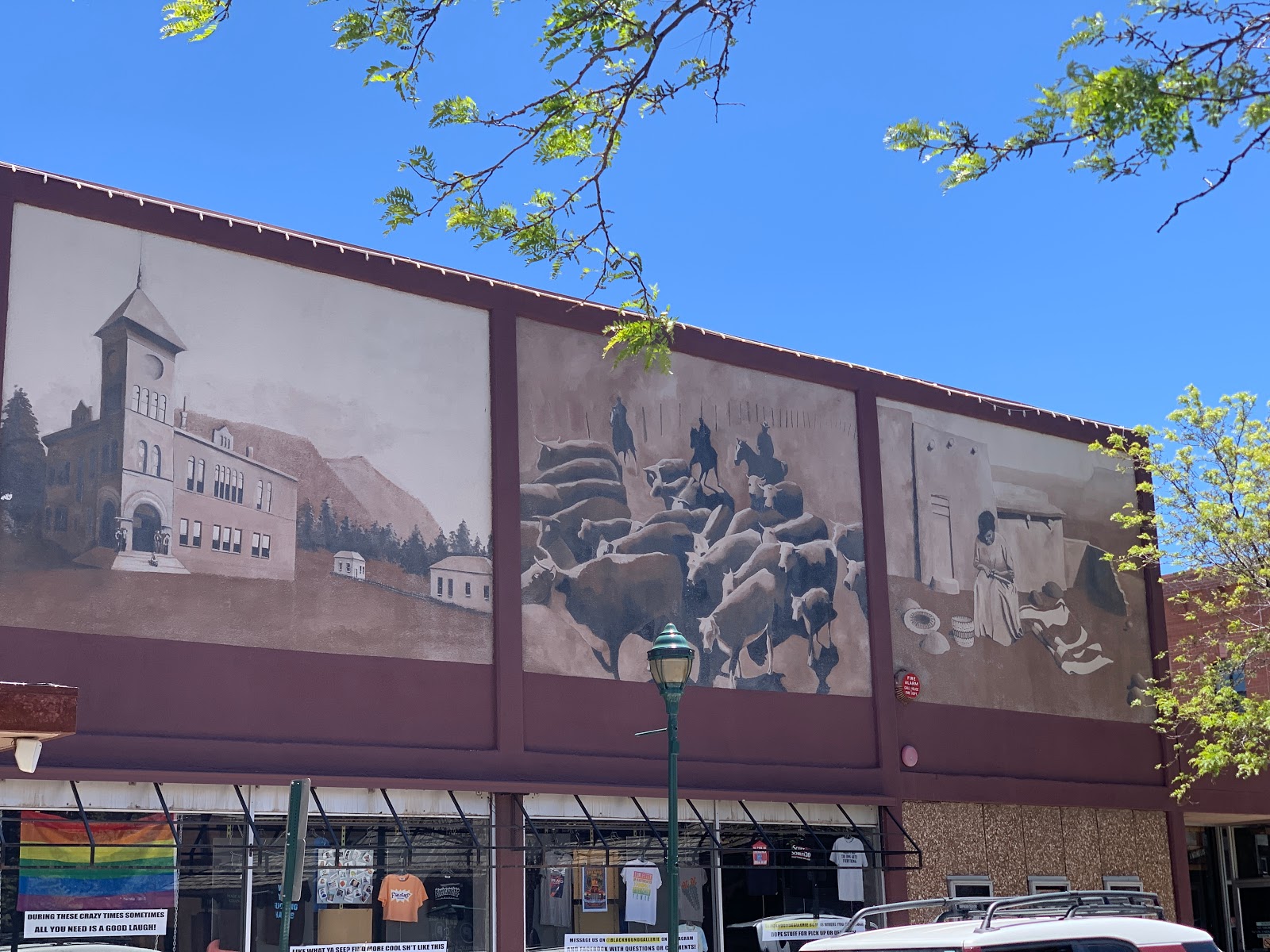
The first stop on our summer travels was Flagstaff in northern Arizona. One day we went to the downtown area of the city, not knowing what would be open in this time of Covid 19. A number of the buildings are decorated with murals. Here are a few I noticed.
The streets and sidewalks were almost deserted. To encourage people to come to the area and, hopefully, spend some money, the street parking is free.
We did find a juggler out in the park.
Flagstaff is a college town--home to Northern Arizona University. Do you imagine that is what this wooden pole is covered with staples? Surely not all of them are there to hold up posters!
Showing posts with label Flagstaff. Show all posts
Wednesday, May 20, 2020
Wednesday, July 11, 2018
The Changing Scenery
Monday we left Blanding, headed to Flagstaff, Arizona, for a few days. For more than 2 weeks we have been amid the colorful rock formations in Utah. As we approached Flagstaff the scenery changed. It was a beautiful drive.
We drove through a narrow canyon for a short time.
On the other side we saw more rock formations. These looked like what we had been seeing.
But then the shape and color of the rock changed. These two formations were thin layers of gray rock.

Then we passed more gray stone, but with more thickness. A sign described this as church rock.
Then the vegetation and the rocks changed for a while.
These two towers weren't named as far as we could see. Like we saw often along the road through the Navajo Indian Reservation, there were booths set up to sell the jewelry and other artistic works of the Navajos.
For a while it looked like we were driving on the moon. I'm not impressed with this lunar landscape.
Finally, we cane to the mountains surrounding Flagstaff.
We will be here for a few days before heading to our house in very hot Gold Canyon to prepare to fly to England in less then 2 weeks.
We drove through a narrow canyon for a short time.
On the other side we saw more rock formations. These looked like what we had been seeing.
But then the shape and color of the rock changed. These two formations were thin layers of gray rock.
Then we passed more gray stone, but with more thickness. A sign described this as church rock.
Then the vegetation and the rocks changed for a while.
These two towers weren't named as far as we could see. Like we saw often along the road through the Navajo Indian Reservation, there were booths set up to sell the jewelry and other artistic works of the Navajos.
For a while it looked like we were driving on the moon. I'm not impressed with this lunar landscape.
Finally, we cane to the mountains surrounding Flagstaff.
We will be here for a few days before heading to our house in very hot Gold Canyon to prepare to fly to England in less then 2 weeks.
Sunday, May 10, 2015
History and the Poor Farm
The Arizona Historical Society Pioneer Museum in Flagstaff is housed in the 1908 Coconino County Hospital for the Indigent--aka the Poor Farm. It was called the poor farm because patients that were able worked in the fields where food was grown for the patients and live-in staff.
Polio was one of the diseases treated there. They had an iron lung on display. I can remember polio scares when I was a young child. During the hottest part of the summer, our parents wanted us to play quietly and not get over-heated. John's late brother-in-law, Russ, had polio as a child. I also remember the first polio vaccine, available in 1953. In 1952, there had been 58,000 new cases of polio in the U.S. By 1957, that number had been reduced to 6,000. By 1994, polio had been virtually eliminated in the Western hemisphere.
One sign in the museum said one woman had lived in an iron lung for 58 years. I can't imagine that.
There were dioramas in the museum showing what the hospital ward and private rooms looked like. This was the six-bed ward.
Early Flagstaff was a lumber town, with shipment of the lumber facilitated by the arrival of the railroad. There was a display of tools of that industry.
In front of the museum, three cars from a lumber company train were on display. Look at the size of the logs on the train.
The most interesting part of the museum was on the second floor of the old hospital. Several items from each decade from the 1880s through the 1960s were displayed, as well as information on cost of living in each decade.
Look at this adding machine from the 1910s.
This permanent wave machine is from the 1920s, I think.
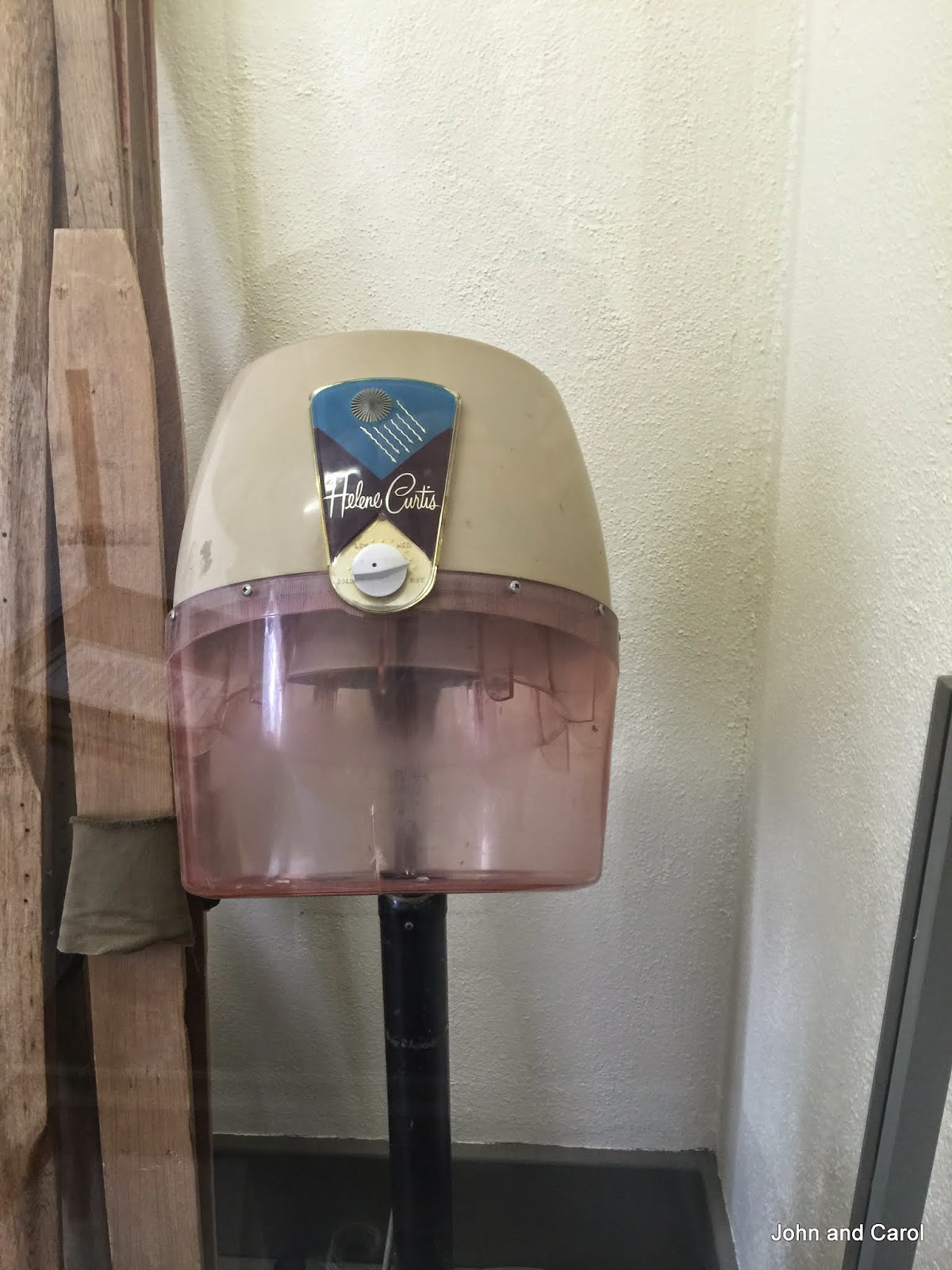
Any of you remember hair dryers like this as the beauty shop? I think they were around in the 1950s and 1960s.
I just had to include this old treadle sewing machine. I never used one, though there was one in my sewing classroom in junior high. We did have a similar, electric, sewing machine when I was growing up. That is where I learned to sew.
I was interested in the cost of various items over the decades. In the 1910s, butter cost 36 cents a pound, eggs 39 cents a dozen and a washing machine, $7.15. The next decade, butter had gone up to 70 cents a pound, eggs to 78 cents a dozen and an electric washing machine to $85.
During the 30s, butter cost 46 cents a pound, eggs 52 cents a dozen and a washing machine $74.50. The 40s were less expensive, with butter at 42 cents, eggs at 45 cents and a washing machine at $48. Prices went up in the 50s, with butter at 74 cents, eggs at 67 cents, and a washing machine cost $65.
In the 1960s, butter was 74 cents, eggs 65 cents, and a washing machine an astonishing $314.95. I think you can buy a basic top-loading washer for that today. However, the high efficiency machines are close to $1000.
Labels:
Arizona history,
cost of living,
Flagstaff,
hospital,
lumber,
museum,
polio,
train
Saturday, May 09, 2015
An Interesting Downtown
Downtown Flagstaff is a mixture of the old and the new. The city was first settled in 1876 and grew rapidly during the 1880s with the arrival of the railroad. Some of the buildings give a glimpse of years gone by.
This building was obviously built many years ago.
The outside staircases (or fire escapes) indicate an era now gone.
If you look closely at the left side of this building, you can see tall vents running up the side. We wondered if these once vented wood stoves.
This attractive building, which houses St. Francis of Assisi Roman Catholic Church, has obviously been standing for many, many years. They don't build anything like this today, unfortunately.
We saw a couple of modern murals on the side of buildings. While new, one depicts an age long gone.
One store had fancy caramel apples. We didn't buy one. They are hard to eat as you walk down the street.
Flagstaff is a very bike-friendly city, maybe in part because it is home to Northern Arizona University. There are paved bike paths around the city, the buses have bike racks on the front and rear, and we saw this fancy, crochet-covered bike rack downtown.
Friday, April 12, 2013
The Mother Road
Route 66, America's Main Street, The Mother Road. These are all names for the highway that was built from Chicago, Illinois, to Los Angeles, California. Route 66 passed through both Williams and Flagstaff in Arizona. Williams has really capitalized on this location. We enjoyed exploring historic downtown Williams, where we found murals,

and souvenir shops,


restaurants with decor reflecting our early love affair with the automobile.

>

This display brought back memories of one of my early jobs. My dad worked for Gates Rubber Company in Denver. The firm gave summer jobs to college student-children of its employees as a form of financial aid. One summer I worked in the fan belt warehouse section of the factory. These were the belts I worked with every day.

This is one of the early Route 66 road signs.

The Red Garter was an early brothel in Williams during the early mining days. It has been reconstructed today.

In the historic part of Flagstaff, we saw buildings and signs that have been maintained since those days of Old Route 66.


Flagstaff also has some impressive old buildings, like the County Courthouse, the Train Station, and this old church.


and souvenir shops,
restaurants with decor reflecting our early love affair with the automobile.
>
This display brought back memories of one of my early jobs. My dad worked for Gates Rubber Company in Denver. The firm gave summer jobs to college student-children of its employees as a form of financial aid. One summer I worked in the fan belt warehouse section of the factory. These were the belts I worked with every day.
This is one of the early Route 66 road signs.
The Red Garter was an early brothel in Williams during the early mining days. It has been reconstructed today.
In the historic part of Flagstaff, we saw buildings and signs that have been maintained since those days of Old Route 66.
Flagstaff also has some impressive old buildings, like the County Courthouse, the Train Station, and this old church.
Subscribe to:
Posts (Atom)