Showing posts with label history. Show all posts

Thursday, August 11, 2016

Our four days in Great Falls, Montana, were filled with walks in Gibson Park and along the Missouri River and visits to two museums. Sometimes we get our 10,000 steps a day walking around our RV park. It is always nice when the towns we are visiting have developed walking and biking trails. We found trails in Butte and Great Falls that made our daily walks very enjoyable.

Paris Gibson helped found Great Falls and a park in downtown, near the Missouri River, is named in his honor. We walked there twice. There is a lake with lots of birds which attract people who feed the birds, which in turn attract more birds.


There is a beautiful garden, built by the CCC in the 1930s, in the park.


There was also a skateboard park nearby. I'm glad they hadn't been thought of when our two boys were growing up. If they had gone to one, I would have had a heart attack, I'm afraid.


The Great Falls History Museum had very well-done displays, mainly of artifacts from the early 20th Century. That means it included items from out childhood. We remembered some of the telephones on display.


As a teenager, John worked in a grocery store that kept customer accounts in a system like this.


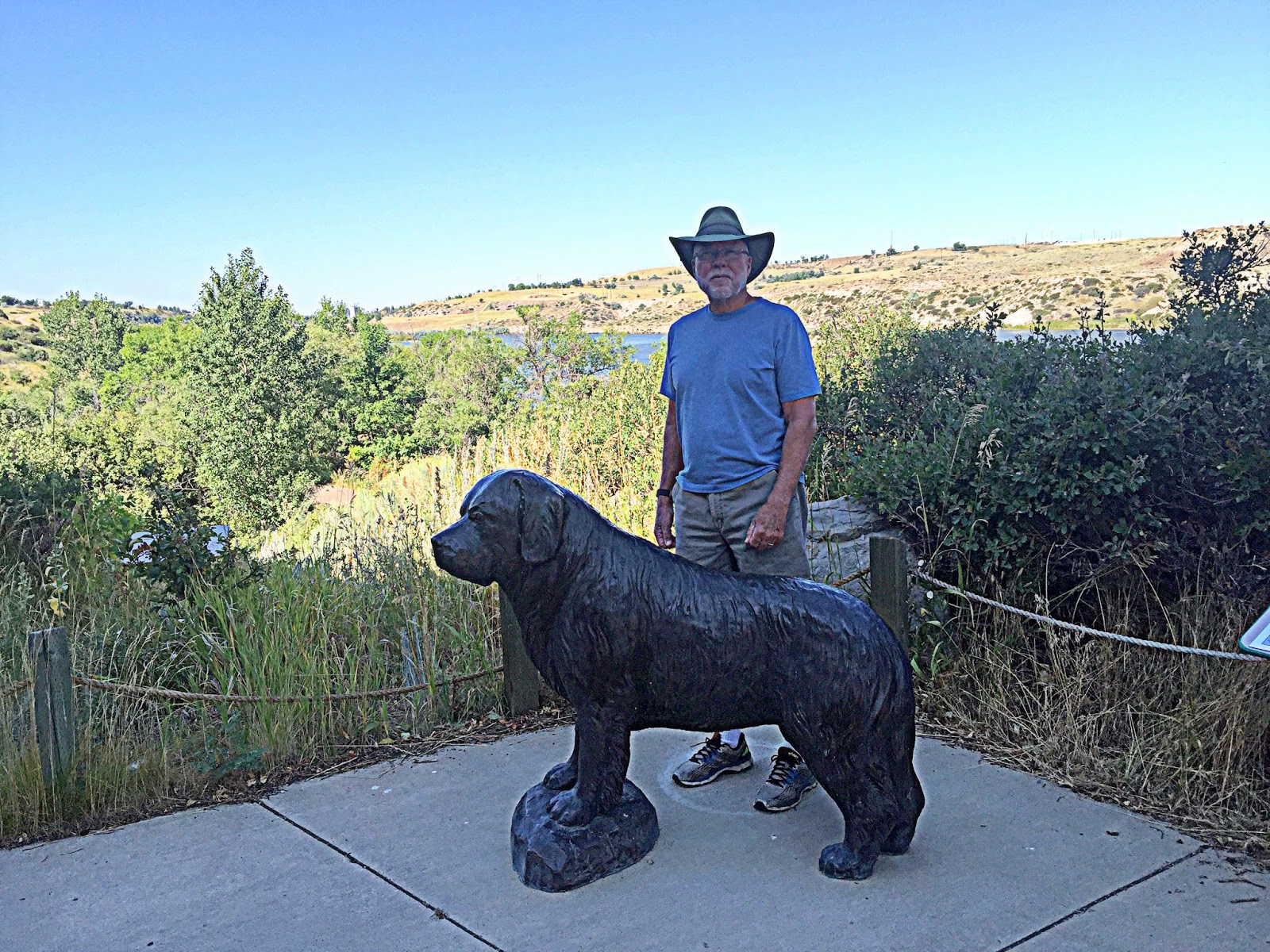
We also visited the Lewis and Clark Interpretive Center. What a great museum. Here you can see a statue of the Newfoundland dog Seaman that traveled with the Corps of Discovery. You can see the Missouri River in the background.


Can you imagine canoeing up the Missouri wearing a uniform like this?


Portaging the dug-out canoes around the great falls they found here was arduous work.


I was amazed to find the Native Americans had sunglasses. They cut slits in shells to protect their eyes from the sun.


We love the art of Charles M. Russell. He lived and worked here and we visited his museum. Photos weren't allowed inside but here is a picture of the retaining wall around his home and studio. He used the skull outline in his signature.

Friday, September 26, 2014

Looking Back, Way Back

After our stroll up the 16th Street Mall in downtown Denver, we went to the History Colorado Center, the new history museum. Before going on the road full time 6 years ago, we volunteered once a week at the old history museum, helping keep the computer up to date on the location of items in the museum's collection. We knew they had a new facility--the Colorado Supreme Court needed to expand its building so it took over the location of the old museum.

This sign was right inside the museum entrance. If you visited Colorado in the past, you would see this sign as you crossed the border. A few of the signs still exist, but they don't have the word "Colorful" in full color.


Who hasn't heard of Colorado's Coors Beer? We learned that the company kept afloat during prohibition by manufacturing malted milk powder.


Who knew that a crocheted cover could serve as a silencer on a chamber pot?


A sad chapter in our nation's history was the internment of people of Japanese ancestry during World War II, many of them US citizens. Numerous states refused to allow refuge camps within their borders because they didn't want "those people" around. Colorado Gov. Ralph Carr disagreed with the internment policy and welcomed the people to a camp in Colorado. Called Amache, it was located in Granada on the eastern plains. At it's height, it house over 7,300 people, two thirds of them US citizens. This sign is a copy of a letter given to people of Japanese ancestry on the west coast, outlining what they were to bring and how to assemble for transport to a camp.


Have you heard of the Denver Boot? It is used to immobilize illegally-parked cars. It really was invented/developed here in Denver. Sorry.


The theme of many of the displays is the issue of race in Colorado. One display talked about the Ku Klux Klan in Colorado. I knew it had had an influence here, but wasn't aware of how great that influence was--or how it was reduced if not eliminated.


I grew up one block west of Washington Park in Denver. One of the two lakes there had a swim beach, though I never went swimming there. But I was not aware of the 1932 race riot there.


The museum is very kid-friendly. One example of that is this buffalo.


This display illustrates the importance of the buffalo to people living on and traveling through the plains. It shows how different parts of the buffalo are used: the stomach could become a container to carry food; dung provided fuel for fires; large bones could be used as cooking dishes; the coat provided warmth; the trail was a good fly swatter.


Saturday, May 24, 2014

Civil Rights

We think it has been 18 years since we were in Memphis and visited the Lorraine Motel, where Dr. Martin Luther King Jr. was shot and killed in 1968. We returned today to what is now called the National Civil Rights Museum.


The sign out front is still the same.


The wreath has changed, but the door to room 306 looks the same. Dr. King was standing in front of that room when he was shot.


James Earl Ray fired the fatal shot from the window of the boarding house across the street, the window with the blue curtain.


The motel and the boarding house have not changed. But in 2013 and 2014 the museum had a $27.5 million expansion that explores the history of slavery and the American civil rights struggle from the days of slavery to the present. In front of the Lorraine Motel, there are sound stations with short videos from the day King was killed.


Across the street, there is another museum in the boarding house building. This quote from a speech Dr. King gave in Memphis the day before he was shot. He had come to town to support the sanitation workers' strike.


Beyond the assassination, the museum has an exhibit on A Culture of Resistance, tracing the history of slavery in America from 1619 to 1861. Here are some statistics on that period.


There was information about the conditions on ships that brought Africans to this country to be sold into slavery.


This is a statue showing a slave auction.


Much of the museum deals with ideas and statistics, like this about people as property.


There was a great deal of information about the major industries that used slave labor, cotton, tobacco, sugar and rice. The number of slaves grew to an astonishing number by the beginning of the Civil War.


There was quite a focus on the contrast between the beliefs expressed in the Declaration of Independence--all men are created equal--and the reality at that time and in the decades following.


That helped me to understand the meaning behind the signs carried during the Memphis sanitation workers' strike, proclaiming "I Am a Man."


Videos taken during the strike are shown on the side of an old garbage truck.


Other exhibits covered Standing Up by Sitting Down, The Year They Walked and We Are Prepared to Die. I remember the lunch counter sit-in at Woolworth's that led to the end of segregated lunch counters. I remember the Birmingham Bus Boycott, set off when Rosa Parks was arrested for refusing to give up her seat at the front of the bus for a white woman. Walking into a bus (the bus?) and sitting behind Rosa Parks or listening to the driver demanding she give up her seat is very moving.


I don't remember the events shown in We Are Prepared to Die. At one point, a Greyhound bus carrying blacks and whites across country, was attacked and burned.


Museum that portray events I have lived through are very interesting. We learned a lot today, though I wouldn't say we had a good time. They museum has so much information, we couldn't take it all in. We never even went into the section across the street. To really study all that is presented, we would have to return for at least one more visit, maybe two.

We are getting older. It is our generation and the baby boomers that fueled the civil rights movement. This museum is important so younger people can learn and remember what helped create the society we live in today. The struggles of the past, whether it is the Revolutionary War, the Civil War, World War II or civil rights, must be remembered.


I remember James Meredith being admitted to the University of Mississippi and the desegregation of Little Rock High School. These events were shown on TV as I was growing up. But I don't remember many of the details of these struggles. The museum had pictures and videos from so many things that were part of the struggle to end Jim Crow laws in this country during the 1950s and 1960s. It took hard work to change our society.

After leaving the museum, we were hungry, so we walked a couple of blocks to the Arcade Restaurant, Memphis's oldest cafe.


We enjoyed our taco salad.


Sunday, May 18, 2014

Presidential Libraries

The National Archives operate 15 US Presidential Libraries. Three of those libraries are in Texas. In the past, we visited two of those, the Lyndon Baines Johnson and George H. W. Bush libraries. We have also visited the libraries of Ronald Reagan, Richard Nixon, Harry S. Truman, and William J. Clinton.


This trip, we headed to Dallas to visit the George W. Bush Presidential Library and Museum.


Each time we have visited one of the libraries, we have learned a lot we weren't aware of before and came away more impressed with the men who have been elected to the highest office in our land. Even the men who we previously knew mainly for their failings. George W. Bush's (Bush 43) time in office was the first time we had really paid attention during all 8 years, beginning with hanging chads in 2000. I don't know that we really learned anything new, but we came away with our affection and respect for him strengthened.

There were, of course, steel beams from the World Trade Center


And a room presenting the president's diary for the rest of September 2001. This was the part of his time in office that all of us remember. We know where we were when the towers fell and we could and can appreciate what must have been going through his heart and mind as Chief of Staff Andrew Card leaned down to tell him about the attack while he was making a visit to an elementary school and a teacher was reading a book to a group of school children.

Not everything was that serious. We saw a series of photographs of the president playing around and joking with his children. And there was a statue of two of the Bush's dogs.


We caught a glimpse of a state dinner.


This painting was a gift from the crew of Marine 1, the president's helicopter. It depicts the Bush family dog Barney looking out of a window in the White House as the helicopter arrives.


President Bush is an avid mountain biker and he has sponsored annual rides for wounded veterans of Afghanistan and Iraq. This picture was taken as he was helping one of those wounded warriors during one of those rides.


In a courtyard, there is a statue of the two Bush presidents, #41 and #43.


Since leaving office, President Bush has taken up oil painting. One room was devoted to some of his paintings of foreign leaders he got to know during his years in office. The exhibit focuses on the role of personal relationships in international relations. This painting is the prime minister of Australia.


When the prime minister of Japan visited Washington, the president asked him what he would like to see while in the United States. Being a big Elvis Presley fan, he asked to see Graceland. So President Bush took him there. I love this photo of the two of them playing guitars there.


While visiting President Putin in Russia, the two heads of state rode in Putin's vintage Volga car.


President Bush and President Kharzi of Afghanistan met a number of times.


Presidents receive many gifts. Look closely at this display of some of the gifts from people in this country. Note the dog dish.


This came from German Chancellor Angela Merkel.


Maybe one reason presidents have presidential libraries is so they have somewhere to put gifts like this lion, which came from Tanzania.


This quote is from President Bush's farewell address on his last day in office in 2009.


The Bush Library is right in the middle of Dallas on the Southern Methodist University campus. Next door, there is a wildflower garden that is full of beautiful flowers and lots of birds. It is a welcome oasis in the middle of the city.