Thursday, August 16, 2018

Lake District

It looks like the Brits are people who know how to enjoy a good summer holiday. We spent 5 days in Lake Country and we saw caravan parks, holiday cottages and hotels absolutely everywhere. Think the Finger Lakes of New York, Dollywood in Tennessee, or Grand Lake, Colorado.

Caravan Parks


The views from our National Trust apartment called Sand Wath in the Temple Sowerby Manor were over lush green hills, stone walls and a flock of sheep. Oh, how we enjoyed watching those sheep! They have come to symbolize rural England to me.


We would walk downstairs from our apartment, out through the Acorn Bank garden, then down the path toward the grist mill or, perhaps, the gypsum mine. There were majestic trees and thick undergrowth. Often, we passed other walkers and families sharing a picnic.


Grist Mill


 Gypsum Mine


Majestic Trees

We drove to Ullswater Lake through the village of Pooley Bridge and across the Eamont River. The lake, when we could see through the trees, was pretty with the Ullswater Steamers and fishing boats. The Steamers are steam-powered tour boats.


Pooley Bridge is a really old village that was mobbed with folks on holiday. There were certainly more visitors than locals. We saw some cute shops.


After our morning outing to Ullswater, we returned to Sand Wath in the manor house, enjoyed lunch and went for a walk.


Tuesday, August 14, 2018

Oh, The Places We Stay

We are staying in some interesting and wonderful places on this trip to England. I have already posted about the Back to Backs. Since then we have moved on to the countryside and stayed in a converted barn with a very large, open apartment, then moved on to an apartment in a stately country home that was first built in the 1600s. We can't ask for better places to stay, cook our own meals, and learn more about the English way of life.

Widdop Gate Barn is a 3-level modern apartment built in an old barn. The place is named for a gate along a road between Hebden Bridge and the neighboring town. We had a great kitchen with dishwasher, fridge with large freezer, microwave and clothes washer and dryer. Seven steps up there was the bathroom, a bedroom and the dining room. Up 7 more steps we were in the sitting room with TV and cabinets full of games and puzzles. One more flight of 7 steps we were in the master bedroom.


The views over the Yorkshire countryside with green pastures, stacked stone walls and flocks of sheep were beautiful and quiet.


As we drove along the narrow roads, pedestrian paths were frequently marked. We were close to both paths down to the gorge and the Hardcastle Crags. There we toured a mill and enjoyed a lunch.

Then we were on to Sand Wath, a 3-room apartment on the top floor of the Manor of Temple Sowerby, which once belonged to the Knight Templar until the order was dissolved in 1312. The original house was built in the late 16th or early 17th century and revamped and added-on to through the late 18th century. Our apartment was created since the 1950s, possibly in the 1990s when the National Trust began opening the house to the public.


When you live in a building where construction began 350 years ago, you can't expect level floors. The hallway in our unit is slanted, not only from end to end, but also sideways. It is very disorienting, especially in the middle of the night, for sure. Here, we have 4 flights of stairs to reach the apartment but there is only one step in side.

There are at least 3 other apartments in the building, plus a gift shop, book shop, and herb drying room. The manor house is surround by a 180 acres of park and woodland with a garden and a water-powered grist mill and old gypsum mine. We have views over the grounds which have many large, very old trees. That includes the Dalston Oak, over 500 years old. The garden includes an orchard with trees of more than 100 varieties of apple, as well are plum and pear trees. There is also an herb garden and sunken garden.

On a previous trip to England in 1990, we stayed in National Trust facilities at the Coast Guard Cottage on the Isle of Wight, at the lighthouse keepers cottage at Dover, and at an apartment in Standen, a large old house at East Grinstead outside London.

This post is long enough, so I will post it when possible and talk about our next 3 National Trust holiday cottages and the trust itself in a future post.

Sent from my iPad

Chasing Ancestors

This was to be one of the themes for our travels in England this year. Our first stop was the British Library in London. Often, libraries provide great resources about the past. We have traced some family roots back to the 13th and 14th centuries in the country and the European continent. Those lines are often faint, but they are there. But when we asked at the front desk of the British Library about records from the 1600s, it was pointed out that the printing press wasn't widely available until the 1700s and very few written records of any type exist from that long ago unless our ancestor was famous—our weren't.qqqq

Since the 1600s are so important in American history, we know quite a bit about it—the Mayflower, the Pilgrims, then the Puritans. They are copiously covered in our history because that is the beginning of our modern story. That isn't as true in England. After searching on both the first and fifth floors of the British Library, we decided we should revise our methods.

Once we got to Hebden Bridge, we went looking for the community of Wiswell or Wyswell. John's grandmother on his father's side was a Wiswell and the family is well researched—at least to the arrival on American shores of Elder Thomas Wiswell in the 1620s. I had found years ago that there was a village in England with that name.


As we got closer to our destination using Google maps and our TomTom, twice we asked for directions. I went into a dress shop where the shop mistress smiled and told me how to find the community. A little later, still not seeing any signs, we pulled into the parking area of an apartment complex. A man came out of his apartment to get into his car and I asked him if he knew where Wiswell was located. "Go out of here, turn left, then left again. You'll come to the church. Across the road there is a car park. Park in there and walk nearby and you find the Wiswell Arms, a pub. This is only a tiny hamlet, there isn't a shopping area but there is that pub." So many people are so helpful here in England.

Womersely—looking like for a good pub or anything else in this community where some of my dad's aunts and uncles came form, we talked to a man who related there is no pub in Womersley. Mrs. Parsons (I think), matriarch of the family who had owned the town had seen too many lives wrecked by alcohol and would not allow anyone to establish a pub there. When she died, her will stipulated that, as long as any of the family members remained in the town, there could be no pub there. Ironically, one of her sons died an alcoholic.

We did, eventually, find Wiswell and took photos of the Wiswell Arms and other signs with the family name. In Womersley, we found St. Martin's Church and walked around inside, as well as in the graveyard surrounding the old building. Upon checking our records when we returned to our rented cottage, I found that my dad's great? aunt was baptized in that church.


Sent from my iPad

Saturday, August 11, 2018

Making Marks

Manufacturing was an important aspect of the city of Birmingham, England.  In the Jewelry Quarter we found a pen museum.  Cutting and forming steel into pen nibs grew out of jewelry making.  Pen nibs are  something that is largely unknown to most of us today.  But William Mitchell was the premier manufacturer of steel pen nibs in England and at the time. Joseph Gillott was another manufacturer and it was estimated that 90 per cent of American school children used Gillott’s pens.

First there was the quill pen, but these pens required constant trimming—I think at the end of every line of writing—and thus it took a long time to write anything.  The metal pen nib was invented/developed and Birmingham was the center of nib manufacturing.  Much of the factory work was done by girls whose small hands could more easily manipulate the materials.

Working 10 hours a day, the workers were required to produce 18,000 nibs each day.  They were not allowed to talk or sing—in fact they were fined if they did so—because concentration was so important.  Each girl performed only one task, truly being a cog in an assembly wheel.

This container show the “lot” of pen nibs each worker was to perform the same repetitive task on.

A machine cuts the nib blank from a strip of steel.  Imagine feeding this piece of metal in so the required number of blanks are cut each time—one blank each 2 seconds!

This is an illustration of one area of a pen factory, the grinding room.  All of these girls are preforming the same task.

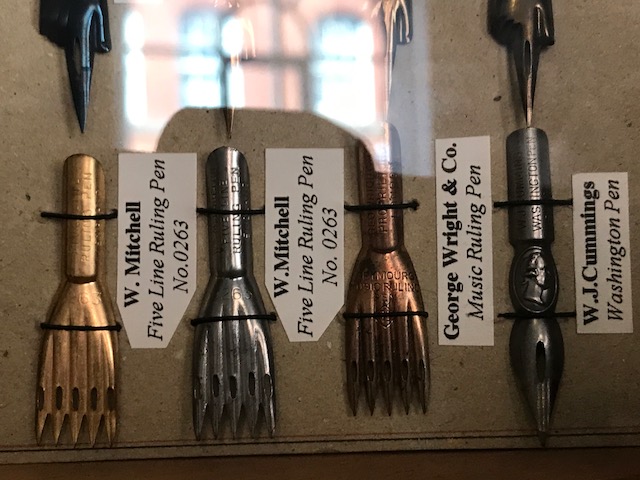
Pen nibs were made for many special tasks, including these, designed for musicians wishing to write musical scores.

The next day we visited Coventry Cathedral, which I will cover in a separate post.  One thing we learned there is that Coventry was the heart of the weaving industry.  There, women or girls worked in conditions similar to what we saw in the pen museum.


This certainly is an impressive arrangement, but of what?  Is it bullets? No, it is made with pen nibs.  Something that is largely unknown to most of us today.  But William Mitchell was the premier manufacturer of steel pen nibs in England and at the time. Joseph Gillott was another manufacturer and it was estimated that 90 per cent of American school children used Gillott’s pens.

First there was the quill pen, but these pens required constant trimming—I think at the end of every line of writing—and thus it took a long time to write anything.  The metal pen nib was invented/developed and Birmingham was the center of nib manufacturing.  Much of the factory work was done by girls whose small hands could more easily manipulate the materials.

Working 10 hours a day, the workers were required to produce 18,000 nibs each day.  They were not allowed to talk or sing—in fact they were fined if they did so—because concentration was so important.  Each girl performed only one task, truly being a cog in the assembly process.

This container show the “lot” of pen nibs each worker was to perform the same repetitive task on.


This machine cuts the nib blank from a strip of steel.  Imagine feeding this piece of metal in so the required number of blanks are cut each time—one blank each 2 seconds!

This is an illustration of one area of a pen factory, the grinding room.  All of these girls are preforming the same task.


Pen nibs were made for many special tasks, including these, designed for musicians wishing to write musical scores.


The next day we visited Coventry Cathedral, which I will cover in a separate post.  One thing we learned there is that Coventry was the heart of the weaving industry.  There, women or girls worked in conditions similar to what we saw in the pen museum.

Photos will be added later, sorry.


Coventry Cathedral

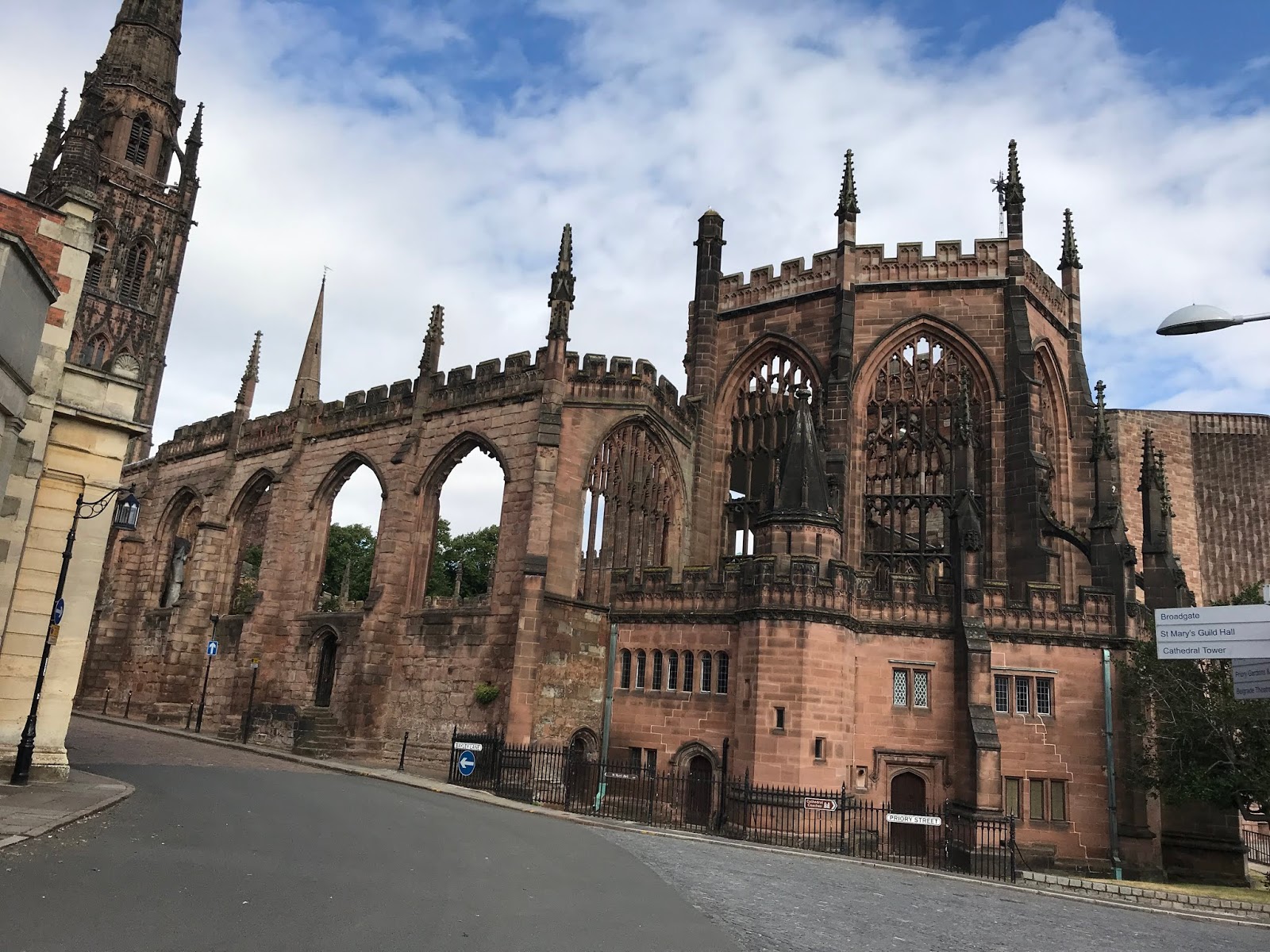
Our visit to Coventry was very moving. We have heard over the years about the Anglican Church that was destroyed during World War II and later a new, grand cathedral was built to express the faith and strength of the English people.

In 1940, during the early months of the blitz, Coventry was rained with fire bombs from German planes. When the fires were finally out, a partial shell of the cathedral was all that was left. The windows and pews had turned to ashes. In the cleanup, a workman found two beams that had fallen in the form of a cross. He raised the cross to inspire hope in the people of the town. Today that cross is displayed in the new Coventry Cathedral.

The new cathedral was built right next to the burned out church. The contrast is quite stunning. The stained glass is beautiful. Behind the high altar is a tapestry of the newly-risen Christ. There are a number of side chapels. In one, the Chapel of Jesus in the Garden of Gethseame , the rood screen evokes the cross of thorns There we gathered for a service of Holy Eucharist.

The organ in the new cathedral was built in Norway. It must sound amazing. The window at the back of this church has shadowing images of people in the glass window.

The theme of a Phoenix rising from the ashes is repeated in many place. We had lunch in the Rising From the Ashes café. As we explored the burned-out church, we saw a group of young adults sharing and learning in one of the old chapels.

The bell tower of the original church has been restored and it is possible to climb the inside stairs to the top. We didn’t.

Thursday, August 09, 2018

Coventry Cathedral

Our visit to Coventry was very moving. We have heard over the years about the Anglican Church that was destroyed during World War II and later a new, grand cathedral was built to express the faith and strength of the English people.


In 1940, during the early months of the blitz, Coventry was rained with fire bombs from German planes. When the fires were finally out, a partial shell of the cathedral was all that was left. The windows and pews had turned to ashes.


In the cleanup, a workman found two beams that had fallen in the form of a cross. He raised the cross to inspire hope in the people of the town. Today that cross is displayed in the new Coventry Cathedral.


The new cathedral was built right next to the burned out church. The contrast is quite stunning. The stained glass is beautiful.


Behind the high altar is a tapestry of the newly-risen Christ.


There are a number of side chapels. In one, the Chapel of Jesus in the Garden of Gethsemane , the rood screen evokes the cross of thorns. There we gathered for a service of Holy Eucharist.


The organ in the new cathedral was built in Norway. It must sound amazing.


The window at the back of this church has shadowing images of people in the glass window.


The theme of a Phoenix rising from the ashes is repeated in many place. We had lunch in the Rising From the Ashes café. As we explored the burned-out church, we saw a group of young adults sharing and learning in one of the old chapels.

The bell tower of the original church has been restored and it is possible to climb the inside stairs to the top. We didn't.


Easier Writing

Manufacturing was an important aspect of the city of Birmingham, England. In the Jewelry Quarter we found a pen museum. Cutting and forming steel into pen nibs grew out of jewelry making. Pen nibs are something that is largely unknown to most of us today. But William Mitchell was the premier manufacturer of steel pen nibs in England and at the time. Joseph Gillott was another manufacturer and it was estimated that 90 per cent of American school children used Gillott's pens.

First there was the quill pen, but these pens required constant trimming—I think at the end of every line of writing—and thus it took a long time to write anything. The metal pen nib was invented/developed and Birmingham was the center of nib manufacturing. Much of the factory work was done by girls whose small hands could more easily manipulate the materials.

Working 10 hours a day, the workers were required to produce 18,000 nibs each day. They were not allowed to talk or sing—in fact they were fined if they did so—because concentration was so important. Each girl performed only one task, truly being a cog in an assembly wheel.
This container show the "lot" of pen nibs each worker was to perform the same repetitive task on.

A machine cuts the nib blank from a strip of steel. Imagine feeding this piece of metal in so the required number of blanks are cut each time—one blank each 2 seconds!

This is an illustration of one area of a pen factory, the grinding room. All of these girls are preforming the same task.

Pen nibs were made for many special tasks, including these, designed for musicians wishing to write musical scores.

The next day we visited Coventry Cathedral, which I will cover in a separate post. One thing we learned there is that Coventry was the heart of the weaving industry. There, women or girls worked in conditions similar to what we saw in the pen museum.


Sent from my iPad

Wednesday, August 08, 2018

Back to Backs

Never heard of back to backs? Neither had we till I started looking for a National Trust Cottage in Birmingham. The National Trust is a non-profit charity that preserves historical properties and has converted some of them into holiday cottages, using the income from the rentals to help support the Trust.

Built in 1802, the back to back houses were constructed to house the families of the growing factory-worker force in Birmingham, a center of the Industrial Revolution and manufacturing for England. Row houses, 3 stories high, with one room on each floor, were built 2-deep. Each floor had a window on one side and the back wall was solid, with another room behind it, facing the other direction.

When constructed, there was no electricity or running water, of course. The houses were built around courtyards which served as recreational and social space, laundry room, the location of the outhouses, and source for water.

This courtyard was used by 60 people. The block of buildings housed 3000 folks. The single water tap provided water to wash clothes and for household use. The apartment we toured at one time housed a husband and wife and 9 children. Plus, they rented out one bed to 2 lodgers!

Four of the children slept on these beds, some with their heads at the top, some with heads at the bottom.

A curtain separated the children's bed from the lodgers' bed, seen here.

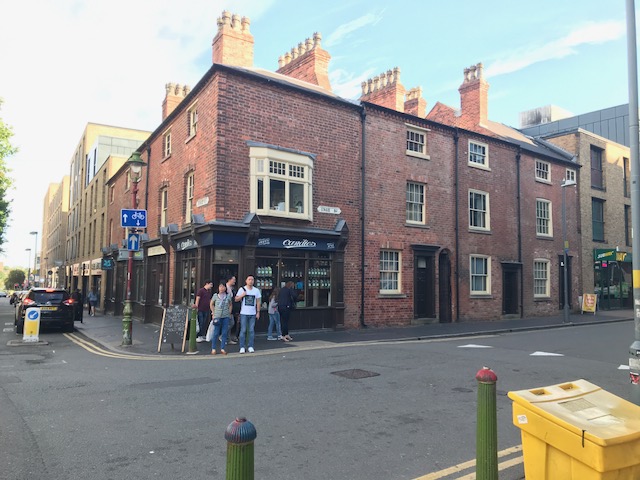
Today, three apartments are rented out by the Trust. Ours was decorated in 1930's style. The others represent the 1870s and 1840s. We didn't see them. Here are a couple of photos of our place, with the kitchen on the ground floor, the bedroom and bathroom on the 2nd floor and sitting/living room on the top floor, all facing the Inge Street.

The steps between floors were brutal—steep, curving and narrow.

Living in the Back to Back house/apartment while we were in Birmingham presented some other challenges, in addition to the steps. We only had a small refrigerator, similar to what you would see in an office to keep a couple of sandwiches and some cans of pop. Ours was in the cabinet on a shelf under the sink. It didn't have good temperature control and one night the lettuce and a bottle of 7-Up froze.

After that we went shopping daily, sometimes twice a day, to buy sandwiches, prepared microwave entrees (we didn't have an oven) and salad fixings. Luckily, the Tesco Express, a take-away store, was at the other end of the block, at the bottom of the road as described in our information packet. Here is our source of food if we didn't want to eat our 2 meals every day.

Photos will be added to this blog later, when we have strong enough WiFi.

Sent from my iPad

Tuesday, August 07, 2018

Back to Backs

Never heard of back to backs? Neither had we till I started looking for a National Trust Cottage in Birmingham. The National Trust is a non-profit charity that preserves historical properties and has converted some of them into holiday cottages, using the income from the rentals to help support the Trust.

Built in 1802, the back to back houses were constructed to house the families of the growing factory-worker force in Birmingham, a center of the Industrial Revolution and manufacturing for England. Row houses, 3 stories high, with one room on each floor, were built 2-deep. Each floor had a window on one side and the back wall was solid, with another room behind it, facing the other direction.

Pen Museum