Thursday, August 06, 2015

What a Surprise

Bayfield, Colorado, is a small town with a population of 2,333 in 2010. Originally a hamlet serving the neighboring agriculture community, it is growing slowly, becoming a bedroom community suburb for nearby (18 miles) Durango. Natural gas production is also active in the area.

In the first quarter of the 20th century, my great grandparents Ady and William Doolin lived in Bayfield. In 1905 and 1908, when my maternal grandmother gave birth to her first two children, she traveled to Bayfield to give birth at her mother's house.

So, what is surprising about all of this? Really nothing except that when we visited Bayfield maybe 15 years ago, it was a very small town with no reason to linger. We came looking for where my great grandmother lived before her death in 1926. The house was all overgrown with weeds and vines. We haven't gone looking for it this time. But we had hoped to stay in both Pagosa Springs and Durango during this trip. Neither town had a decent campground with a vacancy. We picked one in Bayfield which had good ratings on rvparkreviews.com. When we arrived, we were pleasantly surprised.

This is the landscaping around the office of Riverside RV Park.


A stream runs through the park and has been directed into some ponds. Catch and release fishing is allowed. I don't know how successful the anglers have been.


There is an alpaca next to one of the ponds.


And talk about a surprise, we have seen ice cream trucks in other RV parks over the year, but this one is unique. And really cute.


The park's wifi is fairly reliable, lots of the sites have grass out front and they are fairly well spaced. It is a great place to spend a week, resting and exploring both Pagosa Springs and Durango.

Monday, August 03, 2015

Flowers and More

You really can't beat the beauty of northern New Mexico and southern Colorado. The two areas are so similar, I wonder why they are in two different states. We enjoyed our stay stay in Chama. The wildflowers are spectacular. I think the red flower is about to wilt, but it is a beautiful color.  Many of the flowers are yellow.


Others are white.


Can't forget the lavender ones.


Sometimes, when flowers go to seed, they are also beautiful.


And talk about carpets of flowers. We saw these while walking in the Edward Sargent Wildlife Management Area, others from the train, and a few were above 10,000 feet in the NFS Trujillo Meadows Campground. We had camped there years and years ago (in a tent and before our second son was born). We really enjoyed it. Since it is right beyond Cumbres Pass, we ate our picnic there after chasing the train.


We saw a doe on a hillside while walking in the wildlife area. As I zoomed in to take a picture, I realized she also had a fawn and it was nursing. How cool.


There was also a solitary dead tree along our route. It had been killed by lightening, but was still standing. I don't know if I took this photo or John did, but you can see what the scene looked like to us.


Somehow, I set my camera on sepia in the custom colors setting.  It makes an interesting picture, too, doesn't it?  It looks like a lot of old pictures that were printed early in the last century.

Saturday, August 01, 2015

Chasing the Train

If you like trains and looking at historic trains, this blog post is for you.

If you're not a rail buff, you may not know that a lot of enthusiasts drive next to train tracks to "chase" a moving train, taking pictures at various locations. When we rode the Cumbres and Toltec on Wednesday, we saw several folks chasing our train.


Thursday, we were the folks chasing the train. And we weren't the only ones.


The first place we caught the train was just a little way from the station as it crossed a small creek.


At a place called Windy Point, the train can be seen from the road below. It makes a pretty picture. You can click on the photo to enlarge it.


Here are few other views of the train. Enjoy.


Friday, July 31, 2015

More Trains, More Scenery

I told you we love trains. So we moved the RV to Chama, New Mexico, so we could ride the Cumbres and Toltec Scenic Railroad. We have ridden this train several times. This trip, we took the excursion from Chama to Osier, Colorado, where lunch is served. We then returned to Chama. This side of the route is, in our opinion, the most beautiful. Plus, if you ride all the way from Chama to Antonito, Colorado, you must take a bus for the return trip. You can start your ride in either town. This is the train we boarded. The railroad has a number of restored steam engines.


The scenery along the route is beautiful, even more so this year because of all the moisture the area has received this year. The hillsides are green and there are wildflowers everywhere.


At one point, we saw several cowboys heading out on their horses.


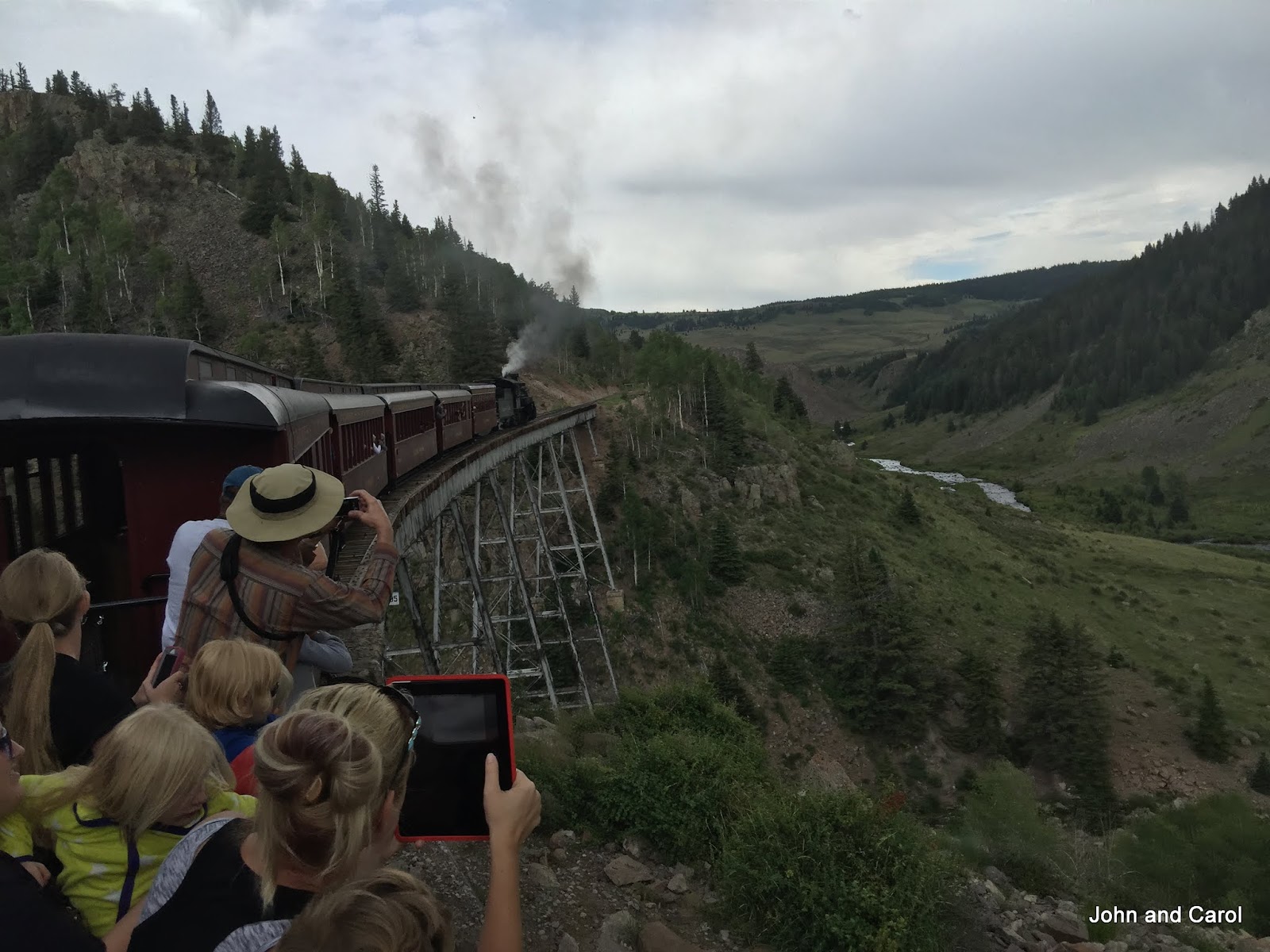
One highlight of the western part of the route is crossing the Lobato Trestle over Wolf Creek.


We were even treated to a full rainbow as the sun shined on the train's steam as we crossed the river.


It is always fun to take pictures of the front end of the train while riding down the rails. All of the train windows open and there is an open gondola car where it is easy to see the head of the train.


It is also possible to stand in the vestibules on the ends of each car, to hear the clicking of the wheels and the steam engine working. That is often John's favorite perch during the ride.


The Cumbres and Toltec has a Cinder Bear Excursion, a half-day outing especially aimed at children. Cinder Bear rode on the train, then he and the children and their families got off the train at Cumbres, the ghost town on top of Cumbres Pass, where there used to be a station, small village and section house. Today, members of the Friends of the Cumbres and Toltec RR are restoring the buildings.


Not far beyond Cumbres Pass, we came to Osier, where lunch is served to passengers on both the east- and west-bound trains. Our meat loaf dinner was good. The other option was turkey, and we hear it is very good, too.


There was a downpour, with some hail, just as we reached Osier. At least the train pulls up right next to the dining room. You can even see the rain coming down through the door at the end of our car.


We watched the other train come in at Osier.


Steam engines require both coal (or wood or oil) to make the steam. They also need water. Our engine was filled with water at one point on the uphill climb from Chama.