Thursday, July 24, 2014

Door-kin It

We are in Door County, Wisconsin, where 11 lighthouses on Green Bay and Lake Michigan provide a way to learn about the county's rich maritime history. Yesterday, we went driving to find three of those lighthouses. The trip took us on numerous country roads and we came on this crane and structure which blocked the road.


As they slowly moved the roof structure down a road on the left, they revealed a truck with a whole stack of similar structures. We were glad we could squeeze around before they finished moving the whole load, or we would have been there all morning. They were building a house down the side road.

Our first stop was at an active Coast guard station at the Lake Michigan end of the Ship Canal.


According to Wikipedia:
The Sturgeon Bay Ship Canal is a shipping canal connecting Sturgeon Bay on Green Bay with Lake Michigan, across the Door Peninsula, at the city of Sturgeon Bay, Wisconsin, United States.[1][2]
Boat passing eastward through the Sturgeon Bay Canal in stormy weather (September 2013).

The canal is approximately seven miles in length, and consists of two parts: a dredged portion of Sturgeon Bay, and a 1.3-mile canal dug through the eastern side of the Door Peninsula. This shorter portion was dug by a private group headed by then-president of Chicago and North Western Railway, William B. Ogden, between July 8, 1872 and the late fall of 1881. Although smaller craft began using the canal in 1880, it was not open for large-scale watercraft until 1890.


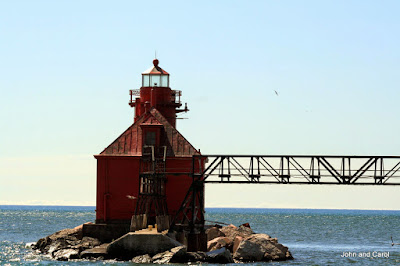
There we saw the Ship Canal Light.


In 1881 work began on a light at the Lake Michigan end of the newly constructed ship canal, linking the town of Sturgeon Bay on Green Bay to Lake Michigan It was a white, open framed tower on the outer end of the north entrance pier. The focal plane of the sixth-order Fresnel lens in the lantern on the tower was 29' above the pier and 35' above the water. The light was white. In 1898 construction began on a double-walled steel tower, 78' high. The third-order Fresnel lens, with alternating red and white lights, was 107' above lake level.

Two fog signals were built in the 1880s and a light added at the entrance to the ship canal. In 1903 one fog signal and the light were consolidated in a building that is reached by an elevated walkway from the lighthouse.


Next, we drove north on the peninsula to Baileys Harbor and the Cana Island Lighthouse.

After parking, we walked a short distance over a raised causeway to the island.


The lighthouse was built in 1869 of Milwaukee brick and was the tallest brick structure in Door County. In the early 1900s, the brick was enclosed in protective steel cladding. The third-order Fresnel lens has been lit continuously since it was first lit, making it one of the few US lighthouses whose original lens is functioning as an active navigational aid.


I choose to climb the 97 steps to the top of the lighthouse. (John stayed on solid ground.) The spiral staircase is a little daunting, but really pretty.


This is a view from one of the port-hole windows out to Lake Michigan.


Looking up into the lens is interesting. It is illuminated by a single halogen light bulb that is about 2 1/2 inches long. There are three bulbs there and when one burns out, the mechanism automatically rotates to another bulb.


Here are the lighthouse grounds from the walkway around the lens.


And a family on the lake-shore, seen from the other side of the walkway.


A stone wall surrounds the lighthouse grounds. There are picnic tables for visitors to use today.


To learn more about the lighthouses of Door County, you can visit the Maritime Museum web site.

Wednesday, July 23, 2014

Not Fun

Driving through the Chicago suburbs to Wisconsin is not fun. The traffic is terrible.


The tolls are expensive. Even though we paid for the privilege to drive the road, it was really rough.


It may be the fastest route (that is what our GPS says), we still had to stop for toll stations--costing 85 cents, $2.80, $17.00 and probably others I can't remember.


Finally, we made it to Wisconsin. After driving through Milwaukee, we saw the beautiful, neat farms we remember from when we lived here in the 1980s.


We are glad to be here.

Monday, July 21, 2014

Old Time Farming

Saturday there was a demonstration of old time farming methods in Shipshewana, so we went to see what they had.


Wait. Is it a steam train engine?


No, it's a thresher.


So is this.


The steam engine runs these belts, which in turn operate other machines. Like a saw mill.


In 2008 we volunteered at Oregon's White River Wildlife Refuge, where we had the opportunity to see the Dufur Threshing Days. You can read about threshing here.

Some of the old tractors in Shipshewana were very interesting.


Can you imagine how long it would take to build something if you first had to make the nails, one at a time?


How about pounding out a small coal shovel this way?


Here is an old washing machine powered by a gas engine. I'll bet there are people near Shipshewana who use a motor like this to run their clothes washer today.

Pumpkinvine

No, we didn't try to harvest pumpkins in a field. We rode our bikes 17 miles on the Pumpkinvine trail from Shipshewana to Middlebury and back. The Pumpkinvine railroad corridor between Shipshewana and Goshen began when the Canada and St. Louis Railroad Company set out to build a railroad from St. Louis, MO, to Bay City, MI. The first passenger train pulled into Middlebury from Goshen on Nov. 5, 1888. The line was operated by numerous rail companies until 1980. Today the trail is managed by several local park systems.

Shipshewana and other nearby communities are very bicycle friendly. The Amish population rides bikes and uses horse and buggy for transportation, so there are wide shoulders in many places. Drivers are used to watching out for slow traffic. We rode from our campground into the center of town to pick up the trail.

Much of the trail passes through a tunnel of massive trees.


We had wondered what the name Shipshewana meant. The trail includes a monument to Chief Shipshewana, so we learned a lot.  You can click on the photo to enlarge it so you can read it.


We saw these colorful flowers in many locations. Are they Indian blanket, coreopsis, black-eyed susans, sunflowers, or what? Who knows?


When we came out of the trees, we passed through farmland, with many attractive farms.


Many Amish and Mennonites have large families and doing the laundry must be a daily chore because we almost always see clothes hanging out.


In several yards, we saw this structure. Does anyone know what it is? Perhaps an above-ground root cellar?


In Middlebury, we stopped to see the Krider Garden.


Krider Nurseries was established in 1896 and published its first seed catalog in 1906. They constructed and exhibited Krider's Diversified Garden at the International Exposition in Chicago, 1933-34.


The garden was a nice place to rest before the ride back to Shipshewana.

We saw this horse and buggy during the ride. We really enjoyed hearing the clip-clop of the horses and watching their hoofs fly as they went along the roads in and around Shipshewana.

Sunday, July 20, 2014

Shipshewana

We enjoyed our time in Shipshewana. But it was time to leave. We had to get away from all the good food--many, many kinds of cheese, lots of different sausages, specialty breads, kettle corn and fried pies. We will need to diet for a month to make up for our time in northern Indiana.

As we walked around the Shipshewana South Campground, we enjoyed horses in the fields on both sides of the campground.


There was a Crossroads RV Rally in the campground over the weekend. They seemed to have a good time and they had several presentations that sounded really interesting. If we had tried, we could have heard the presentations because the covered picnic area was right next door. We had already been to an RV rally this summer, however, so we weren't interested in eavesdropping.

We saw horses in the campground twice. A local Amish caterer served breakfast and dinner  to the rally participants yesterday.


Yes, that is our truck we are looking across to see the horses and buggies. You can see the pavilion on the right side of the photo. We really didn't mind having the rally events so close to our site. Even when they used a microphone, it wasn't very loud. And each evening we overlooked the community fire pit, but the gatherings were quiet and broke up by about 10 pm.

We did have one issue with the group, however. Those RV owners were incredibly rude and lazy and unaware of campground etiquette. Some walked through our site several times. If you look at the above photo, you will see a motor home right across the street. The majority of the Crossroads owners walked through that campsite to get to the gatherings, even when neighboring site was empty. Doesn't anyone have the energy or consideration to walk down one road, around the corner and back up the next road?

Saturday, July 19, 2014

Amish Country

This is at least the fourth time we have visited Amish Country. The first time was near Lancaster, PA, many years ago. And this is our third time in northern Indiana. We thought it was about time we learned more about these Plain People, so we visited Menno-Hof, a museum telling the Mennonite and Amish story here in Shipshewana. What a wonderful museum. We spent at least 2 1/2 hours there. The story is told in video, interactive displays and informative illustrations. First off, I was impressed with the story of the building that houses the museum.


The Shipshewana Flea Market had been bringing many non-Amish to the town and they had a lot of questions about the Amish and Mennonite people and their way of life. The locals began telling that story, first at a booth in the flea market and later in a local church. So many people wanted to learn about this life that, in 1986, Menno-Hof (meaning homestead or farmstead) was built. This one sign tells the amazing story in just a few words.


This is one of the wooden pegs that holds the framework together as it is being built. We learned that after all beams are in place, the structure is so strong the pegs could be pulled out and the building would still be solid.


But the story of the Anabaptist movement that began in Europe in the 16th century is the central theme of the museum. That history was traced through persecutions in Germany to migration to Moravia, then on to North America in the late 17th century when William Penn, an English Quaker, launched an experiment to create a peaceful society in Pennsylvania. There Christians who were persecuted in Europe could live in peace and follow their own religious beliefs. In 1783 the first German Mennonites moved to Pennsylvania.

We learned about the development of the Mennonite and Amish communities, about the conflicts and divisions within them, and about the influence they had on American society and farming. Mennonites who had fled to Russia later came to North America, settling in Manitoba south to Kansas and introduced the hard winter wheat known as "Turkey Red" that strengthened the economies of both countries.

There were displays of the instruments of torture that had been used in Europe to punish the Anabaptists who didn't want to follow the established state churches. This tool was an Anabaptist Catcher, originally called a slave catcher. It was used to seize the wanted person from a crowd of people.


We saw what the conditions were like in the wooden sailing ships that brought these people to America in the 17th century. Passengers spent all their time below deck with bunks three high and a cooking fire nearby. The journey took up to 20 weeks to complete and many, especially children, died before they reached this continent.


We saw examples of the Amish and Mennonite clothing used today.


Every time we go out on the streets of Northern Indiana, we see how these plain people are an integral part of the society here, even as they keep themselves separate from the world to varying degrees with their simple lifestyle.


Friday, July 18, 2014

Visiting Family

Thursday, we drove to Fort Wayne to visit my cousin Mary. Our fathers were brothers, but I think this is only the fourth time we have seen each other. We met for lunch at Ziano's near their home.


Since Mary and her husband Wendel live in Indiana, this is the second time we have come to the state because of our RV and been able to get together. While we were talking about our family, Mary told me she remembers when I was born. She was walking with our grandfather when he told her there had been a birth in the family. When she learned that her Uncle Ray had a new daughter, she asked him what they called me. "Carol," he said. This is only a short story, but it really touched my heart.  It is neat to know family members who lived half-way across the country were talking about me in 1943, shortly after I was born.  I'm glad she shared the story with me.

We had a good visit over lunch. Hopefully, we will come here again with our RV and be able to get together with them.