Wednesday, May 20, 2015

Never Disappointed

New Mexico has several national monuments we have not visited, so we decided to check out at least one, El Morro. It was about 50 miles from where we are parked in Gallup. El Morro is a sandstone out-cropping with a pool of water at the base. Visible for miles, the rock and water was a great attraction for the Puebloan ancestors of the modern day Zunis, who live nearby, as well as travelers through the centuries who left their names and messages in the soft stone.


There are at least 2,000 writings carved into the walls of El Morro, telling the tale of Native Americans in pictographs, reporting parties of Spanish explorers and American expeditions looking for a rail route to California.  Later came passing pioneers and tourists, who left their names, as well.


You may notice that the first photo shows carvings that look dark. Early attempts at preservation of the monument included darkening the writings with graphite--aka #2 lead pencil--so they could be seen more easily. That wasn't the only misguided work done to make this a better tourist attraction. The trail that climbs to the top of the sandstone structure and makes its way to the pueblo there is marked on the stone surface with lines cut into the rock. That would never happen today.


One monument superintendent planted yucca to discourage visitors from getting too close to the stone face. That was a good idea. Look at this yucca, beginning to bloom.


In some places, steps were carved into the stone to make following the path easier!


The people who lived in the pueblo brought their water from the pool at the base of the rock outcropping. That would have been quite a bit of work. There are also depressions in the rock that capture rain water, as we learned hiking there the day after a rain storm.


John was able to jump across another pool, but I had to shimmy across using the rocks on either side of the water.


The remains of the Atsinna (Zuni for "place with writings on the rock) pueblo was discovered by archaeologists in the 1950s and part of the remains were stabilized so we can see them today. Between 1,000 and 1,500 people lived in the pueblo. At least 875 rooms have been counted. The largest pueblo dates from about 1275 and it was abandoned around 1400.


When we finished exploring El Morro's top, we walked down several sets of stairs to get back to the surrounding grounds. Thankfully, these weren't carved into the monument's surface.


We enjoyed our walk of about 3 miles, exploring El Morro. We are never disappointed when we visit a National Monument, National Historic Site, or National Park. They are always worth the time we spend there.

Monday, May 18, 2015

Slick Rock

It has been years since we have hiked on slick rock, like you find in Arches National Park in Utah. Yesterday, we hiked the Church Rock Trail outside Gallup, New Mexico. The trail is part of Red Rock Park, a place I had read about each time we came here. The trail looked like it had good scenery, so we decided to give it a try. We didn't give a thought to the fact red rocks mean slick rock. It took a while for us to discover what we were up for.

The trail starts out in a sandy wash.


We could see Church Rock in the distance and great walls of rock nearby.


The trail description said to watch for stone cairns to be sure we stayed on the trail. We have seen lots of cairns, but none as large as we found here.


The trail is laid out like a lollipop--a relatively straight trail up toward Church Rock, then a loop around in front of the rock formation before you return on the same trail to go back down. Some of the trail went through juniper forest land.


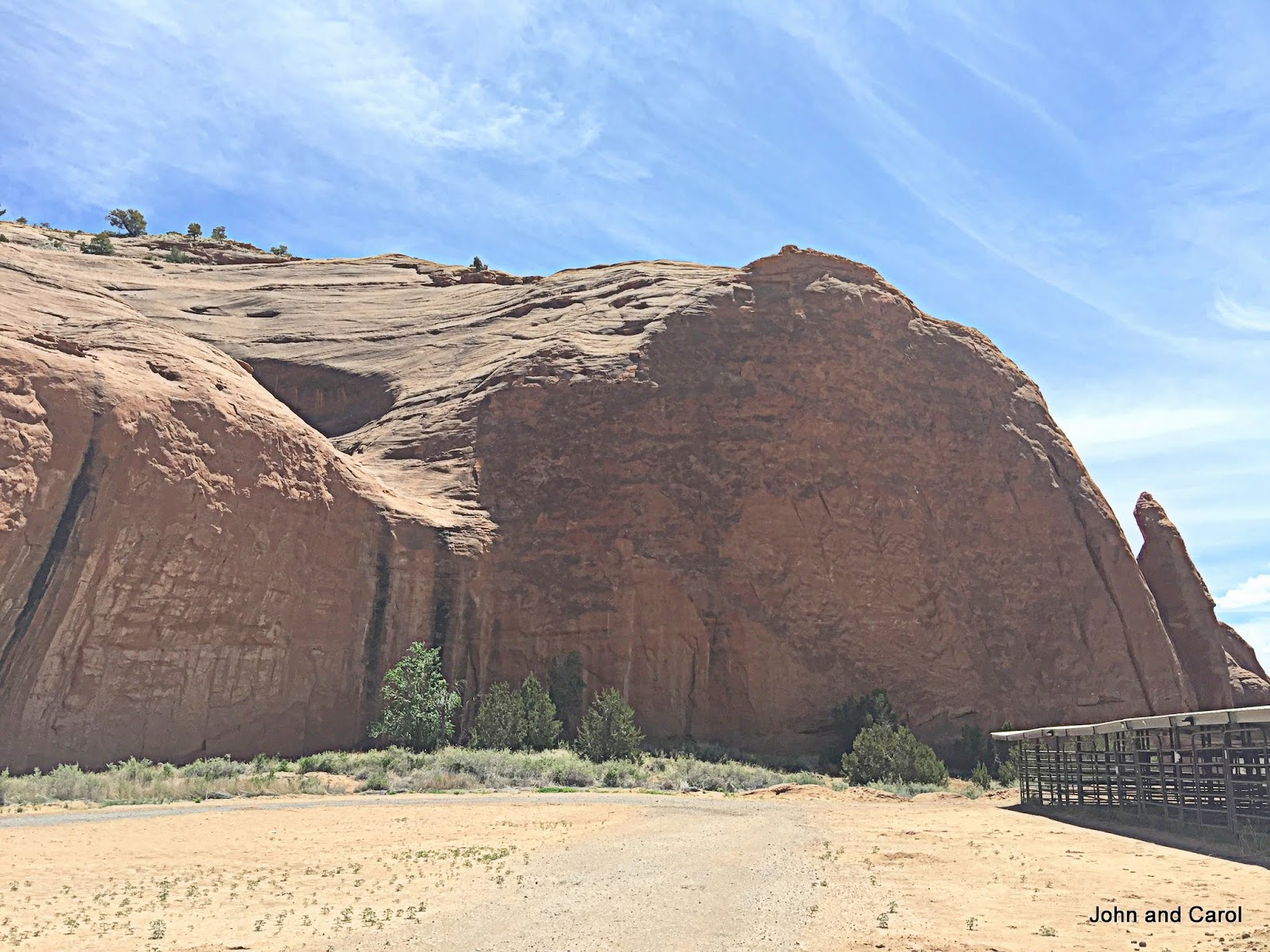
But there was also slick rock to content with. You can get an idea of that terrain by looking at this formation.


Most of the time in these areas, I was concentrating on making it safely along the trail that I didn't take many pictures. As we rounded the loop and started back down, the trail was steep enough that steps have been carved into the rock face. In these areas, we sat down next to the steps and used them to control our scooting down the rock face.


Like I said, we haven't hiked on slick rock for years. But by the time we were on the return trail, we felt more comfortable with this kind of hiking. That is good because we will be going through Utah on our way back south in the fall. This is not my favorite kind of hiking and I would probably avoid it, if it weren't for the beautiful scenery we find on these hikes.

We thought of our friends Jim and Gayle and said, "they would be right at home in this area."

It was good we felt we were relearning our skills in this terrain. On our way back down, we encountered three families with young children on the trail. If those young people can do it, we can, too.

Sunday, May 17, 2015

A Grand Old Place

La Posada Hotel was the last and most elegant of the Fred Harvey Hotels built by the Santa Fe Railroad. Built between 1927 and 1930, it is a must stop when you visit Winslow, Arizona. It was closed in 1959 and converted into offices. In 1997, to prevent the hotel from being torn down, it was purchased and restored to its former grandeur.

The grounds are really nice.


They even have a hay bale maze. We wondered if that was for visiting children.


There is a fabulous gift shop with many fine native craft items located off the lobby.


Look at the chandelier in the shop.


This hallway with iron doors is very interesting.


The hotel interior is decorated with many beautiful works of art. Here is a short movie of some of them.


We think this would be a great place for a short get-away sometime next fall or spring. We love old hotels.

Friday, May 15, 2015

The Power of Advertising

You have probably heard of Wall Drug in South Dakota. Why? Because there are signs all along I-90 as you approach Wall, announcing free ice water if you stop at Wall Drug. Today, Wall is a major destination for travelers. Almost the same thing can be said for Winslow, AZ. Why do we know about it? Most of us have heard, and can repeat, at least a couple of lines from the song, Take It Easy. "Standin on the Corner in Winslow, Arizona, watching all the girls go by." That may be the only song I know from the Eagles (I'm not much of a pop music person), but even I know that line. And each year thousands of people have their picture taken at Standin on the Corner Park. Even John.


The corner is on famous Route 66.


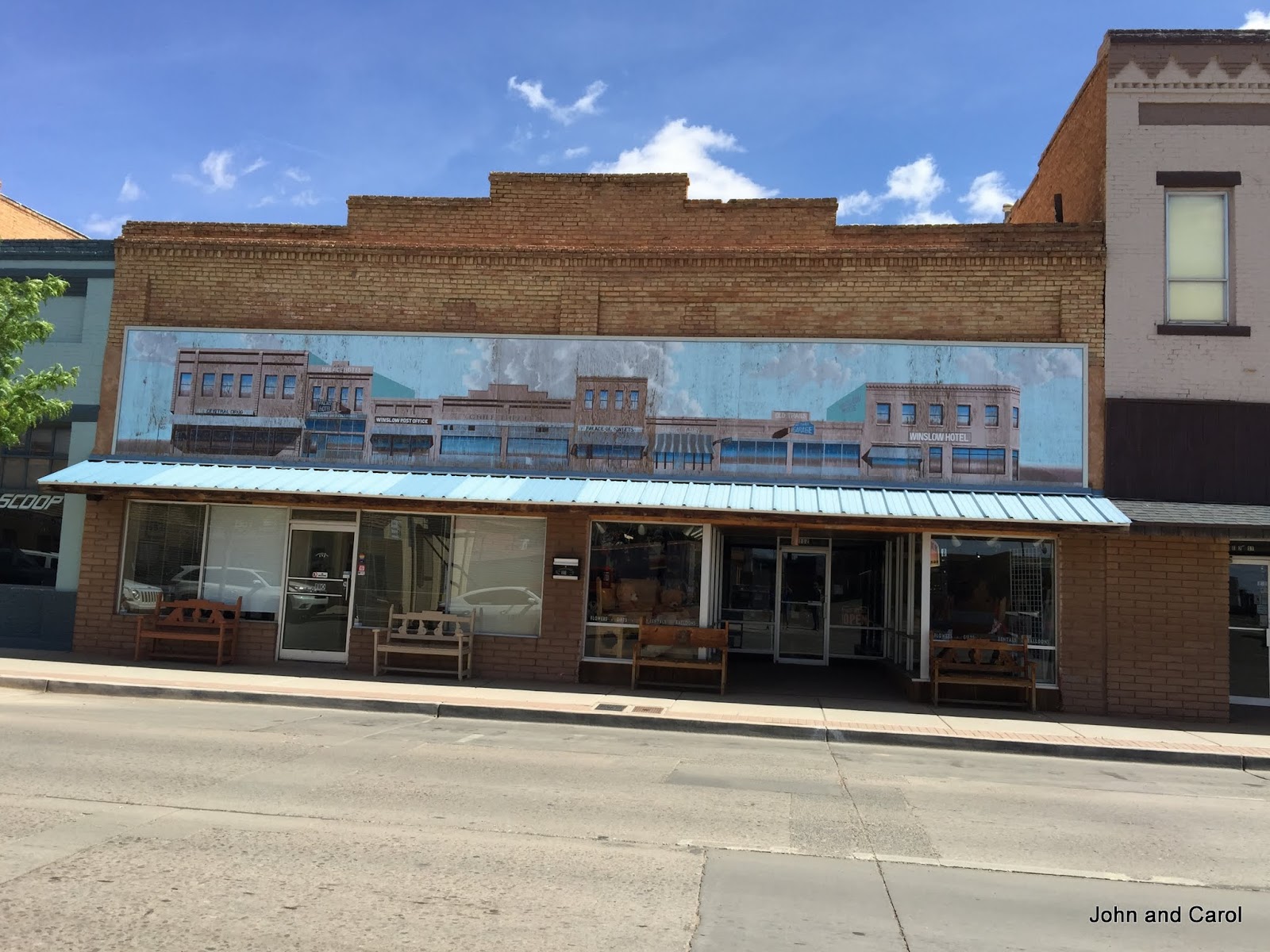
Winslow is a fun town to visit and we have spent five days at nearby Homolovi Ruins State Park. The town has a number of murals.


There was a cute statue? decoration? in front of the store across the street from the corner.


The Winslow High School mascot is the bulldog. One corner on the road out of town has this great statue.


And we really enjoyed the sign in a cafe window, especially since we will celebrate our 50th anniversary next  month. I wonder if  Jim and Carolyn are the owners or if the celebrating couple are just being honored before the cafe is sold.


We stayed in Homolovi Ruins State Park two years ago. We spent three winters volunteering at Casa Grande Ruins in Arizona and have visited Mesa Verde National Park, so we are fairly familiar with the native peoples who settled here in the southwest. Although less well known, Homolovi Ruins shows some of their settlements. Modern-day Hopi people believe this was the home of their ancestors.

This informational kiosk tells about one of the villages visitors can explore here in the park, Homolovi I. A second village, Homolovi II, is a little over two miles away, at another location in the park.


If you are interested in more information about Homolovi Ruins, you can check out my blog from two years ago here of the park's web site here.

Mormon settlers also came to this area in 1876, under the leadership of General Lot Smith. They moved on in 1881 after a number of floods on the nearby Little Colorado River. The settlement's cemetery is near Homolovi I.


We were interested to see that a couple of the trails in the park had been constructed by Elderhostel groups (now Road Scholar).


We saw a couple of interesting RVs here in the state park campground. They are earth cruisers, all terrain RVs. Originally built in Australia, they are now built in the U.S. to be shipped throughout the world. You can get more information about them here.

Sunday, May 10, 2015

History and the Poor Farm

The Arizona Historical Society Pioneer Museum in Flagstaff is housed in the 1908 Coconino County Hospital for the Indigent--aka the Poor Farm. It was called the poor farm because patients that were able worked in the fields where food was grown for the patients and live-in staff.


Polio was one of the diseases treated there. They had an iron lung on display. I can remember polio scares when I was a young child. During the hottest part of the summer, our parents wanted us to play quietly and not get over-heated. John's late brother-in-law, Russ, had polio as a child. I also remember the first polio vaccine, available in 1953. In 1952, there had been 58,000 new cases of polio in the U.S. By 1957, that number had been reduced to 6,000. By 1994, polio had been virtually eliminated in the Western hemisphere. 
One sign in the museum said one woman had lived in an iron lung for 58 years.  I can't imagine that.


There were dioramas in the museum showing what the hospital ward and private rooms looked like. This was the six-bed ward.


Early Flagstaff was a lumber town, with shipment of the lumber facilitated by the arrival of the railroad. There was a display of tools of that industry.


In front of the museum, three cars from a lumber company train were on display. Look at the size of the logs on the train.


The most interesting part of the museum was on the second floor of the old hospital. Several items from each decade from the 1880s through the 1960s were displayed, as well as information on cost of living in each decade.

Look at this adding machine from the 1910s.


This permanent wave machine is from the 1920s, I think.


Look at this old chain saw--1930s, I think.


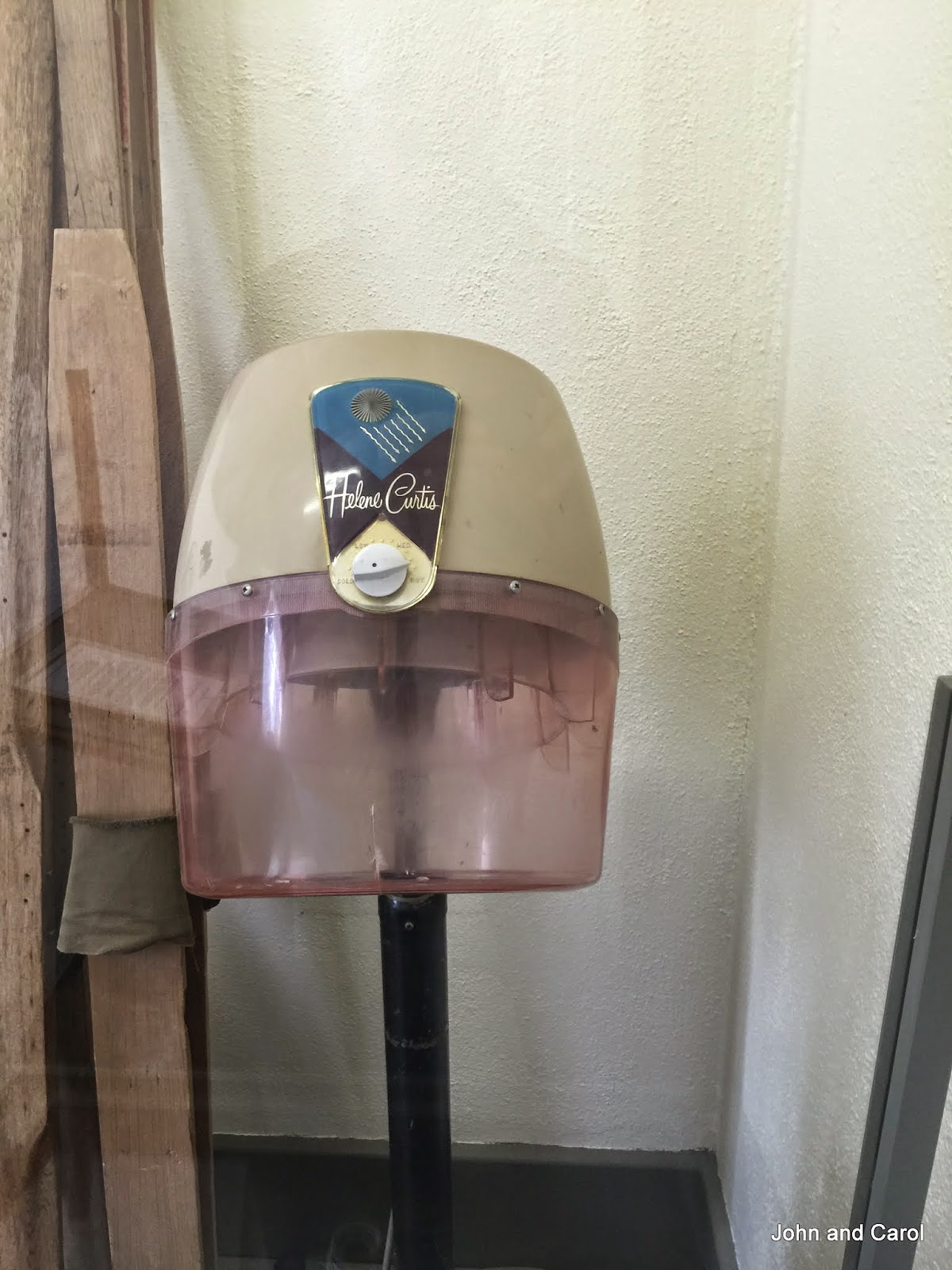
Any of you remember hair dryers like this as the beauty shop?  I think they were around in the 1950s  and 1960s.


I just had to include this old treadle sewing machine. I never used one, though there was one in my sewing classroom in junior high. We did have a similar, electric, sewing machine when I was growing up. That is where I learned to sew.


 I was interested in the cost of various items over the decades. In the 1910s, butter cost 36 cents a pound, eggs 39 cents a dozen and a washing machine, $7.15. The next decade, butter had gone up to 70 cents a pound, eggs to 78 cents a dozen and an electric washing machine to $85.

During the 30s, butter cost 46 cents a pound, eggs 52 cents a dozen and a washing machine $74.50. The 40s were less expensive, with butter at 42 cents, eggs at 45 cents and a washing machine at $48. Prices went up in the 50s, with butter at 74 cents, eggs at 67 cents, and a washing machine cost $65.

In the 1960s, butter was 74 cents, eggs 65 cents, and a washing machine an astonishing $314.95. I think you can buy a basic top-loading washer for that today. However, the high efficiency machines are close to $1000.

Downtown Williams

Before leaving Williams, we walked around that city's downtown. It has a very different feel than Flagstaff, evoking Route 66 of the 1920's through the 1950's, instead of the early railroad days.


I posed with Elvis as we walked around.


A number of the downtown restaurants have outdoor seating and live music, like this one.


Doesn't these signs make you think of the mid-20th century?


Whoever owns this truck obviously parks it under a tree for shade and doesn't worry about the deposits left by birds.