Monday, September 10, 2012

Family, the Familiar, and a New Camera

Friday we pulled into Chatfield State Park in Littleton for a two-week stay. It is close to our son's house and a place we have stayed a number of times when we are near our old home. Eric's family bought a boat this summer and they have spent a lot of time on the water at Chatfield, especially during the record hot summer (70 days 90 or above by Sept. 4 and more since then, when the average is 33 days). Saturday, we spent several hours on the lake with Eric, his wife Liz, and our grandchildren Kylie and John.


Here they are preparing to launch the boat.


Kylie ran up to greet us.


Later, John wore his papa's hat. this was our favorite picture of him for the day.


Family time is the one thing we miss, living on the road. It is always good to come here and see them. Eric and Liz take care of our rented house and our mail. Grandchildren grow so fast and it is important to catch up with them every few months. We will see them several more times before we leave here.

During our first few hours here at Chatfield, we saw a coyote.


A little later, we saw these deer in the campground.


There were a number of Canada geese on the water Saturday, looking for a handout from our boat.


Last week, we ordered a new camera, a Canon PowerShot SX 40HS. We had seen pictures taken with this model during our trip and also read about it online. It was shipped to Eric's house and Sunday I was able to try it out on my walk. It has an incredible zoom and I captured this Cooper's Hawk (I think) in a tree.


I'm really pleased with it. My Canon digital SLR is much heavier and with the 300 mm zoom lens, it is hard work to carry around. This new camera has a 35X or 840 mm equivalent zoom and 12.1 megapixels, and is much smaller and lighter. It's great.

Thursday, September 06, 2012

Scenes in Wyoming

We are spending 3 nights in Cheyenne, waiting for Friday when our 2-week reservation at Chatfield State Park begins. Yesterday, John's sister Cindy and husband John drove up from Fort Collins to have lunch we us. We had a great time eating and talking at Olive Garden.


Then they came back to our RV to talk some more.


There are four people named John in our family, my John, our grandson John, and two brothers-in-law named John. It can be difficult to make it clear who you are talking about or to when we all get together.

The scenery across Wyoming is very different from what we saw as we drove through Canada and Alaska. These western plains have a beauty of their own. And the numerous snow fences make interesting patterns on the hills.


The wind blows here, a lot. So the wind turbines on the ridge make a lot of sense.


We even saw blades for a new turbine coming down the road. Isn't it huge?


Do you remember hearing about a whole town that was for sale earlier this year? That town is Buford, Wyoming. We passed it as we drove east in I-80.


Often, you see more pronghorn than cars as you drive through Wyoming.


And there is a large herd of buffalo here at Terry Bison Ranch RV.


Thoughts About Alaskan Trip

This was truly the trip of a lifetime.  This was our second trip through western Canada and Alaska.  But this time was different.  The first time we were tourists—eager to see all we could and go “ooh” and “aah”.  This time we experienced the journey.  The 2004 trip was our first long RV excursion.  Is that the difference?  Or is it our age and, I hope, some accumulated wisdom?  Whatever, it was even better than before.

In addition to stunning scenery and abundant wildlife, what did we encounter this trip?  Canadians and Alaskans must really love and respect their lands.  We saw almost no litter.  The RV parks are really nothing to write home about.  We found what we needed—electricity (20 amp or 30 amp often, rarely 50 amp).  Some parks even provide their own power with generators. Sewer hookups are unusual.  For one reason, permafrost makes it difficult to run the lines underground.  Two times we encountered parks that required us to take our trash with us.  It seems Yukon no longer provides trash pickup.  Except for a provincial park and two national parks in Alberta, we almost always had wifi and at times it was very fast and reliable.  It was much easier to get email this trip and I seldom had trouble posting my blog. These parks do make us appreciate the amenities we encounter in the lower 48.

The local people were almost invariably friendly and helpful.  RVers provide a major portion of their annual income and they are grateful we are there. All along the route, gas stations are very RV friendly—plenty of room to maneuver and no worry about low canopy roofs. We had no trouble finding diesel fuel, wherever we went.  We carried a 5-gallon container of diesel, but never needed to use it.  We experienced a sense of camaraderie with other RVers on the same journey.

The roads are mostly 2 lane and often have no shoulder.  In places they are downright awful.  The good news: traffic is light and you can drive as slow as you wish or need to without worrying about interfering with other vehicles.

We experienced a summer that locals call “a little winter.”  It was cool, often cloudy and rainy.  We didn’t sit outside much.  But we did get out and go places, often on foot.  The weather didn’t stop us from exploring.  We only had mosquito issues a couple of times.  We never encountered what we have read about—hoards of what some call the Alaska state bird.

Traveling to Alaska with a 36-foot 5th wheel trailer, that happens to be your home, is not for the faint of heart.  Knowing you are not just miles from any technical help you might need, but at times 500 to 800 miles from that help, leads to a sense of vulnerability. 

We didn’t drive the Top of the World Highway to Dawson City and Chicken, as many do.  We didn’t drive the Cassiar Highway or go to the Arctic Circle.  No flightseeing excursions.  No chartered fishing trips.  All of these were choices we made and we have no regrets.  For others, they may be the highlight of their trip. We did what we wanted, when we wanted.  Walking Valdez and Haines several times.  Visiting a botanic garden outside Fairbanks.  Going to Rica’s Roadhouse and watching Alaskan residents net fishing. Some days we did nothing.

Although it was the most expensive part of the trip, we are so glad we took the Alaska Marine Highway ferry from Haines to Bellingham.  It saved us 2 1/2 weeks and hundreds of miles of driving and we were tired of driving.  And we were able to again see the Inside Passage, at least part of it.  We really did nothing for 3 1/2 days. 

Let me repeat, the scenery and wildlife were spectacular.  That is what we enjoyed the most.

We considered buying a smaller trailer to make this trip.  We spent several days last summer shopping.  We never found something reasonably priced that we felt we could live in for three or four months.  At this end of the journey, we are glad we didn’t get another trailer.  That purchase would have saved wear and tear on our Montana, which is home, but would it save money in the long run?  We would have a trailer to sell now.  We aren’t sure the amount we would lose in that transaction would be less than the damage we must deal with on the Montana today.  We’re glad we went in the Montana.

Our only advice to others—take as much time as you possibly can. There is so much to see and to savor. Don’t hurry. It is much better to be “full” and ready to leave than to rush through it and miss things you really want to do.

There are lots of ways to see Alaska. You can take a cruise or a cruise and land tour; you can RV on your own or join a caravan. You can stay in commercial campgrounds all the time or boondock most of the time. You can RV in a pickup truck camper, a 5th wheel or travel trailer, or a motorhome. We did it our own way and loved it. No regrets. Nothing we wished we hadn’t done or were sorry we did do.

We stayed in commercial campgrounds all but two times during the trip.  If you are reading this post, you probably followed our journey on this blog.  We also followed another blog of a couple RVing in Canada and Alaska, but boondocking almost all the time.  They spent a whole lot less money.  And they experienced the journey differently than we did.  From what we read, they were very happy with they way of doing it.  Just like we are happy with our trip.  You can read what they did here.

What did it cost?  I will only include rv park expense and fuel in Canada and Alaska and our ferry trip back to Washington.  Everyone has to eat, wherever they are.  We spent some money on tours, etc.  Those are decisions everyone makes on their own.  I will say that the bus tour through Denali National Park and the boat tour to Kenai Fjords National Park were highlights of the trip and worth every penny we paid. 

RV park expense—26 campgrounds for 84 days, $2709.16.  This was $32.25 per day

Diesel fuel—6,300 miles of travel in Canada and Alaska, $2,517.49. That is 40 cents per mile.

Ferry trip back to the lower 48—$4605.00.

Bank charges were $129.39.  That was mainly foreign transaction fees for credit card purchases and $9 fees for using ATMs that weren’t part of our bank’s network.  If we leave the US again, I will investigate a credit card with lower foreign transaction fees.  I’m not sure if using all cash would be less expensive.  It would result in more frequent trips to the ATM so we wouldn’t have to carry a lot of cash around.  We are used to charging everything because we get 1% back on all purchases and we pay the bill in full each month.

One other consideration.  Telephone.  I added Canadian roaming on my Sprint phone so we could use it in Canada.  We felt there would be enough places with no cell phone coverage that we should have a calling card for pay phones.  Before leaving the US, I bought an international card from a Kroger store, only to find when we reached Canada that it didn’t work in Canada.  (The card included a Canadian flag.  Go figure.)  Next, I picked up a $10 Telus card in Canada.  On reading the fine print, it wasn’t honored in Northern British Columbia or Yukon. I was able to use it once in Jasper National Park.

The trip of a lifetime.  Make it, in an RV, if at all possible.  You won’t be sorry.

Monday, September 03, 2012

East Meets West

Let me tell you a story.

In the 1860s the United States Congress approved the construction of a trans-continental railroad. Not much was done about it until after the Civil War ended. The railroad would unite the eastern states to the western states and was seen as important to make us one nation, especially after the divisions of the Civil War.

Thousands of men, including Civil War veterans, out-of-work Irish immigrants and Chinese immigrants recruited from their homeland specially to work on the road bed, used tools like this scoop to level the roadbed


and this shovel to dig through hills and fill ravines,


and incredible amounts of black powder, as well as nitroglycerine, to blast through rock.

On May 10, 1869, two trains met at Promontory Point north of Salt Lake City, Utah, where the last spike of the rail line, one made of gold, was driven into a special laurel wood tie, making it possible to travel all the way from Omaha, Nebraska, to Sacramento, California, by rail.


Union Pacific built across the plains and often had to bring in soft wood ties from along river banks. They looked like this.


The Central Pacific was able to cut down trees in the Sierras and have them cut at sawmills into proper shape.


Here is the gauge used to make sure the rails were exactly 4 ft 8 1/2 inches apart.


We recently both read Nothing Like It in the World by Stephen E Ambrose, the story of the building of the transcontinental railroad. So when we decided to spend 3 nights in Brigham City, a visit to the nearby Golden Spike National Historic Site was a must.

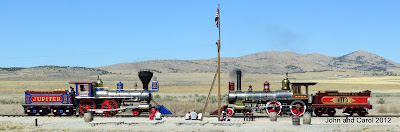
In the photo above, you see a reproduction of the blue and red Jupiter on the left. It was a wood burner that brought Leland Stanford, president of the Central Pacific which built east to Utah from Sacramento, and other dignitaries. I love the smoke stack on wood-burning steam engines.


Engine 119, in red paint, is a coal-burning steam engine. It brought Grenville Dodge of the Union Pacific and other dignitaries.


In the photo of the two trains together, notice the American flag. It has 20 stars. Those arranging the ceremony remembered to bring the trains, the dignitaries, the flag, the speakers, a minister to pray. But they forgot an American flag. A search for one turned up a Civil War veteran who had one from his time in the service. At that time, the U S had only 20 states.

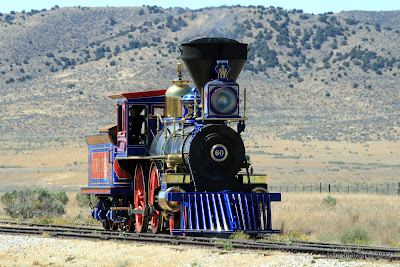
Here are some closeups of the engines.


Several times each day, the two engines are steamed up and run down the track. Here is Jupiter.


And here is Engine 119


We were surprised to see the engines were run so often. It was treat to see them in operation.

This is a replica of the special rail they used for the Golden Spike ceremony.


Saturday, September 01, 2012

Holiday Weekend

Certain things full-time RVers have to consider in their travels. One is where to spend long weekends. Those weekends are when the most recreational RVers hit the road, filling up campgrounds. So, when we look ahead, we have to plan where we can go that won't be booked up weeks ahead (such as state parks). We also try to pick a location where there won't be campfires or large family gatherings with lots of children.

Back in early July, I made our reservations in the Denver area for September. The first consideration was to not try for either of the Colorado State Parks there over Labor Day. They were probably booked in April or May and, if we could get in, they would be full of campfires and children. So, where to spend this holiday weekend? A few days ago we decided the Ogden-Salt Lake City area would be good. It would give us 4 days to get to Denver for our Sept. 7 reservation and it probably wouldn't be full for the weekend.

Obviously, we aren't here because we have big plans for the weekend. So today was a perfectly ordinary day. In fact, though we aren't "home" yet, things are getting back to normal. After our exercise this morning, we went to WalMart for groceries. During the afternoon, John had time to work on his diamond willow hiking sticks.


I spent the time baking bread. Tomorrow we are having hamburgers. I could buy hamburger buns, but they only come in packages of 8 or 10. That means we have to use them for our sandwiches next week or freeze them for later. They are too much bread for sandwiches and I don't think they have a good texture after they are frozen. Instead, I decided to bake my own.

When our boys were young and I wasn't working, I baked all our bread, making at least 4 loaves a week. It must have rubbed off on our older son, Doug. Once during grade school, the students were asked what they thought their mothers were doing at home and he said, "baking bread." After he was married, he and Sherry bought a bread making machine and he asked for the recipe I used when he was growing up. I gave it to him, though I wasn't sure how it would work in the machine. (And, I never heard.)

Anyway, that is the bread I baked today. For several years before we went on the road full time, I owned a mixer with a bread hook. But I didn't use it very often. I really like kneading the dough. Here is the kneaded dough, waiting to go into a bowl to rise.


And here is the finished product, six hamburger buns and one loaf of bread. These buns will freeze well.

Friday, August 31, 2012

Clear Skies and Another State

Today we entered yet another state, Utah. That is four this week. Driving into and across Idaho, we continued to have smokey skies.


During our 2-night stay in Boise, we were able to run (John) and walk (Carol) three miles each morning along the Boise River. It is a really neat trail through the woods


across the river


and along upscale neighborhoods.


The campground is right next to the fair grounds, which are very large, but old. I loved this sign.


We saw these cormorants above the river.


I don't often blog about the RV parks we stay in, especially those located behind a gas station. But the one we stayed in last night, Valley of Trees, was really special. The first photo is of our site. The driveway you see is for the next site over. Since no one parked there overnight, the second photo shows the view we had of the Valley of Trees between us and the gas station.


Today, as we drove from Declo, ID, to Brigham City, UT, the skies were smoke free but filled with a mix of clouds and sun. I really liked these clouds.


We saw very little evidence of wildfires today. Yesterday, we drove by mile after mile of burned sagebrush. We did see this hillside that had been burned.


In this photo, we couldn't decide if we were seeing smoke or irrigation sprinklers in the distance.


During our stay at Santa Ana NWR in Alamo, TX, early this year, we saw fields of onions being harvested. Today we saw this truckload of Idaho onions. Obviously, we have fresh produce year-round because different parts of the country raise fruits and vegetables at different times of the year.


Not only do they grow onions in this part of the country, they also raise cattle. This is the sign for Grants Range Bulls.


And that's no bull. It's plastic.

Tuesday, August 28, 2012

What is Home?

The word "home" can mean many different things. I can go "home" to the physical space I live in; or to my "home" town; or to the state where I live or where I grew up; or to the part of the country or the country where I live.

We have been "home" in the United States since we entered Alaska from Canada on June 29. We have lived this whole time in the RV which is our "home" (except for the 4 nights on the ferry). As we drive south and east from the Seattle, Washington, area, we feel we are getting closer and closer to "home." Why? Because of the cattle in the fields.


And the sagebrush.


And the round wheat and hay fields, growing that way because of the irrigation sprinkler that goes in a circle.


The air is getting drier. We have both lived most of our lives in the higher altitudes of Colorado and, more recently, in the Arizona desert. The humidity we found in much of Alaska is not "home" to us.

I am happy to report that the nights are once again dark. Among other things, that means I can see the moon at night. For many weeks, I was never up when it was dark. As the nights got a little longer, we were often along the ocean and the sky was covered with clouds. But for the last two nights, I actually saw a moon in the sky before I went to bed.

We drove from Ellensburg, Washington, to Pendleton, Oregon, then today to Boise, Idaho. That is three states in three days. If you drive on the East Coast, you can easily pass through three states in one day. Out west, where the states are larger, our trip is pretty amazing, especially for us.

Eastern Washington and Oregon have interesting hills, mostly covered with brown grass.


We also saw lots of vineyards, providing a good dark green contrast to the brown.


There are lots of hills to go up and down. And triple-trailer loads are allowed, leading to this sign on a FedEx truck.


Hay is a major cash crop around Ellensburg, where we saw lots of covered haystacks.


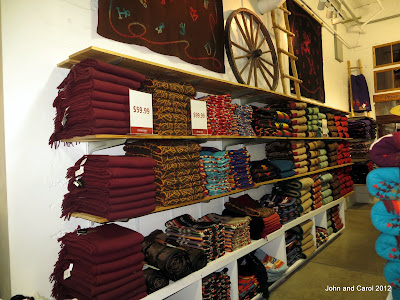
Pendleton, of course, is home to the famous Pendleton Woolen Mills. We didn't tour the mill, but we did check out the mill's outlet store. Of course, there were lots of Pendleton clothes, most made of wool. And we don't need those in Arizona. We did enjoy looking at the shelves of blankets.


And, through a window, we saw stacks of different colored yarn and a bright blanket on the loom.


Our RV park in Pendleton sat on a hill and we could look out over the valley and part of the town. Look above the ground and you can see the thick smoke that blankets the area and got worse, the closer we came to Boise. A number of wildfires are burning in Idaho and have been for several weeks. I read a story said they don't anticipate a major storm that could put the fires out at least until after October 1.


Driving from Ellensburg to Pendleton, we saw two mountains. I hope someone can let us know if this is Mt. St. Helens?


And, is this Mt. Rainier?


They sure are beautiful.