Showing posts with label fish. Show all posts

Sunday, May 04, 2014

It's Not the Desert

After leaving Arizona and driving across New Mexico, we traveled I-10 into Texas. West Texas looks very similar to the desert terrain in Arizona and New Mexico. But by Wednesday, we had entered Texas Hill Country. No more saguaros. There are real, honest-to-goodness trees here.


We also see lots of vultures, both turkey vultures and these black vultures.


Driving on the roads around here at night must be tough. We see so much road kill, especially white-tailed deer. The presence of several vultures on the side of the road tells us where to look. We also see them circling in the sky.

One distinctive feature of the woods here in Texas is the live oak tree. They don't grow in Colorado, but they thrive there. Isn't this a magnificent tree?


We are spending several days at Potter's Creek Corps of Engineers Campground, north of San Antonio, on Canyon Lake. Texas is the only place we have seen screened shelters like this.


In colder areas, we see camping cabins where folks can bring their sleeping bags and camp stoves and stay in a basic log cabin with (usually) no electric and no water. Also, no beds, just wooden platforms for the sleeping bags. Here, these shelters have electricity for a light and a ceiling fan. Sleeping bags are rolled out on the floor and cooking is done outside. The screens keep out the bugs and let in lots of light, something missing in the camping cabins.

Just look at these catfish, caught Friday on Canyon Lake!


We aren't in the desert, any more.

Thursday, August 16, 2012

Alaska -- Day 92

Just when we thought we had seen all the beautiful mountain scenery Canada and Alaska had to offer, we drove the Haines Highway from Haines Junction in Yukon Territory to Haines, Alaska, on the Inside Passage. The trip took us from Yukon Territory to a small part of British Columbia into Alaska. The mountains are amazing.


So were the lakes. This is Dezadeash Lake.


We went over Chilkat Pass, elevation 3510 ft. But it reminded us a lot of driving over 12,183 ft. Trail Ridge Road in Colorado's Rocky Mountain National Park. The alpine environment here is just at a much lower altitude.


Very soon, however, we were back down in the forest.


And, of course, Colorado doesn't have glaciers.


When we came to the Chilkat River, we saw fish wheels.


This picture of tundra swan on a small lake has to be the prize of the day. I was looking through the side window, back over my shoulder.


Back on July 20, we visited Anchor Point, North America's most westerly highway point (see Day 65). Two days ago, we stayed in Beaver Creek, Yukon, Canada's most westerly community.


Today, as we pulled into our RV spot in Haines, the neighbors were showing off the salmon they caught here in Haines.

Tuesday, August 07, 2012

Alaska -- Day 83

What are all of these gulls waiting for?


Something to eat! In case you can't tell, the dark areas in this water are virtual rivers of pink salmon, moving toward Solomon Gulch to spawn.


Here you see them crowded up against the wire of a fish weir. It diverts many of the returning salmon to the Solomon Gulch Fish Hatchery, from where they were released a year or so ago.


Part of the wier is stretched across the river. Only the strongest-jumping fish make it on up the river.


The rest are diverted into the fish runs to the hatchery.


We were there before the hatchery opens at 8 am, but a walkway is open so we could see the raceways and read about the fish. The salmon eggs that are deposited in the hatchery are artificially fertilized. The fish had returned to Solomon Gulch because they had been released here. However, the stream itself can't accomodate all the fry (little fish) that will hatch next year. That is where the hatchery comes into play each year.


We found the morning absolutely fascinating, even if it wasn't what we had planned. These signs show why were out there.


We didn't see any bear, but we can certainly understand why they are in this area some time each day.

After returning to the RV for breakfast, we went for a walk. We found this bus in our RV park. We have seen another of these buses somewhere in the past. Click to learn about the Green Tortoisee.

Here you can see the travelers' gear and water supply in the bus basement. Look carefully and you can see two tables on the other side of the buss, one with their breakfast dishes dripping dry and the other where breakfast was prepared.


These are the travelers' tents.


Our walk took us out of town north, where we saw these peaceful wetlands. Look at the reflection in the water.


On the other side of the road, there was fog on the bay. And it was clearing from the mountain tops.


One more great sight.


I have seen bald eagles somewhere every day since we arrived in Valdez.

Monday, July 30, 2012

Alaska -- Day 75

It has been another cool, cloudy day in Seward, Alaska. The high temp was 54 degrees. Last winter Alaska saw all-time record amounts of snow. July has been the coolest on record. The state is having a summer that they call a "little winter." We love to see sunshine, and we have seen it every day it was really important to our plans. However, we would rather be here in this chilly summer than in the lower 48 with your record-breaking heat and drought.

Today, sunshine didn't matter. We used our Alaska Toursaver book to visit the Alaska SeaLife Center here in Seward. Entrance for two cost one single ticket price of $20. We hadn't really known if we would visit this place or not when we first came here. But the more we heard about it, the more we realized we wanted to go. And are we ever glad we did. These two folks from Colorado saw sea life like we hadn't even imagined existed. But first, we saw more beautiful flowers here in town.


The SeaLife Center has numerous tanks of fish and other sea life, as well as facilities for birds and seals. They have some exhibits where you can touch some sea life, like sea stars and sea anemone. The facility rescues and cares for animals. This week they took in a six-week-old walrus calf, stranded near Barrow. We didn't get to see it, but facilities that care for creatures like that are certainly great.

We did learn a lot about the life-cycle of salmon, the various fish and other sea life that are harvested in the Bearing Sea,
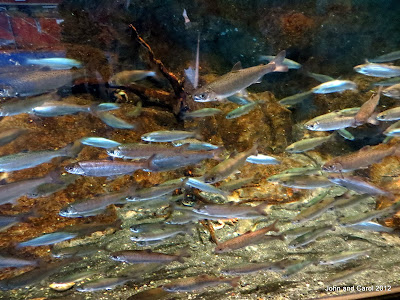


and about the Exxon Valdez oil spill. The most startling facts I learned about the spill is it was not even among the 50 biggest oil spills in the world and that every 9 months, more oil goes into US marine waters from run-off from roads and parking lots and incidental land oil spills than came from the Exxon Valdez spill.

We saw numerous birds that were new to us. We had seen puffins on our cruise earlier this week and today, John finally got a really good photo of one. I have wanted to see and photograph puffins for at least 8 years, when we were first in Alaska. Finally!  It is a tufted puffin.


This is a parakeet auklet.
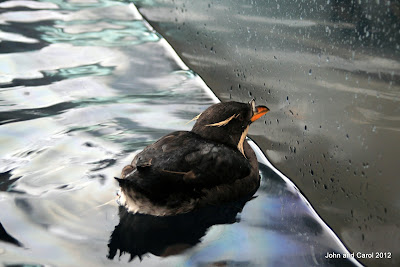


I'm pretty sure this is a king eider.


I know there were red-legged kittiwakes.  I don't know what this one is.


The bird on the left is a long-tailed duck and the bird on the right is a pigeon guillemot.


This is a black scoter.


We were able to watch stellar sea lions from above the water and also below. They moved too fast underwater to be able to photograph them.


The invertebrates are as beautiful as the flowers we had seen earlier.

Sea anemone.


A sea urchin.


Sea star.


I don't know what this is.


We were both fascinated by all we saw and learned so much. We know we will visit other aquariums in the future. It was a great experience.