Showing posts with label Ohio. Show all posts

Friday, May 12, 2017

What a Trip!

Normally, we drive about 200 miles a day and only travel every 2nd or 3rd day so we can relax and enjoy each location.  Earlier this trip we stayed 5 days in Tulsa and 5 days near St. Louis.  But in the last week we have driven 4 days in a row, covering 797 miles.  We parked in 4 states and crossed part of another.  Whew! 

There wasn't anything on our route through Illinois, Indiana and Ohio we wanted to see.  We will be back in Pennsylvania and Ohio as we return west next month.  We have checked off one item on our bucket list: we spent 2 nights in Hagerstown, Maryland .  We have now slept in 45 of the 49 continental states.  Only 4 more to go--Delaware, Connecticut, Rhode Island and New Jersey.

Our home is in Colorado and the Continental Divide runs through the middle of the state.  To cross it, you often have to go over a 11,000 foot or higher mountain pass.  We didn't realize there is an Eastern Continental Divide until Wednesday when we crossed the 2,670 foot divide.

When was the last time you saw an operating drive-in theater?  It has been a long time for us.  We spotted this one on our trip across Ohio.


Trail Ridge Road between Grand Lake and Estes Park, Colorado, crosses the Continental Divide in Rocky Mountain National Park.  From the top you can see into 4 states.  There are other places you feel you can see forever, like the Youghiogheny Overlook in a Pennsylvania highway rest stop.  (Does anyone have any idea how to pronounce that word?)


This is another view from the same area.


I think this view was in West Virginia.  Obviously it is early spring here.  Many of the trees hadn't leafed out.

The limestone (?) hills in West Virginia are also great.


We haven't seen dogwood trees for years.  We found this one in our Hagerstown RV park.


Where we spend our winters in Arizona people refer to it as summer camp for geezers. Maybe we now have regressed to childhood. The best option we could find to park in Hagerstown was the Jellystone Park. It really was nice--since school is still in session and we were there mid-week. It must be wonderful for families with children. They had everything from a zip line to laser tag to water parks and mini golf. 

Monday, October 13, 2014

Summer Summary

We left Mesa, Arizona, last year on April 22 and returned October 3. During that time, we towed the RV 7,515 miles and drove the truck an additional 3,820 miles. That means we drove a total of 11,385 miles. In 2012, we made our second trip to Alaska. That summer, we traveled at least 10,000 miles. All this means, meandering through the middle of this wonderful country we live in can mean driving more than a trip from the Rio Grande Valley of Texas to Alaska and back to Denver, Colorado. No wonder we were tired after our travels this summer.

During the past summer, we traveled through 15 states and stayed in 41 campgrounds. What were some of the sights we saw? In May they included the Zilker Botanical Gardens in Austin, TX, and the George W. Bush Presidential Library.


We also visited the National Civil Rights Museum in Memphis, TN.


We were in Tennessee and Kentucky during most of June. First we attended a rally for owners of Mobile Suites RVs like ours. While there we had our RV and truck weighed and were happy to learn we were well withing the maximum weights for both the truck and trailer and we were fairly balanced from side to side.


One of our stops in Kentucky was at the Town Branch Brewtillery, where they make both bourbon and beer. The beer is aged six weeks in bourbon barrels and is probably the best beer I have every tasted.


July took us to Ohio and Indiana. In Ohio, our main focus was on the graves of ancestors.


We had some warranty work done on our RV in Howe, IN, and also visited Amish Country.


We moved on to Wisconsin, where we visited the Cana Island Lighthouse on Lake Superior.


During August, we continued our travels through Wisconsin and took a boat tour to see the Apostle Islands Sea Caves on Lake Superior.


Moving on to Minnesota, we visited the Spam Museum.


Then we were on to South Dakota, where we hiked in Badlands National Park.


September brought us to Colorado and time with family and friends before moving on to Arizona. It was a wonderful summer. Now, it is good to stop traveling for a few months.

Sunday, July 27, 2014

Learning from History

For the past couple of months or so, we have been visiting libraries, cemeteries and museums.  Much of the history we have been exploring concerns the Civil War, early pioneers in what was once considered the "west" and slavery.  Both John and I have always enjoyed history, but why this focus?  It's all about family, especially John's ancestors.

From 1865 to 1934, a former slave and Civil War veteran, Benjamin Franklin Robinson, shared his life with members of John's family. He was known as Uncle Ben.  Uncle was a term of respect after Civil War by whites for African Americans they valued. (We learned this fact while touring the Andrew Jackson estate near Nashville, TN.) This summer, we visited the Civil War battlefield at Franklin, Tennessee.  In 1864, Uncle Ben was a teamster in the Colored Troops at that battle.  History has a lot more meaning when you know, or know of, someone who was present during some historic event.

Uncle Ben first came to the Gans-Andrews family in 1865 in Olathe, Kansas.  William Gans was John's great-great grandfather.  The family story is that he came to the home and asked if he could work for the family in  return for a meal and a place to sleep for the night.  Over the years, we had wondered why he came to William Gans' home and why he was in Kansas.  In our research over the past few years, we have learned that Uncle Ben had enlisted in the Union Army in Kansas.  We also learned that William Gans, a minister in the christian Church, moved to Kansas in 1858 in the movement to assure that Kansas was admitted as a free state, not a slave state.  This was part of the result of the  1854 Kansas-Nebraska Act.  We wonder if Gans was a part of the Underground Railroad. Because of all of this family history, we have been interested in museums that concern slavery and the Underground Railroad, as well as Civil War sites.

We know Uncle Ben had been a slave.  We don't know how he received his freedom.  Did he escape?  Did he buy his freedom?  In one museum we visited this summer, we learned that Union troops freed slaves when they occupied Southern areas.  The slaves were considered  "contraband" property and immediately given their freedom.  So, we have even more options to consider regarding how he became free.

In Tennessee, we visited the Shiloh Battlefield National Historic Park.  Since then, we have been reading a series of books by  Phillip Bryant about soldiers from both sides that fought in that battle. A few weeks later, we found that one distant relative had fought and died at Shiloh.

In 1905, another of John's great-great grandfathers, Ray W. Andrews, died in the Old Soldiers and Sailor's Home (now known as a VA hospital) in Leavenworth, Kansas. He had been wounded in the Battle of Pea Ridge.  His application for a VA pension states that he was wounded by shrapnel in the Battle of Pea Ridge in Missouri.  Several years ago, we visited that battlefield.  In our travels this year, we stayed at an RV park in Parker's Crossroads, TN.  We toured a battlefield there, where we learned that the dried wood of the split-rail fences often shattered when hit by artillery shells.  The shrapnel from that wood caused many serious wounds.  Was Ray W. Andrews, John's ancestor, injured by wooden fence shrapnel?  We will probably never know.

During one museum visit, we learned that Abraham Lincoln received so many death threats after his election in 1860 that a private group of soldiers accompanied him on his journey to Washington, D.C. for inauguration.  They also stayed in the White House to protect him for some time.  This all fit in with another aspect of William Gans' history.  We had learned that Mrs. James Lane moved from Indiana to Kansas with the Gans family in 1858.  Her husband, General Lane, was a part of the militia that fought to make Kansas a free state.  He had served in the Indiana legislature and as a US senator from Indiana before moving to Kansas.  He and some members of the militia were the soldiers protecting Lincoln in 1861.

We have also learned about the early settlers in Ohio during our travel this summer.  Ohio became a state in 1803.  In 1787, the Northwest Ordinance had created the Northwest Territory, allowing Americans to settle the area northwest of the Ohio River, land that had previously been a part of Quebec, Canada. John's great-great-great grandfather came to Ohio in the year it became a state. We found Daniel's grave in the Spring Grove Cemetery in Cincinnati. Daniel's son William, born after the family came to Ohio, married a woman in Indiana. When she died, he returned to Indiana where his brother John was living, and met and married his second wife there, as well. Traveling to Indiana, we found marriage records, cemetery records and graves of that part of the family. Sometimes the best research must be done in the locations where ancestors lived. Many members of the same family tend to live and die and be buried together. Looking at the graves often fills in blanks that were left on the internet, like who some members married. "Unknown" dates of death can be filled in.

During our time in Shipshewana, Indiana, we visited the Menno-Hof Museum, where we learned the history of the Mennonite and Amish people. They left Germany because of persecution of all those who refused to be a part of the established state church. The Brethern was another group that fled that persecution and their beliefs are/were similar. That gave us more insight into the Gans family. These groups also were anti-slavery. George Gans, John's great-great-great-great grandfather, came to Pennsylvania from Germany with The Brethren. His son Daniel settled in Ohio in 1803; his son William moved to Kansas to help assure it would become a state that did not allow slavery. All of this research on family, Civil War and slavery is interrelated. Our travels, our research, our seemingly unrelated museum visits, all helped us understand more.

While staying outside Columbus, Ohio, we visited a number of cemeteries. One helped us to appreciate how things had changed since John's early ancestors had lived there. In 1830 and 1831 a great-great grandfather and great-great grandmother, Amasa and Polly Wiswell, were buried in the Kempton Cemetery. Seven years later, a great grandfather, Amasa Wiswell Jr., was also buried there. Since Ohio only became part of the US in 1787 and became a state in 1803, it couldn't have been very heavily populated in the 1830s. Today, the tiny cemetery (it is only about 1/4 of a city block square) is surrounded by a busy road and a condominium complex. Columbus is a major metropolitan area. Very few of the gravestones in the Kempton Cemetery are even legible. Marble deteriorates quickly. We had to rely on internet research to know the family member graves were there. It was sad, while at the same time, an emotional experience to make the visit.

Sunday, July 06, 2014

Holiday Weekend

As all full-timer RVers know, it is important to plan ahead for holiday weekends, especially Memorial Day, 4th of July and Labor Day.  These holidays are very popular with recreational RVers and campers, as well as those of us who live on the road.  We made reservations in March for the July 4 weekend.  I knew we would be in Ohio, where we are doing more genealogy research.  We decided on Delaware State Park north of Columbus, a park we had stayed in several years ago.

The park gave us access to the Columbus Public Library, which has a large genealogy and local history section.

Columbus Library

They even have rental bicycles out front.  The cost is $6 an hour.  We didn’t take the time to bike around downtown Columbus, though it looked as interesting as Cincinnati.

IMG_2852

On the 4th, we needed to do laundry.  We hadn’t been to a laundromat for 10 days, so the supply of clean clothes was about exhausted.  We found one in the nearby town of Delaware.  As we drove down the main street, it was lined with chairs.  Obviously, the town had a parade.  After washing and drying our clothes, we ended up in a line of cars stopped for the parade.

IMG_2862

We saw a few parade entries, before making a u-turn and making our way out of town.

IMG_2861

Surprisingly, we have heard absolutely no fireworks over the weekend.  We didn’t see any information about local fireworks shows and there wasn’t any here in the state park.  The campground is completely full, but it has been very quiet.

Yesterday, we visited two cemeteries.  On the way, we drove through the town of Mechanicsburg.  Since the local Chevrolet dealer was open, we had the truck serviced.  While the work was being done, we walked around the pretty small town.  There were lots of neat old houses.  Almost every one had a great front porch.

IMG_9918IMG_9924


IMG_9930

One impressive house didn’t have a front porch, but we enjoyed looking at it.

IMG_9893

In the downtown area, we saw a small park with this nice gazebo.  The building next door had a pretty mural..

IMG_9886

Each of the downtown buildings had interesting fronts and roof lines.

IMG_9885

Sunday, June 29, 2014

Cincinnati

I can't say that a visit to Cincinnati, Ohio, was anywhere near the top of my bucket list. In fact, we ended up here this summer because we were unable to find a good RV park any closer to Jefferson County, Indiana, where we wanted to do some genealogy research. After planning the visit, we discovered that John's great-great-great grandfather is buried in Cincinnati.

After the last four days here, I would suggest Cincinnati for anyone's bucket list. It is a beautiful, clean, interesting old city and we have encountered numerous very helpful people in the cemetery and libraries we have visited.

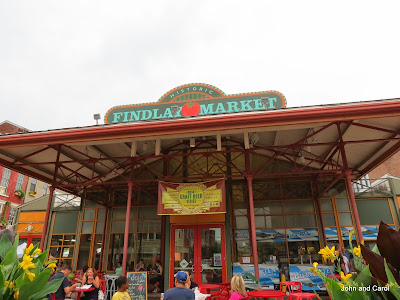
Yesterday, we checked out the Findlay Market, Ohio's oldest continuing operating public market and the location of a weekend farmers' market during the summer.


Both inside and outside, the aisles were crowded with shoppers.


We immediately came on a long line at the Blue Oven bread stall. We decided the bread must be good, so we got in line and bought a loaf of spelt bread. We will eat it with our meal this evening, so I don't know if it is really good or not.


Markets like this always bring out some interesting people.


There was lots of good looking, local produce, as well as seafood and beef--including ox tails. I wonder what you do with them?


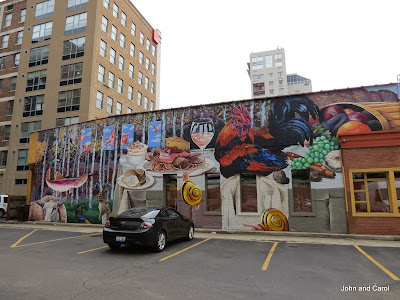
Along the street across from the market, the empty buildings were at least made pretty on the outside.


A couple of blocks away, it wasn't as nice.


We did see a community garden in the neighborhood.


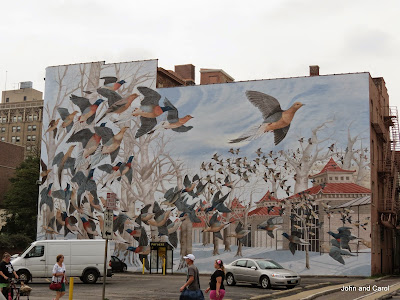
The neighborhood around the market was the only place in Cincinnati that wasn't really, really nice. Our GPS takes us on the fastest route, supposedly, and it took us through a number of residential neighborhoods during the past few days. The old houses, mainly built of brick, are well-maintained and beautiful. There are numerous parks and woods. Cincinnati is very hilly and large areas of forest are maintained for public use. On all our drives, we only saw one small piece of tagging.  Many cities, Denver and Phoenix included, can't say that.  Downtown, near the main library, we saw some really nice old buildings and murals.


This is at the entry to the library.


This is the Cincinnati City Hall.


The Roman Catholic Cathedral of Saint Peter in Chains is an impressive building.


So is the Plum Street Jewish Temple.


Friday, June 27, 2014

And Now, For Something Really Different

This blog post will be of the most interest to our family. And before you read it, you need to understand that we used to own a funeral home; John grew up in a funeral home; his dad, his brother and he were all funeral directors; the family used to own two cemeteries.

Today we drove to the Spring Grove Cemetery in Cincinnati to visit the graves of John's great-great-great grandfather. More about that in another blog. We have been in many cemeteries over the years and this is the most beautiful one we have ever seen.

Our first stop was in the cemetery office. As we approached the front door, a woman walked out and said, "I've never seen a cemetery with a visitor center!" We went and asked for directions to the grave we wanted to visit.  David Simon, family service advisor, said "I can help you."  He asked us to have a seat, gave us a map to find the grave, and graciously gave us much more information than we had expected.

From Spring Grove

We were given a sheet of information on the iconography used in cemeteries. He also gave us a list of revolutionary soldiers and Civil War generals that are buried there. He directed us to the Cedars of Lebanon Chapel and Mausoleum, which has 33 magnificent stained and faceted windows. Here are just a few.

From Spring Grove

From Spring Grove

From Spring Grove

From Spring Grove

The mausoleum also has several sections of crypts for urns holding cremated remains. We had seen such crypts with marble or brass fronts. These were all glass and the urns inside were beautiful and allowed families to reflect a little of the person who has died.

From Spring Grove

From Spring Grove

From Spring Grove

From Spring Grove

The cemetery grounds are also lovely. Spring Grove was dedicated on August 28, 1845. Members of the Cincinnati Horticultural Society formed a cemetery association to provide proper interment facilities for the city. Today, it is named Spring Grove Cemetery & Arboretum. The public is invited to not only visit the graves there, but also to enjoy the peace and beauty, to learn about the trees and plants growing there, and to use the roads for walking and running.

From Spring Grove


From Spring Grove

From Spring Grove

The gravestones are beautiful sculptures and monuments, works of art on their own.
From Spring Grove

From Spring Grove

From Spring Grove

The weather today was hot and as we were walking around the grounds, the security guard who patrols the cemetery stopped and gave us each an ice cold bottle of water.

We came away impressed with the beauty of the place, with the work they go to maintain the grounds for families whose loved ones are there, and how friendly and helpful and caring the staff are.  We admired and appreciated all that Spring Grove is.

If you want to see all the photos we took in the cemetery, you can access the online album here.