For the past couple of months or so, we have been visiting libraries, cemeteries and museums. Much of the history we have been exploring concerns the Civil War, early pioneers in what was once considered the "west" and slavery. Both John and I have always enjoyed history, but why this focus? It's all about family, especially John's ancestors.
From 1865 to 1934, a former slave and Civil War veteran, Benjamin Franklin Robinson, shared his life with members of John's family. He was known as Uncle Ben. Uncle was a term of respect after Civil War by whites for African Americans they valued. (We learned this fact while touring the Andrew Jackson estate near Nashville, TN.) This summer, we visited the Civil War battlefield at Franklin, Tennessee. In 1864, Uncle Ben was a teamster in the Colored Troops at that battle. History has a lot more meaning when you know, or know of, someone who was present during some historic event.
Uncle Ben first came to the Gans-Andrews family in 1865 in Olathe, Kansas. William Gans was John's great-great grandfather. The family story is that he came to the home and asked if he could work for the family in return for a meal and a place to sleep for the night. Over the years, we had wondered why he came to William Gans' home and why he was in Kansas. In our research over the past few years, we have learned that Uncle Ben had enlisted in the Union Army in Kansas. We also learned that William Gans, a minister in the christian Church, moved to Kansas in 1858 in the movement to assure that Kansas was admitted as a free state, not a slave state. This was part of the result of the 1854 Kansas-Nebraska Act. We wonder if Gans was a part of the Underground Railroad. Because of all of this family history, we have been interested in museums that concern slavery and the Underground Railroad, as well as Civil War sites.
We know Uncle Ben had been a slave. We don't know how he received his freedom. Did he escape? Did he buy his freedom? In one museum we visited this summer, we learned that Union troops freed slaves when they occupied Southern areas. The slaves were considered "contraband" property and immediately given their freedom. So, we have even more options to consider regarding how he became free.
In Tennessee, we visited the Shiloh Battlefield National Historic Park. Since then, we have been reading a series of books by Phillip Bryant about soldiers from both sides that fought in that battle. A few weeks later, we found that one distant relative had fought and died at Shiloh.
In 1905, another of John's great-great grandfathers, Ray W. Andrews, died in the Old Soldiers and Sailor's Home (now known as a VA hospital) in Leavenworth, Kansas. He had been wounded in the Battle of Pea Ridge. His application for a VA pension states that he was wounded by shrapnel in the Battle of Pea Ridge in Missouri. Several years ago, we visited that battlefield. In our travels this year, we stayed at an RV park in Parker's Crossroads, TN. We toured a battlefield there, where we learned that the dried wood of the split-rail fences often shattered when hit by artillery shells. The shrapnel from that wood caused many serious wounds. Was Ray W. Andrews, John's ancestor, injured by wooden fence shrapnel? We will probably never know.
During one museum visit, we learned that Abraham Lincoln received so many death threats after his election in 1860 that a private group of soldiers accompanied him on his journey to Washington, D.C. for inauguration. They also stayed in the White House to protect him for some time. This all fit in with another aspect of William Gans' history. We had learned that Mrs. James Lane moved from Indiana to Kansas with the Gans family in 1858. Her husband, General Lane, was a part of the militia that fought to make Kansas a free state. He had served in the Indiana legislature and as a US senator from Indiana before moving to Kansas. He and some members of the militia were the soldiers protecting Lincoln in 1861.
We have also learned about the early settlers in Ohio during our travel this summer. Ohio became a state in 1803. In 1787, the Northwest Ordinance had created the Northwest Territory, allowing Americans to settle the area northwest of the Ohio River, land that had previously been a part of Quebec, Canada. John's great-great-great grandfather came to Ohio in the year it became a state. We found Daniel's grave in the Spring Grove Cemetery in Cincinnati. Daniel's son William, born after the family came to Ohio, married a woman in Indiana. When she died, he returned to Indiana where his brother John was living, and met and married his second wife there, as well. Traveling to Indiana, we found marriage records, cemetery records and graves of that part of the family. Sometimes the best research must be done in the locations where ancestors lived. Many members of the same family tend to live and die and be buried together. Looking at the graves often fills in blanks that were left on the internet, like who some members married. "Unknown" dates of death can be filled in.
During our time in Shipshewana, Indiana, we visited the Menno-Hof Museum, where we learned the history of the Mennonite and Amish people. They left Germany because of persecution of all those who refused to be a part of the established state church. The Brethern was another group that fled that persecution and their beliefs are/were similar. That gave us more insight into the Gans family. These groups also were anti-slavery. George Gans, John's great-great-great-great grandfather, came to Pennsylvania from Germany with The Brethren. His son Daniel settled in Ohio in 1803; his son William moved to Kansas to help assure it would become a state that did not allow slavery. All of this research on family, Civil War and slavery is interrelated. Our travels, our research, our seemingly unrelated museum visits, all helped us understand more.
While staying outside Columbus, Ohio, we visited a number of cemeteries. One helped us to appreciate how things had changed since John's early ancestors had lived there. In 1830 and 1831 a great-great grandfather and great-great grandmother, Amasa and Polly Wiswell, were buried in the Kempton Cemetery. Seven years later, a great grandfather, Amasa Wiswell Jr., was also buried there. Since Ohio only became part of the US in 1787 and became a state in 1803, it couldn't have been very heavily populated in the 1830s. Today, the tiny cemetery (it is only about 1/4 of a city block square) is surrounded by a busy road and a condominium complex. Columbus is a major metropolitan area. Very few of the gravestones in the Kempton Cemetery are even legible. Marble deteriorates quickly. We had to rely on internet research to know the family member graves were there. It was sad, while at the same time, an emotional experience to make the visit.

Showing posts with label cemetery.. Show all posts
Showing posts with label cemetery.. Show all posts
Sunday, July 27, 2014

Thursday, August 08, 2013
Learning About Ancestors' Lives
Since Mueller State Park is so close to where my mother and grandparents lived (John and Kylie's great grandmother and great-great grandparents), we wanted them to learn a little about that part of their history. My grandfather and uncle had both been miners in Victor and Cripple Creek, so we took them on a tour of the Mollie Kathleen Gold Mine.


We went down 1,000 feet into the mountain in a metal cage. That was after we all donned helmets and Kylie put on one of the mine's canvas jackets. (She said it was very warm. That was good because she was wearing short shorts.)
Our guide Chico, who obviously has worked in the mines, led us through the tunnels on level 10 and explained the evolution of drills and other details of underground mining for gold. As we walked through the tunnels, we went in single file, staying between the rails that ore carts used to travel on.


All of us were really interested in the tour and the life of the miners. The Molly Kathleen was in operation from 1891 to 1961. (Four years after the mine closed, in 1965, John and I toured the mine on our honeymoon. The tour today is much, much better than that early one.) I am glad I don't have to work 10- to 12-hour shifts undergound in the wet and cold, hefting heavy drills and hammers and shovels and surrounded by the loud noise of drills and blasting.
The job that looked the worst was to climb up this long ladder and spend the day sitting on a board that bridged an opening, all the while drilling and digging overhead. The miner stayed up there his entire shift. And no miner dared complain. There was always someone waiting to take his job if he expressed any dissatisfaction. Double click on the photos to get a better view.


When we were back above ground, we had some lunch at the diner on the mine grounds. The food was surprisingly good. John I and Kylie had burgers, John II had grilled cheese and I had fish and chips. Everything was tasty.
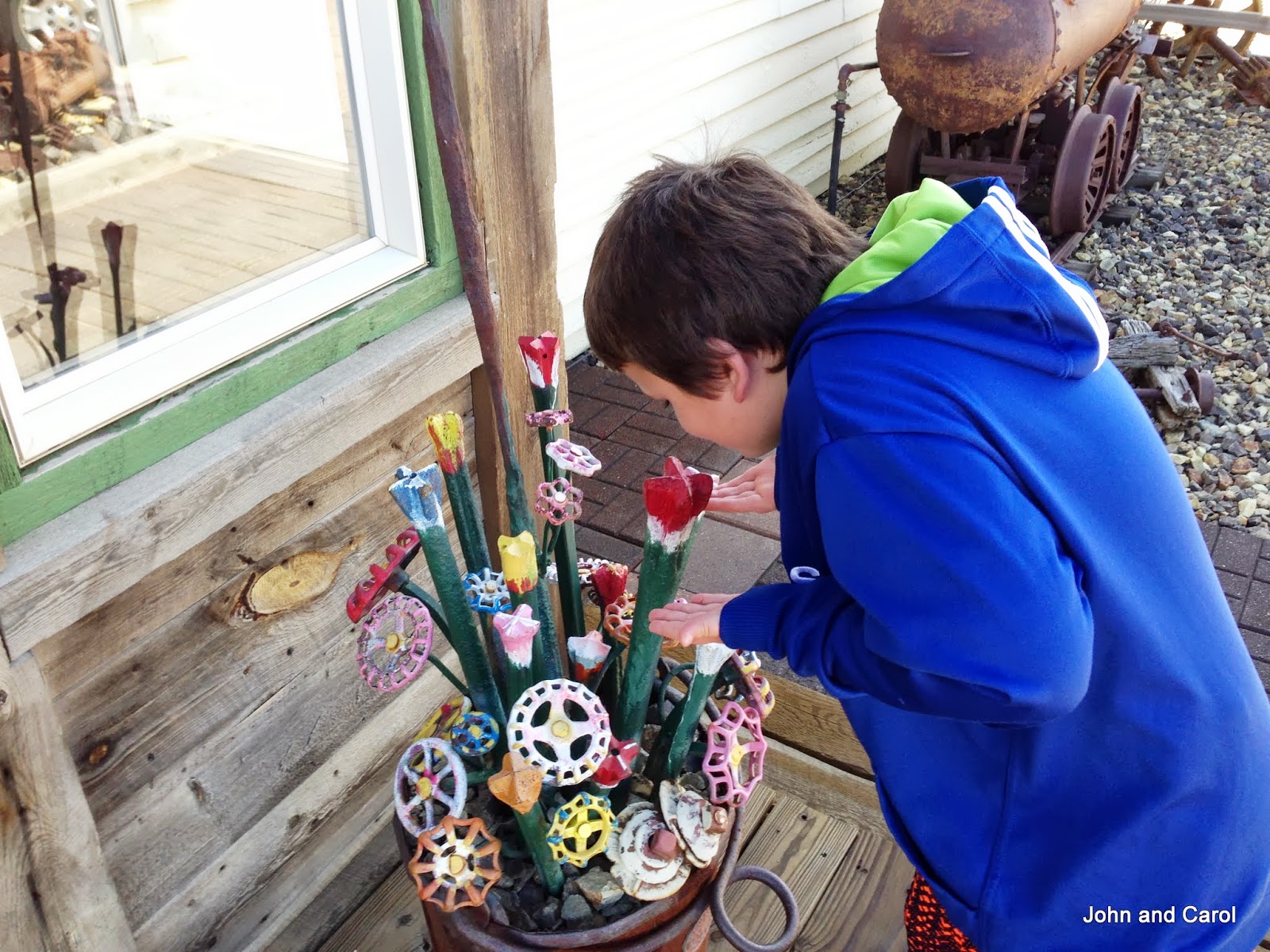
John II had to smell these flowers outside the gift shop.

Both Kylie and John thought about getting miners' helmets with lights.


Next we took a ride on the Cripple Creek and Victor Railroad. When mining was at its peak, numerous trains a day came and went between the towns of the mining district, carrying passengers and shipping gold ore to mills, both in the district and in Colorado Springs and other places. This tourist train is all that is left of all the infrastructure.

The train's engineer also worked as the fireman, shoveling coal into the fire box, and as our tour guide, narrating our trip.

After the train ride, we showed Kylie and John where their great grandmother attended high school and took them to see where their great-great grandfather is buried, in the Elk's plot in Victor's Sunnyside Cemtery.


Monday evening was the only dry night of their visit, so dessert had to be smores over the campfire, didn't it? We had such a good time sitting around the fire and talking to Kylie and John. They are really growing up and becoming wonderfully interesting people to be with.


We went down 1,000 feet into the mountain in a metal cage. That was after we all donned helmets and Kylie put on one of the mine's canvas jackets. (She said it was very warm. That was good because she was wearing short shorts.)
Our guide Chico, who obviously has worked in the mines, led us through the tunnels on level 10 and explained the evolution of drills and other details of underground mining for gold. As we walked through the tunnels, we went in single file, staying between the rails that ore carts used to travel on.


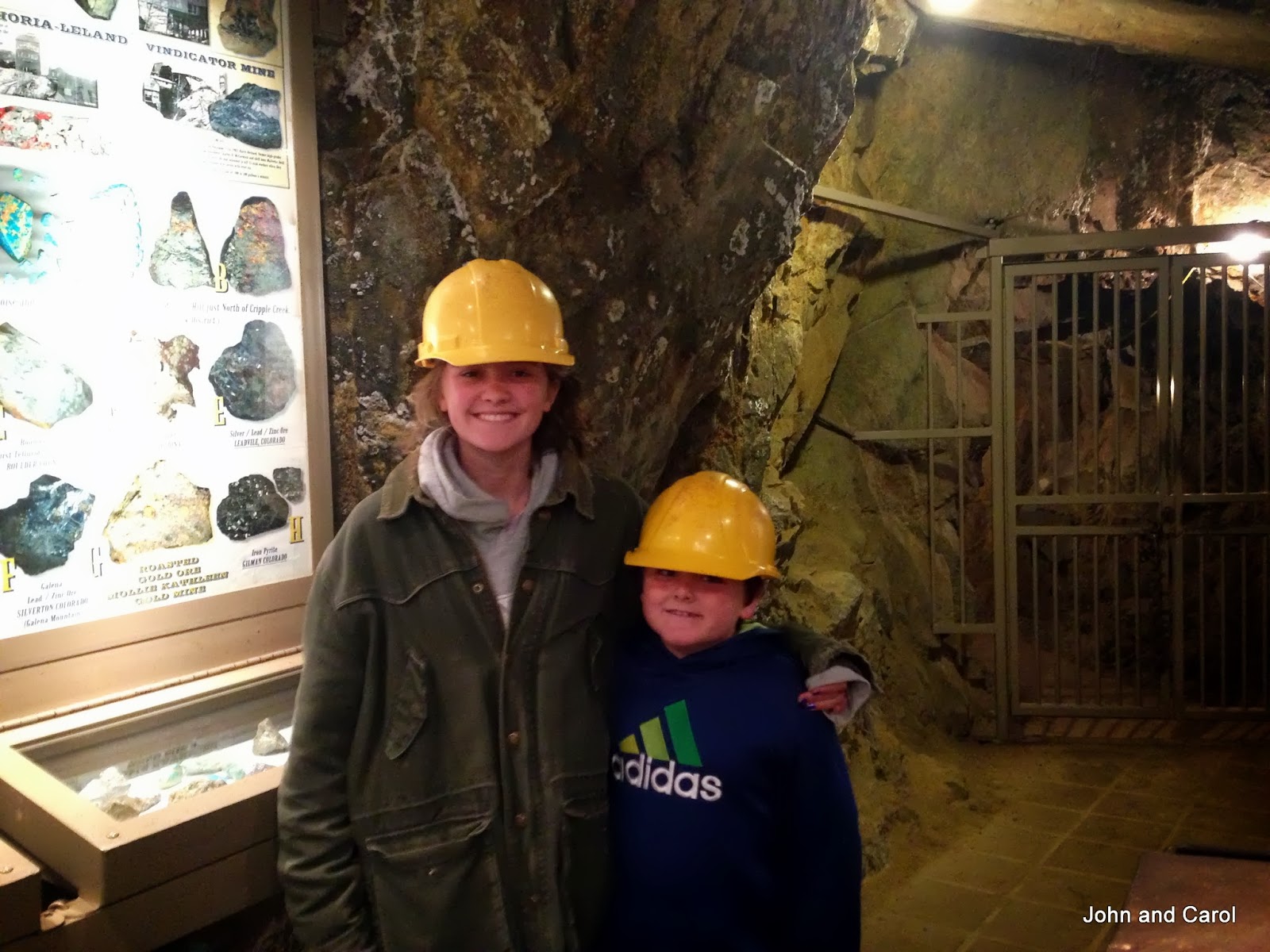
All of us were really interested in the tour and the life of the miners. The Molly Kathleen was in operation from 1891 to 1961. (Four years after the mine closed, in 1965, John and I toured the mine on our honeymoon. The tour today is much, much better than that early one.) I am glad I don't have to work 10- to 12-hour shifts undergound in the wet and cold, hefting heavy drills and hammers and shovels and surrounded by the loud noise of drills and blasting.
The job that looked the worst was to climb up this long ladder and spend the day sitting on a board that bridged an opening, all the while drilling and digging overhead. The miner stayed up there his entire shift. And no miner dared complain. There was always someone waiting to take his job if he expressed any dissatisfaction. Double click on the photos to get a better view.


When we were back above ground, we had some lunch at the diner on the mine grounds. The food was surprisingly good. John I and Kylie had burgers, John II had grilled cheese and I had fish and chips. Everything was tasty.
John II had to smell these flowers outside the gift shop.
Both Kylie and John thought about getting miners' helmets with lights.


Next we took a ride on the Cripple Creek and Victor Railroad. When mining was at its peak, numerous trains a day came and went between the towns of the mining district, carrying passengers and shipping gold ore to mills, both in the district and in Colorado Springs and other places. This tourist train is all that is left of all the infrastructure.

The train's engineer also worked as the fireman, shoveling coal into the fire box, and as our tour guide, narrating our trip.

After the train ride, we showed Kylie and John where their great grandmother attended high school and took them to see where their great-great grandfather is buried, in the Elk's plot in Victor's Sunnyside Cemtery.


Monday evening was the only dry night of their visit, so dessert had to be smores over the campfire, didn't it? We had such a good time sitting around the fire and talking to Kylie and John. They are really growing up and becoming wonderfully interesting people to be with.

Subscribe to:
Posts (Atom)