Sunday, May 15, 2011

Pecos Pueblo

RV campgrounds are great places for people watching and vehicle watching. Don't you wonder who chose what this little girl was wearing this day?


When we saw this tractor with its sleeper area, jeep and bicycles, we thought they were really minimalist, even if they had lots of towing power.


However, this morning, when they pulled out of the campground, they were pulling a very long 5th wheel trailer. So now we wonder why they used the big motor to do their sight-seeing. They must not want to leave anything when they go on the road!

Pecos National Historical Park is just a little east of where we are staying right now in Santa Fe. We seemed to remember we had visited there before but couldn't find a stamp for the park in our National Parks Passport. This shows what is left of the second mission church constructed near the Pecos Pueblo. It was built in the early 1700s.


The church had a large Convento, buildings to house the priests and provide space for workshops, corrals, stables, kitchen, gardens and dining room. Here the priest taught Indians new ways of building, carpentry and caring for livestock. The first mission church was even larger and build in the early 1600s. It was destroyed in 1680 during a Pueblo Revolt across New Mexico that drove the Spanish, both priests and soldiers, back to Mexico for a period of time.


This low stone wall surrounded the grounds of the 5-story high Pueblo, housing perhaps 2,000 people. The pueblo was constructed during the 1300s and early 1400s. The wall would not have provided protection, but it did delineate the area reserved for pueblo residents from the surrounding plain where trade was carried on with Plains Indians. The trade was welcomed and possibly carried out closer to the pueblo, but the traders had to spend the night outside the stone wall.


At least 20 underground Kivas have been found near the pueblo. They were not all in use at one time. Different clans and societies carried out various ceremonies, each in their own Kiva.


This is a view through the front into the church. With all the religious ties represented by the Kivas, it is no wonder the Franciscan friars had a hard time winning the hearts and minds of the pueblo residents.


The pattern of adobe brick construction you can see here shows the sophistication of building techniques the Spanish priests taught the Indians.


This cobblestone floor most likely shows where the kitchen of this 1600s farm house was located. The stones allowed water to run off.


This shows more rooms in the same building.


The Historic Site certainly helps illustrate the interaction of several Native American groups with each other and with the Spanish.

By the way, we had been there before, but we learned a whole lot more this time.

Friday, May 13, 2011

A Frustrating Time

For more than 15 years I have worn a pedometer almost every day, aiming to take 10,000 steps a day. The first goal was to keep active and maybe lose some weight. Then, nine years ago I lost 35 pounds that I had gained after quitting smoking. The 10,000 steps a day helped keep it off. I enjoy being this active.

That has made the past few days very frustrating. Monday my right knee started to bother me. I have no idea what I did. Perhaps I over extended my knee. By the end of the day Tuesday, when I had put on 11,641 steps, the knee hurt every time I put weight on that leg. Something needed to be done. And that something was to rest. Wednesday, I wrapped the knee with an ace bandage and spent the entire day inside the trailer, reading and surfing the internet and updating our finances. I only logged 734 steps that day! And usually a day with 6,000 or 7,000 steps disappoints me.

By Thursday, there was some improvement, even though I walked 4,036 steps. Today, I have hit 5,400 steps. The knee is still wrapped when I am out and about, but it is improving. But I need to be patient for a few more days before I resume my regular routines.

Wednesday, May 11, 2011

Lots of This and That

Monday, while our RV was in the shop, we made our second visit to the Tinkertown Museum. We had been there years ago. It contains a marvelous collection of miniatures, paintings, old things and sculptures made and acquired by Ross Ward.


But before I show you the museum, as a proper RV blogger, I need to report that we have gone out for lunch twice during a stay in Albuquerque. One day we went to Garduno's Mexican Restaurant and enjoyed our meal. After our visit to Tinkertown, we picked up a bite and Burgers-N-More and had a passable lunch.

Since John and I have built and decorated three dollhouses for our granddaughters and one small wall house for ourselves, we are fascinated by what Ross has built. This is a country store.


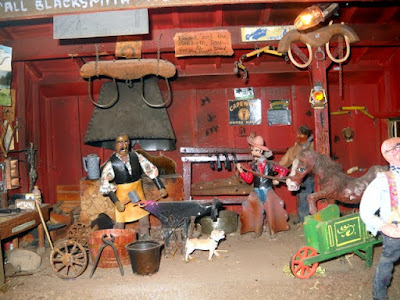
A blacksmith shop.


One of numerous sayings and quotations mounted on the walls.


I wonder if this is a shotgun wedding?


Ross painted scenery for the circus and county and state fair entertainment booths for many years. The love of the circus carried over into a large part of the museum.


This old sea captain is the masthead on the sailboat "Theodora R," which was retired to the museum. It had been sailed for 10 years by Ross's brother-in-law, Fritz Damler.


This display is part of the exhibit about the boat and the large white headline voices our own experience, traveling the country in an RV.


Here is a slideshow of some more of the exhibits in the museum.


A number of the miniatures are animated. Just look at the detail and delightful movement of these figures. Doesn't it remind you of department store windows at Christmas--years ago?

Etched in Stone

One of the attractions we have visited here in Albuquerque is Petroglyph National Monument. The 17-mile-long West Mesa, a volcanic lava flow from 150,000 years ago, contains over 20,000 images pecked in stone.


Archaeologists estimate that most of the images were made 400 to 700 years ago by the ancestors of today's Native people. Some may be 2,000 to 3,000 years old. Others were made during the 1600s by the heirs of the Atrisco Land Grant. Other explorers and ranchers left their names and dates in the 1800s and 1900s. We hiked the 2.5 mile round-trip trail through Rinconada Canyon.

This is one of the more recent stone images.


My guess is, these are some of the oldest stone pictures.


The Monument brochure indicates that chipped images like these were probably done in the 1600s or later.


This looks like a drawing of a space alien--but I don't know how old it is.


We couldn't figure out these petroglyphs, either.


Is this Sponge Bob Square Pants?

Tuesday, May 10, 2011

Whole Again

This is what John had to do yesterday so we could put the RV on the truck and drive to Aloha RV to have new front landing gear installed. Every time we tried to raise the RV, using the power front stabilizers, we blew a fuse and the motor stopped working. So the hand crank was necessary. Do you have any idea how heavy a 36-foot trailer is?


The RV was at Aloha all day, from about 8:20 am to 3:45 pm. John had to hand crank the RV up so we could pull the truck away when we go there. But when it was time to head home, our new Ultra-Fab 5th Wheel Levelers did the job and we easily raised the RV, backed up the truck, and hooked up. And we were on the way.

The drive back to our RV park was very nervous. The entire state of New Mexico was under a high wind warning from noon to 8 pm and we were facing wind gusts up to 60 mph. We were so relieved when we got off the highway!

These levelers have a motor on each leg and a button to operate each one. They worked great yesterday and we had read of others who had the same product installed and love it. We hope we do, too.

We were really impressed with Aloha RV. When they learned we were just traveling through, they got us in for service as soon as the parts arrived, though they were booked for two weeks. Everyone there was friendly and helpful, especially Mark in Service. THANKS.

Friday, May 06, 2011

Fun While Waiting

If you have to wait a week to have your RV repaired, American RV in Albuquerque isn't a bad place, at all, to wait. We have some nice shade trees next to our site.


If the park was full, we would have neighbors pretty close, but even then, we still would have a nice private patio.


One day Das Rollende Hotel spent the night in the park. We first saw this company when we were in Alaska. I don't know if all of the people who take these tours are from Germany, but this group was. There were 22 tourists, a bus driver and a guide. The tour provides breakfast and dinner and they go to restaurants for lunch.


They ride in the front of the bus and the rear provides sleeping space. It is kind of like a youth hostel on wheels, but this group was older people. They had been to Zion and Arches National Parks in Utah, and Taos. The morning they left here, they were headed to the Petrified Forest in Arizona, then on to the Grand Canyon. The whole trip lasts three weeks. Here you can see the clean-up after dinner.


Albuquerque is full of people who enjoy outdoor activities. Today we rode our bikes on the Paseo del Bosque trail along the Rio Grande River through the middle of town. It is 16 miles long, but we didn't ride the whole thing. We were impressed with the number of people biking, walking and jogging on the trail.


We eventually pulled off to a shaded bench near the Rio Grande River State Park so we could have lunch.


We saw these jetty jacks. Around 1950 they began putting these along the Rio Grande, especially in the city, to prevent debris from floods from being deposited too far from the river channel. Since a dam was built upstream, they are no longer necessary and there is apparently quite a debate in town about whether or not they should be removed.


We made a quick visit to the nature center, where we saw these turtles and a hummingbird feeder. The birds flew away when we took this photo.


When we returned to where our truck was parked, we realized we were next to the Botanic Gardens. Visitors there can also ride a train to the nearby zoo. There are two trains with cute steam engines.


There are some very attractive sculptures around the zoo parking lot.


Last, here is a picture of the cottonwood bosque along the Rio Grande. Bosque means forest.

Wednesday, May 04, 2011

Not What We Planned

Tuesday we planned to move from the Lions Beach Campground at Elephant Butte Lake State Park to the South Monticello Campground there. That is, before this happened.


That is something you don't want to see happen on a travel day. John is replacing a fuse on the front landing gear of our RV. After over and hour of struggling with it, then getting ideas from the campground host for who to call, then making some calls, we finally managed to get the trailer onto our truck and decided to drive north to Albuquerque, where there is a Camping World and Aloha RV, which sells Montana trailers.

As we were getting diesel for our truck at the Diamond Shamrock in Elephant Butte, we think we saw a couple drive by who we have gotten to know through our RV blogs. We knew they, too, were headed to South Monticello and thought we might get to say "Hi!" But that was not to be.

More about our RV repairs later. We did have fun while staying at Elephant Butte. Monday, we tried to visit the El Camino Real International Heritage Center. The El Camino Real de Tierra Adentro (Royal Road of the Interior Land) was a route between Mexico City and Santa Fe, NM, beginning in the 1500s. Unfortunately, the New Mexico State Monument is closed on Mondays and Tuesdays, so you will have to learn about the road here.

I did get a photo of the sculpture at the monument entrance.


Instead, we visited Fort Craig, a National Historic Site managed by the Bureau of Land Management. The fort was established in 1854 to help protect farmers and ranchers who came to settle in the lands newly acquired through the Gadsden Purchase. The fort was active in helping fight the Indian wars with the Apaches and Navajos until 1885, when Apache leaders Nana and Geronimo surrendered.

Since the fort was built largely of adobe bricks, not much remains. In some places they did use local stone, including at this sally port (entry) of the fort.


Less than a decade after the fort was built, the American Civil War began and in 1861 Confederate troops invaded New Mexico from Texas. They hoped to seize the gold fields in Colorado and other western states, as well as a west coast seaport.

Soldiers at Fort Craig were quickly put to work building earthworks to protect the fort. On February 21, 1862, the two sides fought at Valverde Crossing at the base of the mesa you can see in the background behind the earthwork ruins.


This interesting reconstruction of an 1850s military fort flag pole stands in front of the remote landscape where U.S. soldiers served.


In addition to exploring the fort, we met volunteers who work for the BLM. This is Jan. She and her husband are here for seven months, I think.


Jan and Art work five days on, two off, and are on call 24 hours a day. But, since the fort doesn't have many visitors--only three had left their names the day before--they said they had lots of time to catch up on their reading.

Their living arrangement is a dream for all those who enjoy the New Mexico landscape. Here you can see the visitor center and their RV and its surrounding yard.


RVers who want to volunteer during their travels have so many different opportunities. This is one of them.