Sunday, August 16, 2009

Crow Indian Fair

7th Ranch RV Camp is located within the Crow Indian Reservation in south central Montana. The Crow are allow to sell their land to outsiders and some time ago the Enemy Hunter family sold their land. Eventually Chip and Sandy Watts bought the land to ranch, then later developed the RV park.

The 91st Annual Crow Fair is being held August 13-17, featuring daily parades, rodeos, dancing contests, Pow Wows, and other competitions. Indians from throughout North and South America attend.

The Crow traditionally build the largest tipis (teepees) around and some of them still use them when traveling. The Crow Fair is the largest assembly of tipis in the country. As we drive around the surrounding area we often see piles of tipi poles leaning against ranch buildings or fences. Many who come to the fair bring their tipis, while others bring tents or trailers or stay in motels.

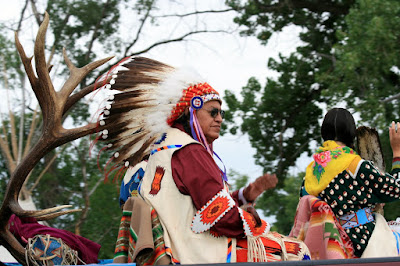
Crow women historically decorated their clothing with elk teeth. Today they may use the real teeth or manufactured replicas. We saw lots of evidence of that at the parade we attended Saturday. I can't tell you a lot about what we saw except it was a riot of color and very interesting.

Here are a few of the approximately 200 photos we took. Enjoy.

This little girl looks so proud, wearing her traditional clothes and sitting on a full-sized horse. The horse is being led by her mother. We saw many young children in the parade, with parents leading the horse.


Here is mom leading a horse with two young children on the Paint. I think the Paint horses are my favorite. We understand the Indians feel the same way. This young Indian boy chose a motorcycle over a horse. What is the world coming to?

Isn't his young Indian maiden in her traditional clothes, tiara and huge sunglasses about the sweetest thing you have seen? Here is another example of mother and child. There is a real emphasis on teaching the traditions to the children here.

Both young and old women were riding on this float.

Notice the saddle on the roof of the truck. And don't you wonder how the driver sees to navigate the parade route? Many of the trucks were covered with blankets, scarves, emroidered and beaded pieces.


Here is one group of tipis.


This Crow Indian was wearing his feather headdress and many fine beaded items.


Tuesday, August 11, 2009

Big Horn Mountains

Yesterday we left the wheat fields of Montana to visit the Big Horn Mountains in northern Wyoming. It was only about an hour's drive to US Higway 14, which goes up into the mountains. The steep climb from 3400 ft to 8000 ft was beautiful, with many interesting sights. Signs along the way point out the geological formations and the dates the rocks were formed. We were sorry our son Eric, the middle school science teacher, wasn't along for the ride.

The Fallen City is one of the features we saw. This boulder field looks something like its name.
US 14 is being straightened and widended. So the next few miles took us another hour, till we reached the US Forest Service Visitor's Center at Burgess Junction. After we bought some books, we walked a 0.6 mile trail with some good views of the area. Twin Buttes is one of the most obvious landmarks around.
We were delighted to see this marmot on the rocks. At least we think it is a marmot. It doesn't look like any of the marmots in my National Audubon Society Field Guide to Mammals.
These two small butterflies were also a delight.

This wind generator behind the Visitor Center produces 1000 watts of power. To an RVer, that is pretty good. We also saw our first solar-powered trash compacter. Isn't that amazing? After gathering some information about nearby hiking trails, we drove off. Just a little ways down the road, several cars and trucks were pulled to the side and their occupants were pointing cameras into the trees next to the road. Of course, we joined them. I was so grateful for my new long camera lens when we spotted this moose! What a treat.
We took a short hike around Sibley Lake. The anglers were having good luck and the duck families were a delight to watch. Is this a female Mallard Duck? If not, then what is it?

On the back side of the lake, it was peaceful and we saw some pretty reflections.

Friday, August 07, 2009

Harvest Time

It is wheat harvest time in eastern Montana. We have spent most of our lives on the Front Range and in the mountains of Colorado, so we are much more familiar with the process of cutting hay than that of harvesting wheat.
There is a large wheat field that can only be accessed by driving through 7th Ranch RV Camp. Three times a week we run up and down the road to that field. So we were very interested when we learned that the harvesters would be driving through the RV park to do their work.
Last Sunday, soon after the cattle roundup was completed, we saw the harvesting equipment drive in. To us, it seemed like an awful lot of equipment for what appeared to be a small field.
On Monday and Tuesday mornings, the harvest crew drove in at about 8 am. On Wednesday we saw part of the equipment being driven out. A number of large grain trucks had been filled with wheat. Later that day, John and I talked to a man (we guess he owns the wheat field) and he said they harvested 71,000 bushes of wheat up there.
On Thursday we watched several large flat-bed trucks drive up to the field, then return with huge round bales of straw.
According to the Big Horn County News on July 30, “Dryland wheat harvest is in full swing with winter wheat doing well, Scott Schubert (of Big Horn Ag Services) said. ‘We’re coming in at anywhere from 40 to 70 bushels per acre with the average being about 50-60 bushels per acre.’…According to the United States Department of Agriculture, Big Horn County has about 134,000 acres of wheat being grown.” This story would indicate that nearby field we saw being harvested was somewhere between 1000 and 1775 acres.
Being city-slickers, we don’t know much about wheat and straw. For those of you who are like us, I include the following question and answer I found on the internet.
Dear Twig: What’s the difference between hay and straw?
Hey, good question. Often the words “hay” and “straw” are used interchangeably. But hay and straw aren’t the same thing. If you’re a farmer, a horse or a cow, the difference is especially important.
To explain: Hay is made out of grasses and legumes (plants like clover and alfalfa). Farmers grow these plants in fields; cut the plants down a couple times a summer; dry them out; then roll, wrap or cram them into bales. (Imagine mowing a really tall lawn then rolling the clippings into a really big Ding Dong.) Hay is full of nutrients, and farmers feed it to their livestock.
Straw, on the other hand, is made of the leftover stalks of plants like oats and wheat and barley. The hollow stalks are left behind when the seeds of the plants are harvested. The stalks are cut and dried and baled. The result, voila, is straw. Straw has fewer nutrients than hay but is light and warm and absorbent. It’s best for livestock bedding, not food.
There you are, fellow city-slickers. We all learned something this week.

Wednesday, August 05, 2009

Big Man Strays

Big Man, a Mexican bull, spends part of his summer in a field at 7th Ranch. He lives there with a small herd of Mexican cows. Apparently on Sunday Big Man was bored with his own herd of cows. When he spotted a group of attractive Black Angus ladies, he went through or over or under the fence to join the other herd.

That didn’t please Chip, owner of 7th Ranch. So he and Ron saddled up their horses, deciding to move the whole bunch of cattle—Big Man and the Black Angus ladies—down to the parking lot, then into the corral, where Big Man could be separated and held. That meant opening a gate to let the herd out of their pasture, driving them down a hill to an opening in the fence around the parking lot, persuading them to cross the parking lot and move into the corral. Since the parking lot has several avenues of escape, a number of vehicles were moved in to close the gaps.

Last year we watched a cattle roundup while we were volunteering at White River Wildlife Area in Oregon. There we watched at least five or six people on horseback yell, wave their hats and charge their horses to move the cows. Chip and Ron took a very different approach. They moved slowly, talked softly. I heard Chip say, “Come on ladies. There’s the gate. Go through it.” “It’s OK. You can go right there.” Ron said, “Go, cows.”

It didn’t take too long to get all the animals into the corral. Next, Chip and Ron moved Big Man and a couple of the Black Angus toward a pen. The next task was to get the cows and calf out and leave just Big Man. Finally, he was penned in alone.

Next, they herded the cows and calves out of the corral, back across the parking lot and up the hill to their own field. It didn’t take the cows long to realize where they were headed. They were happy to be back home.

Later in the afternoon Big Man was loaded in a trailer and taken to another rancher’s field. He should have been content to stay with his own ladies, rather than having a roaming eye. He wouldn’t have had to go through the trailer trip so soon, if he had been a good boy.

I have put photos of the cattle drive into a slide show, so you can see how everything went.


Saturday, August 01, 2009

Birds at 7th Ranch


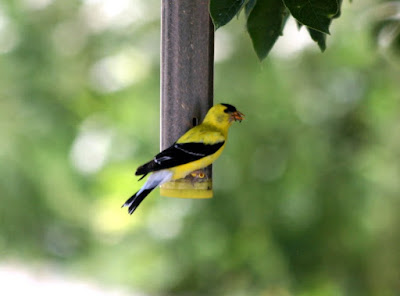
I used to think American Goldfinches were unusual. That was before we came to southeast Montana. They are everywhere! Sunflowers are blooming throughout 7th Ranch RV Camp and the Goldfinches feast on the sunflower seeds.


At the office, we have four feeders filled (and filled and filled) with thistle seed. The Goldfinches particularly enjoy eating at these. Filling the feeders is one of the responsibilities of whoever is staffing the office. Two feeders are filled with black oil sunflower seeds. They attract the Goldfinches, Western Meadowlarks, and Black-headed Grosbeaks. There are other birds feeding there, as well, but they are so shy I haven't been able to identify them, much less get a picture.


A birdhouse on one of our fence posts here houses a family of Barn Swallows.


A pair of Mourning Doves also lives nearby. Sometimes they visit the sunflower seed feeder.


Monday, July 27, 2009

We've Arrived in Montana

We have arrived at 7th Ranch RV Camp in Garryown, Montana, where we will be workampers until mid-October. Early last winter we posted our resume at Workamper.com and received a call asking if we would be interested in working here. At that time we had completed seven volunteer assignments in state and national parks and state fish and wildlife facilities. This is our first experience in a commercial RV park. We have spent very little time in Montana and are looking forward to learning more about the state.

We are one of four couples here right now. They had planned on having eight couples and we had expected that we would work two days on, then have four or five days off. Four of the couples were unable to be here, one couple left this week and another will leave the middle of next month. That means we will be working two or three days on, two to five off. Our first week we worked five days straight--three shorter days training and two full days.

My job is in the office—taking reservations, checking in campers, answering the phone, watering the flowers and grass around the office. I work from 8 am to 3 pm. John works from 7 am to 3 pm, hauling trash, cleaning restrooms and doing grounds maintenance, such as fertilizing and spraying for weeds and grasshoppers. When new campers come in during our shift, I call John on the radio and he escorts the party to their site. The park has 65 RV spaces, 17 tent spaces, four camper cabins and one teepee. The grounds are very well landscaped and well kept. And it takes a lot of work to keep everything clean and looking good. John works very, very hard during his eight hours. The temperature has been in the high 80s and 90s, hitting 100 a couple of days.

Chip and Sandy, the owners, are really great to work for and with. They go out of their way trying to make their workers feel at home, valued and comfortable. They developed 7th Ranch RV Camp on their ranch, replacing most of their cattle with travelers. The RV park is in the Little Big Horn River valley, which has lush green trees and fields along the river bottom. The surrounding rolling hills have fields of wheat, oats and hay that we have identified so far. It is pretty country.

We may have more social life here than we are used to. The day we arrived, Chip and Sandy took us and one of the other worker couples to lunch. Thursday they brought in pizza for lunch because one couple has to leave early because of illness in the family. Then Sunday one of the couples cooked dinner for all of us. We gathered at the office, where Jeri and Jim were working, to eat a delicious chicken enchilada casserole.

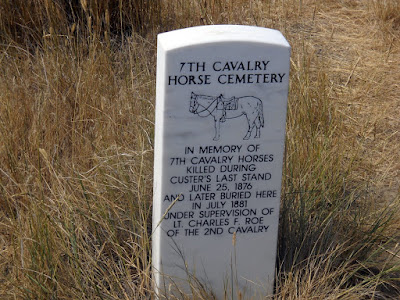
We are situated on Anglo-owned land in the middle of the Crow Indian Reservation, just a few miles from the Little Big Horn Battlefield National Monument, where Gen. Armstrong Custer lost his fight, his troops and his life in a battle against the Sioux, Arapahoe and Cheyenne Indians in 1876. The battlefield monument is the main tourist attraction in this area, so it is important we learn a little of the story. Last Tuesday we made our first visit, listening to a ranger explanation of the battle, watching the orientation film and viewing Last Stand Hill where Custer was killed, the Indian Memorial


and the Cavalry Horse monument. There also is a National Cemetery at the monument where veterans from the Indian Wars, as well as all the wars since then, are buried. We will return to explore the rest of the monument this week.

Thursday, July 23, 2009

Driving Through Wyoming

Last week we drove north across Wyoming, from Cheyenne to Laramie, then Casper and Sheridan. We were in the foothills and we saw many pretty places along the way. The biggest features of the drive are trains, wind farms, snow fences, cattle and antelope.

There also are a lot of cattle.


This haystack is one of a kind (not really, there were several in the field, but we had never seen one like this before.) The hay is pilled high inside a small enclosure.

We saw this unusual rock wall as we drove toward Casper.

Medicine Bow is a small town south of Casper. I liked the water tower there.

This really old building across the lot from the gas station we stopped in is the Virginian Hotel in Medicine Bow.

We spent two nights in Sheridan, a delightful small town. On Sunday we drove to the McIntyre Commons in the downtown area for our run. It was a really great area—Little Goose Creek flowed nearby, and there are gardens and nice paths and green lawns. The downtown area of Sheridan appears to be very prosperous, with no empty or run-down buildings.

We were making our way to Montana, where we will be workamping till October. I will write about that after we get settled in to our work.


Friday, July 17, 2009

What a Change!

We haven't been in a commercial RV park since April 26. This afternoon has been a shock to our systems.

These two pictures show the view out our front door and the window on the other side of the trailer this morning. We were at Curt Gowdy State Park, Cheyenne, Wyoming.


This afternoon we checked into the Casper East RV Park. This is the view from our back window.


This is a view between our trailer and the one next to us on the side of the front door. The other trailer is so close I can't take a picture looking straight at it.


Tonight we have full hookups--we have sewer, but it is so far to the back we will have to back up to use it in the morning. But it is there. We are enjoying 50-amp electric. For the last two nights at Curt Gowdy we had no hookups. These two generators provide enough electricity that we can use the microwave or one air conditioner.


Tonight we can use both air conditioners at the same time. There are trade-offs. At the state parks we have stayed at--Lathrop, Cheyenne Mountain, Chatfield and Curt Gowdy, we have privacy and great views. Sometimes we have hookups, sometimes we don't. If you look at these photos, you know why we choose state parks whenever possible.

At Curt Gowdy we were surrounded by bluebird houses and the Mountain Bluebirds were everywhere. We really enjoyed watching them and listening to them.


Posted by Picasa

Monday, July 13, 2009

Why We Love RVing

It has been very good to be here in the Denver area, near our stick house. We had a great visit with our son and his wife and their two children Friday. Saturday we watched our granddaughter, Kylie, compete in two events at her swim meet. We also have enjoyed shopping in familiar stores and buying food at our favorite specialty food store, Tony's Market. We bought chicken Kiev and chicken cordon blue for dinner Sunday and three pairs of New York strip steaks, which we froze for future dinners.
All of that has been good, but I think what has been best is the confirmation that we are doing the right thing in renting our house and RVing full time. We have driven through beautiful neighborhoods with lovely houses and yards. We are so glad we haven't returned to our stick house here. If it was available, we wouldn't feel right paying to stay at Chatfield State Park. Instead, we would have unpacked everything, moved back into the house, and put the RV in storage. That is a lot of work. And it is the reason we always avoided coming into Denver as we moved around. If we came to Color ado, we always made sure to go to other parts of the state. The house almost felt like a whirlpool that would suck us in if we came here.
Owning a house means there is work to do on the house or yard before we could leave again. When we first bought the house, we would fill planters with flowers and hang baskets of flowers on the patio. We worked on the gardens and updated the inside—having furniture reupholstered and installing hardwood floors and new carpet. We enjoyed entertaining and used our living room and dining room often. They we began RVing. It got to the point we were gone most or all of the summer—so no more flowers and hanging baskets. When we were gone seven or eight months of the year, the time we did spend in the house was spent catching up with family, cleaning the gutters, Christmas shopping and spending the holidays with family. We didn't have time (or, really, the inclination) to entertain much.
We are glad we are only here for a few days this time. Life in the city, living in one place all the time, doesn't appeal to us. After we take care of the house and go to the gym, there really isn't much we like to do here. Life on the road is so much more interesting. Yesterday morning we had our coffee outside, listening to the birds. In the afternoon, a thunderstorm came through. In the house, we might glance outside and see it was raining. Here, it was so loud we could do nothing but listen. That is a real treat. We can see most of the eastern and western horizons, as well as the sky to the south. We can watch the storms come in and watch them move on. All day we can hear the Western Meadowlark singing. We watch the cotton tail rabbits as we walk around the campground. Last night I woke up at about 2 a.m. to hear coyotes howling.
In short, we are so much more in touch with nature when we live in our RV. Because our living space is small, the outdoors is much more important than when we are in the stick house. We spend as much time outside as we can. We rejoice in God's creation daily during our life on the road.

Thursday, July 09, 2009

What a Life!

What other lifestyle could we choose and see a mule deer doe, a wild turkey and a chipmunk before 7:15 am, while looking at a view like this


while staying is a site like this

Posted by Picasa


overlooking this trail?


Tuesday we left Lathrop State Park and drove to Cheyenne Mountain State Park in Colorado Springs. This is the newest park in the Colorado park system and it is certainly first class. The camp sites are large and have full hookups. They offer privacy, as well as great night-time views of the Colorado Springs lights. The trails are well planned and well maintained. We had a great run downhill Wednesday mornign (we walked back up to our campsite).

The entrance is across the road from Fort Carson Army Base and we heard reveille waking up the soldiers this morning. But the park is quite and beautiful. We will definitely return.

After a short visit with family and some doctor, dentist and truck appointments, we are headed for Montana, where we will be workkamping till October.