Arizona is one of 14 major cotton-producing states in our country, all in the south. World-wide, we use more cotton than any other fiber and cotton is a leading cash crop in the U.S. The plant grows in warm climates and most of the world's cotton is grown in the US, the Soviet Union, the Peoples Republic of China and India, as well as Brazil, Pakistan and Turkey.
Many people are familiar with cotton farming, but since we have lived most of our lives in the cooler climes near mile-high Denver, we weren't familiar with how it is grown or harvested. The Ancestral Sonoran Desert people who lived at Casa Grande Ruins raised cotton, increasing our curiosity about this crop. This year Arizona cotton farmers have a bumper crop and we wondered about the harvest, so when the Pinal County Historical Museum in Florence announced a program on growing and harvesting the crop, we knew we wanted to attend.
In mid-October we had seen cotton fields where the leaves were still green. You could see the cotton bolls, but it wasn't ready for harvest.
By early November the plants had turned brown and looked very dry and the cotton bolls really stood out.
Forrest Dougherty, an 83-year-old Irish storyteller who was born on the family cotton farm in Gilbert, Arizona, kept us entertained for an hour Sunday afternoon.
It was standing room only be the time he began telling us about growing up on a cotton farm.
Forrest was named after a Yaqui Indian who was a a foreman on his dad's farm. He told us that by the age of eight, he was helping with the planting and harvest. He explained that in this state they planted the seed in March 14, three days before St. Patrick's Day (remember, he is Irish).
In case you are like me and have rarely, if ever, seen a cotton plant close up, this is what it looks like.
This is a machine (don't know what it is called) that harvests the cotton.
After harvest, the cotton is piled at the side of the field in what Forrest called modules. Over the coming months, the modules are picked up one at a time by very large trucks and taken to the cotton gin.
At the front of the room you can see Forrest and his daughter, Suzie, who helped with his visual aides.
We learned that all parts of the cotton plant are useful. The fiber or lint is used in making cloth; linters--the short fuzz on the seed--provide cellulose for making plastics, explosives and other products. Linters also are used in high quality paper products and processed into batting. The cottons seed is separated into oil, meal and hulls for use in food for humans, livestock and poultry, as well as fertilizer. Even the stalks and leaves are plowed under to enrich the soil.
This year, at least, the economic picture for Arizona cotton farmers is excellent, especially since the harvest is so large. (I don't know if that is true in other states.) Because of bad weather conditions in cotton-growing countries around the world, there is a shortage of the fiber and cotton prices are very high, so Arizona farmers are having a good year.
Forrest is a great entertainer, beginning his presentation with a Yaqui Indian prayer in honor of his namesake, and ending by twirling his cotton rope lasso while singing a song
I had a chance to talk to Forrest before we left the museum.
The program went extremely well Sunday. There was seating for maybe 75 people and possible 200 crowded in to hear the presentation. Who was happiest that it went so well, and that it was over? That would be Chris Reid, who operates the museum each day--and gave us the great tour last week. She arranged for the cotton program.
After we visited the museum in Florence last week, we visited the True Value Hardware there. We were looking for a small hook to hang the mobile we received for Christmas from Eric and Liz. Today John was figuring out exactly where it belonged in this window.
But we spent a lot more time in the store than what was needed to find the hook. The store is a museum, as well as a well-stocked business. This gives you an idea of how many screws, bolts and other hardware they have on hand.
Several really neat old toys are displayed in the front window.
Don't you love the apron and beads in this display?
They have some old school desks along the ramp from the main display floor to the back room.
I don't think I've ever seen a fireman come down a pole into a hardware store before.
The system of belt-driven fans on the ceiling makes me think I might be in Havana 75 years ago.
This shows another one of the fans. It was turning when I took the photo, so some of the blades look a little blurry.
Just look at all these clocks!
In addition to the Pinal County Historical Museum and the hardware store, the old part of Florence has lots of buildings that are on the National Register of Historic Buildings. The city is well worth visiting for a look at Arizona history.
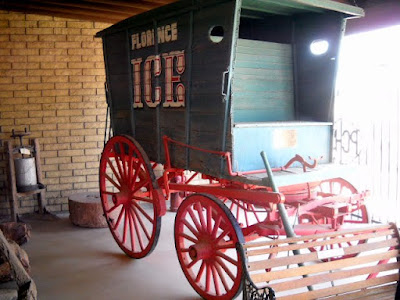
Tuesday we drove to the town of Florence, 8 miles east of here. We wanted to visit the Pinal County Historical Museum in the county seat. And were we ever impressed! It is a small museum with a great collection of items and stories about the history of Florence, the Arizona prisons located there, and the early Native American residents of the county. This great ice wagon greets museum visitors.
As a very young child, I remember the ice man delivering ice for our ice box. Of course, he didn't come in a horse-drawn wagon. As soon as an electric refrigerator was available after the end of World War II, my parents bought one. I imagine the ice man was out of business in Denver by about 1946.
Chris Reid runs the museum and also is senior warden at St. Michael's Episcopal Church in Coolidge, where we worship and John assists on Sunday. She gave us an excellent tour of the museum collection. We have never before seen furniture made out of saguaro cactus ribs. Isn't this set beautiful? The builder found some really large saguaros.
For a number of years, Florence had a company that manufactured furniture from cholla cactus. The texture of that wood is really attractive.
Southern Arizona was the home of several bands of Apache Indians--some still live here. This is a display of Apache Playing Cards, patterned after the cards we know today. Apparently the Apache really enjoyed gambling on card games.
The museum has a very good display of artifacts and information on the Hohokam sites in the County, including Casa Grande Ruins where we are volunteers. This yucca sandal is very interesting.
Two well-known mid-20th century icons, Tom Mix and a comic strip named "Gordo", have ties to Florence. Mix's daughter moved to the town with her husband. Over the years, Mix visited his family here and made lots of friends. Even after his daughter divorced and moved away, he continued to visit friends here. In 1940 he died in an automobile accident nearby on his way to town.
I vaguely remember reading Gordo in the Denver Post. It was written and drawn by Gustavo "Gus" Arriola, who was born in Florence and he loosely based part of the comic strip on the local area.
Florence is home to two Arizona state prisons, as well as a Border Patrol detention facility and two private prisons. In 1908 the Arizona Territorial Prison moved from Yuma to Florence, in part because the Phoenix-Tucson area accounted for the largest number of inmates. The Pinal County Museum houses many prison artifacts and files, including this trap door used when a death sentence was by hanging. We are looking at the bottom of the trap door.
For years, a new noose was used for each prisoner hung and afterwards, a photo of the prisoner was framed inside the noose and hung on death row. Here are three of those.
Winnie Ruth Judd, the "Notorious Trunk Murderess", was housed at the Florence prison. There is a quite a display of artifacts associated with her, including two books written about her.
After leaving the museum, we visited the Florence hardware store. It is a great place, but that will have to wait for another post.