Eastern Kansas is as flat as all my images and memories of the state. Maybe that comes from driving on I-70. The last couple of legs of this journey we haven’t been on I-70, but we have seen the lush, flat farmlands the state is famous for: dark green corn fields, golden acres of wheat being harvested this month, small towns, and grain elevators. If there is a tree, it is a cottonwood. Western Kansas is experiencing drought, but the eastern part or the state is having much the same weather as Texas, which means rain. It was sooo green. We have never seen it look so beautiful.
As we came west along Kansas 156 on Wednesday, we were amazed to see water on both sides of the road. We wondered if there had been a flood, since we knew that Kanapolis Lake, which we had just left, had been flooded in May. We discovered we were driving next to the Cheyenne Bottoms Preserve, held by the Nature Conservancy. The 7,300 acres of marsh wetlands host nearly one-half of all North American shorebirds migrating east of the Rockies. We didn’t see any birds, but we sure did see a lot of water. In Kansas? We were amazed.
Why all this time in Kansas in late June? It isn’t the typical tourist destination. John’s ancestors were pioneers in Kansas, settling just across the state line from Missouri in Olathe in 1860. Those were the years of Bloody Kansas, when the prelude to the Civil War brought border raids between Kansas and Missouri as it was being decided whether the state would have slavery or not. Two decades later, his great-grandfather and mother homesteaded in southwestern Kansas in Kearny County. This week we found the land they settled on—where combines were just harvesting the wheat. It is very rich farmland.
It has been an interesting journey. We try to feel connected to America’s heartland, since we learned of the family connection here. Our stay at the Venango Corps Park, and earlier at Lake Stockton State Park in Missouri, put us in contact with local farmers enjoying their weekends at the lake. For many people in these states, their fate is in the hands of weather and the market for farm products. From the looks of Garden City (where we stayed in an RV Park) and Lakin, the county seat of Kearny County, where John’s family lived, farming can be fairly prosperous at times. We know that drought and hail and other factors make it very risky at other times. Many of those staying in this RV Park are part of a harvesting crew out of Minnesota, traveling throughout the plains cutting grain. Traveling across this country and into Canada helps us to understand a little of how other people live.

Saturday, June 30, 2007

Monday, June 25, 2007
Kansas
Friday night we were grateful we sleep in an RV, not a tent. About 2 a.m. I  woke up to see lightening all over the sky, though I couldn’t hear any thunder yet. After watching it for a while, I got up and turned on our NOAA weather radio, then went back to bed. Soon the wind began blowing and the rain started to fall. It kept that up until after 7 in the morning. Not everyone in the Venango Corps Park on Kanopolis Lake in south central Kansas was as fortunate as we are.. These folk had their tent collapse and they must have moved into the 5th wheel parked on the same site. They didn’t have a good night. A number of people had moved from their tents into their cars or trucks to wait out the storm.
This is our second visit to this park. We were here in early May 2006. Our site is lovely, large and very private. The nearest campsite is offset from ours so we don’t look into each other’s units. Friday night there were very few campers. Saturday night a goodly number, but the five loops are nowhere near full. Our site has 50 amp and water, some have just electric—either 50 amp or 30/20 amp. Some have no hookups at all. Venango and other nearby state and COE parks on the lake are used almost exclusively by local Kansans.
This morning we woke up to a humid, foggy morning. These Coloradans aren’t used to seeing 68 degrees be below the dew point. But the dew gav e the park a mystical feeling for a couple of hours. Many artistic spiders had been at work overnight and the dew made their webs visible. It also gave a new beauty to dandelion seeds.
Especially during the past two summers, we have experienced many parks where we joined locals in their recreation. Tourists are unusual. We are able to get a feel for the local population and what is important for their leisure time. Here, beyond camping, there is swimming and boating on the lake. Last summer in Canada we stayed in several parks that offered extensive activities for both adults and children, who returned to the same park week after week. We have camped in state parks in Idaho, Mississippi, Utah, Arkansas, Texas, Alaska, Ohio, Iowa, Vermont and New York—maybe some other states I have forgotten—as well as our own Colorado State Parks. Many states provide beautiful camping experiences for their residents and the occasional tourist who happens by.
After we left Independence, MO, we stayed in the Lawrence, KS, KOA for four nights to do a little genealogy research. We had discovered which Kansas church John’s great-great-grandfather had served in the 1860s and 1870s, so we drove to Olathe for a visit. No one at the church knew much history, but the local library did contain a church history. Earlier, at the Mid-Continent Library in Independence and the Kansas History Library in Topeka, we located more information from microfilm of old newspapers about John’s great-grandfather and great-great-gran dfather. We also drove to the Eisenhower Veterans Hospital in Leavenworth, KS, where another great-great-grandfather had lived for several years in the Old Soldiers and Sailors Home. The buildings that were then—the turn of the last century—are still there, though most are not in use. How interesting to see a place important to our family over 100 years ago. When we leave Venango, we will continue our research in Kearny County in west
 woke up to see lightening all over the sky, though I couldn’t hear any thunder yet. After watching it for a while, I got up and turned on our NOAA weather radio, then went back to bed. Soon the wind began blowing and the rain started to fall. It kept that up until after 7 in the morning. Not everyone in the Venango Corps Park on Kanopolis Lake in south central Kansas was as fortunate as we are.. These folk had their tent collapse and they must have moved into the 5th wheel parked on the same site. They didn’t have a good night. A number of people had moved from their tents into their cars or trucks to wait out the storm.
This
 is our second visit to this park. We were here in early May 2006. Our site is lovely, large and very private. The nearest campsite is offset from ours so we don’t look into each other’s units. Friday night there were very few campers. Saturday night a goodly number, but the five loops are nowhere near full. Our site has 50 amp and water, some have just electric—either 50 amp or 30/20 amp. Some have no hookups at all. Venango and other nearby state and COE parks on the lake are used almost exclusively by local Kansans.
This morning we woke up to a humid, foggy morning. These Coloradans aren’t used to seeing 68 degrees be below the dew point. But the dew gav
 e the park a mystical feeling for a couple of hours. Many artistic spiders had been at work overnight and the dew made their webs visible. It also gave a new beauty to dandelion seeds.
Especially during the past two summers, we have experienced many parks where we joined locals in their recreation. Tourists are unusual. We are able to get a feel for the local population and what is important for their leisure time. Here, beyond camping, there is swimming and boating on the lake. Last summer in Canada we stayed in several parks that offered extensive activities for both adults and children, who returned to the same park week after week. We have camped in state parks in Idaho, Mississippi, Utah, Arkansas, Texas, Alaska, Ohio, Iowa, Vermont and New York—maybe some other states I have forgotten—as well as our own Colorado State Parks. Many states provide beautiful camping experiences for their residents and the occasional tourist who happens by.
After we left Independence, MO, we stayed in the Lawrence, KS, KOA for four nights to do a little genealogy research. We had discovered which Kansas church John’s great-great-grandfather had served in the 1860s and 1870s, so we drove to Olathe for a visit. No one at the church knew much history, but the local library did contain a church history. Earlier, at the Mid-Continent Library in Independence and the Kansas History Library in Topeka, we located more information from microfilm of old newspapers about John’s great-grandfather and great-great-gran
 dfather. We also drove to the Eisenhower Veterans Hospital in Leavenworth, KS, where another great-great-grandfather had lived for several years in the Old Soldiers and Sailors Home. The buildings that were then—the turn of the last century—are still there, though most are not in use. How interesting to see a place important to our family over 100 years ago. When we leave Venango, we will continue our research in Kearny County in west
Sunday, June 17, 2007
Independence and Kansas City
 Today we did our three-mile run on the streets where President Harry S. Truman used to walk in Independence, Missouri. This is a delightful small town, clean, easy to walk and run in. After our run, we toured the Truman home, operated by the National Park Service. Then we visited the Truman Library and Museum.
The home is much as it was when President Truman died in 1972. His wife, Bess, lived there 10 more years, but she made very few changes. She willed the house and
 its contents to the people of the United States. The President’s hat and coat still hang by the door where he always kept them. The home shows the humble dwelling where our 33rd President regarded as home during his 18 years in the US Senate and as vice president and then president. It really looks like the 1950s, which is when they returned to Independence for good.
The Library is outstanding. The introductory film gave some background on Truman up to the day he was sworn in as president after FDR’s death. The exhibits highlight the many major issues President Truman had to deal with within the first year in office, as well as the massive changes that occurred over his eight years in office. It wasn’t a peaceful time and not easy for our citizens of our president—from the end of World War II to the Berlin Crisis to the Cold War and the Korean War, just to name a few.
 Yesterday we went into downtown Kansas City, where we ate some barbeque and toured the World War I Monument and Museum. The monument is truly impressive and the museum gives good insights into why the war came about and the life of the soldiers who fought it, as well as the effects on civilians at home, both in Europe and the U.S.
Kansas Cit
 y is called the city of fountains, and we saw several near th
 e World War I memorial. One was delighting the children on a hot and sunny day. The other stands between the Memorial and Union Station.
It has been very hot here. We are so glad we were able to repair our air conditioner. When we were at Branson, we found it main air conditioner wasn’t working right. Set at 80, it would keep working until it froze up, even as the interior temperature got down to the low 70s. We realized that earlier in the season, the furnace had continued running till the temp was over 80. That probably meant it was the thermostat that was bad. We found an RV parts store and bought a new thermostat. Neither of us knows much about those things, but we installed it and it is working fine. That is very important when we want to leave for the day with our two cats in the RV.
Saturday, June 16, 2007
We move north in Missouri

Stockton Lake State Park in Missouri was a wonderful two-day stay. It is about midway between Branson and Kansas City. There are so many birds, it sounded like we were in an aviary. Summer Tanagers and Northern Orioles were the new birds for this year’s travels. When we arrived on Wednesday, the park was largely empty. The loop with 50-amp electric (where we had reserved a site, not knowing that more than ha lf of the 50-amp sites would be empty) had only six other rigs. We enjoyed the large sites, the privacy and quiet. I put out two hummingbird feeders and we were able to watch several birds feeding. They were sure disappointed when we removed them and drove out of the park. When we started to set up our trailer, we saw lots of bugs. They next thing we noticed was that all the other campers were wearing long pants—despite the 85 degree heat. That was probably partly due to the fact most of them are Missouri farmers. But we decided they had a good idea and we wore jeans, as well. We still ended up with bites and one tick. We were able to ride bikes at Stockton Lake, as we did at both Indian Point and Horseshoe Bend.
We had nothing but sunshine at Stockton Lake, which was a real treat after two days of rain at Indian Point. One of the things we most enjoy about RVing is being outdoors. That isn’t possible in a driving rainstorm. I don’t know how much rain we received on Table Rock Lake. But Joplin was just a little north and west and they received 13+ inches in two days.
We attended a second show in Branson, Spirit of the Dance. It was a great troop of about 18-20 dancers who do marvelous numbers in a semi-Celtic dance style. They are amazing athletes. As time for the intermission approached, I found myself wishing it would hurry so they would have a little time to rest and catch their breath. They were really working hard.
Everywhere we went in Branson, we saw discount ticket outlets. We finally asked why there were so many. The area is rapidly growing, with new resorts and condominiums being built everywhere. Each resort and condo complex has a discount ticket outlet, where you get cheaper admission in return for a 1-3 hour sales presentation. We decided to pass on the sales pitch and pay full price.
I had forgotten about the joy of seeing lightning bugs around dusk in the humid mid-west. What a treat! I’d love to chase them with my grandchildren and see if we could catch any.
 lf of the 50-amp sites would be empty) had only six other rigs. We enjoyed the large sites, the privacy and quiet. I put out two hummingbird feeders and we were able to watch several birds feeding. They were sure disappointed when we removed them and drove out of the park. When we started to set up our trailer, we saw lots of bugs. They next thing we noticed was that all the other campers were wearing long pants—despite the 85 degree heat. That was probably partly due to the fact most of them are Missouri farmers. But we decided they had a good idea and we wore jeans, as well. We still ended up with bites and one tick. We were able to ride bikes at Stockton Lake, as we did at both Indian Point and Horseshoe Bend.
We had nothing but sunshine at Stockton Lake, which was a real treat after two days of rain at Indian Point. One of the things we most enjoy about RVing is being outdoors. That isn’t possible in a driving rainstorm. I don’t know how much rain we received on Table Rock Lake. But Joplin was just a little north and west and they received 13+ inches in two days.
We attended a second show in Branson, Spirit of the Dance. It was a great troop of about 18-20 dancers who do marvelous numbers in a semi-Celtic dance style. They are amazing athletes. As time for the intermission approached, I found myself wishing it would hurry so they would have a little time to rest and catch their breath. They were really working hard.
Everywhere we went in Branson, we saw discount ticket outlets. We finally asked why there were so many. The area is rapidly growing, with new resorts and condominiums being built everywhere. Each resort and condo complex has a discount ticket outlet, where you get cheaper admission in return for a 1-3 hour sales presentation. We decided to pass on the sales pitch and pay full price.
I had forgotten about the joy of seeing lightning bugs around dusk in the humid mid-west. What a treat! I’d love to chase them with my grandchildren and see if we could catch any.
Saturday, June 09, 2007
Branson Adventures
This is our fourth night at Indian Point Corps Park near Branson, Missouri. Two crows are talking to each other down the hill. As the sun sets, I can see it through the trees reflecting off Table Rock Lake. We love this park. We have extended our stay for three days, though we have to move to another site tomorrow to do that.
Today we attended the afternoon performance of the RFDTV—the Theat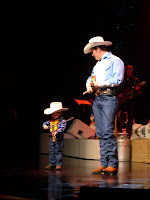 er Revue with the Sons of Tennessee and Penny Gilley. A new venture of the 6-year-old cable channel, the audience at 3 pm was
  small. But the price was right. As subscribers to RFDTV Magazine, it was buy one – get one free. So we got two tickets for $25—a real bargain in Branson.
The two-year-old son of one of the Sons of Tennessee joined his dad and grandpa on stage. He was so focused and so cute. Penny is a very talented singer. The performance was very patriotic and brought tears to our eyes as the focused on our soldiers in war—especially since our son Doug will go to Iraq in September.
Earlier in the day we found this Walking Stick (that really is its name, according to our biology teacher son Eric) on our door fra me. It is five inches long and we don’t know if it crawled or flew there. How interesting.
Yesterday was a lost day because we got so little sleep the night before. Thursday the weather news was filled with talk of the severe thunderstorms and tornado threat heading for the mid-west, from Michigan to Texas. That storm line went right through Kansas City and Branson. We went to sleep with the NOAA Weather Radio on and were awakened four times by alert signals regarding watches and warnings. At 4:30 am the most dramatic electric storm I’ve ever seen took place all around our trailer. Two lightning bolts were white explosions of light and sound right outside our windows. I’ve always enjoyed watching thunderstorms, but this was a little too close for comfort. Earlier in the day we had watched the noon fountain show at Branson Landing, where the waters played to the tune of the Star Spangled Banner, accompanied by cannon-like tubes belching noise and fire. “Bombs bursting in air” was the effect there and again the next morning in the space around our RV. No pictures of the fountain show or the thunderstorm, I’m sorry to say.
Today we attended the afternoon performance of the RFDTV—the Theat
 er Revue with the Sons of Tennessee and Penny Gilley. A new venture of the 6-year-old cable channel, the audience at 3 pm was
  small. But the price was right. As subscribers to RFDTV Magazine, it was buy one – get one free. So we got two tickets for $25—a real bargain in Branson.
The two-year-old son of one of the Sons of Tennessee joined his dad and grandpa on stage. He was so focused and so cute. Penny is a very talented singer. The performance was very patriotic and brought tears to our eyes as the focused on our soldiers in war—especially since our son Doug will go to Iraq in September.
Earlier in the day we found this Walking Stick (that really is its name, according to our biology teacher son Eric) on our door fra
 me. It is five inches long and we don’t know if it crawled or flew there. How interesting.
Yesterday was a lost day because we got so little sleep the night before. Thursday the weather news was filled with talk of the severe thunderstorms and tornado threat heading for the mid-west, from Michigan to Texas. That storm line went right through Kansas City and Branson. We went to sleep with the NOAA Weather Radio on and were awakened four times by alert signals regarding watches and warnings. At 4:30 am the most dramatic electric storm I’ve ever seen took place all around our trailer. Two lightning bolts were white explosions of light and sound right outside our windows. I’ve always enjoyed watching thunderstorms, but this was a little too close for comfort. Earlier in the day we had watched the noon fountain show at Branson Landing, where the waters played to the tune of the Star Spangled Banner, accompanied by cannon-like tubes belching noise and fire. “Bombs bursting in air” was the effect there and again the next morning in the space around our RV. No pictures of the fountain show or the thunderstorm, I’m sorry to say.
Tuesday, June 05, 2007
A great anniversary
Today is our 42nd anniversary. Who could ask for a better day? We were able to run 3  miles at Horseshoe Bend Corps Park, where we spent the past 5 nights. While we were running, we saw 11 deer, including two does with fawns still covered with spots. Our cat Partner spent several minutes staring down a gray squirrel on our picnic table.
After a slow, twisting drive through the Mark Twain Forest to Table Rock Lake near Branson, MO, we discovered we have reserved a site in the best loop of the park. It is paved, level, private and beautiful. It also has both water and 50-amp electric. What more could you want at $8.50 a night? We will really enjoy our visit to Branson from this spot. We have seen white- tailed deer here, also. And we have a three-toed box turtle right below our trailer pad. That sure got Partner’s attention. (Our other cat, PC, was car sick on the way here, so he isn’t enjoying anything. He wanted to eat, then sleep.)
It is really special to spend our anniversary doing what we most enjoy—traveling. And, at age 64, being able to run 3 miles is also special. Our National Parks Senior Pass, which gives us free entry to parks and half-price camping on all federal lands, is such a bonus. It makes the cost of our travels much more reasonable.
While staying at Horseshoe Bend, we spent a pleasant day at Eureka Springs, AR, and visited Pea Ridge N ational Military Park, where John’s great-great-grandfather fought in the battle at Elkhorn Tavern and was injured. We were able to learn a lot about what he experienced there.
 miles at Horseshoe Bend Corps Park, where we spent the past 5 nights. While we were running, we saw 11 deer, including two does with fawns still covered with spots. Our cat Partner spent several minutes staring down a gray squirrel on our picnic table.
After a slow, twisting drive through the Mark Twain Forest to Table Rock Lake near Branson, MO, we discovered we have reserved a site in the best loop of the park. It is paved, level, private and beautiful. It also has both water and 50-amp electric. What more could you want at $8.50 a night? We will really enjoy our visit to Branson from this spot. We have seen white-
 tailed deer here, also. And we have a three-toed box turtle right below our trailer pad. That sure got Partner’s attention. (Our other cat, PC, was car sick on the way here, so he isn’t enjoying anything. He wanted to eat, then sleep.)
It is really special to spend our anniversary doing what we most enjoy—traveling. And, at age 64, being able to run 3 miles is also special. Our National Parks Senior Pass, which gives us free entry to parks and half-price camping on all federal lands, is such a bonus. It makes the cost of our travels much more reasonable.
While staying at Horseshoe Bend, we spent a pleasant day at Eureka Springs, AR, and visited Pea Ridge N
 ational Military Park, where John’s great-great-grandfather fought in the battle at Elkhorn Tavern and was injured. We were able to learn a lot about what he experienced there.
 Wednesday, May 23, 2007
Exploring Central Arkansas
During our two months at Hot Springs National Park, we have hiked most of the trails in the park. They are excellent trails and a good way to get away from the busyness of Central Avenue and Bath House Row.
 We toured Garvan Woodland Gardens, spectacular botanic gardens near Hot Springs. The Japanese Gardens were really special, as was the waterfall. They also have built the Anthony Chapel on the grounds, a beautiful space t
 hat makes you feel you are surrounded by the forest and God’s creation.
We have gone geocaching several times. This is a sport where we use our GPS to locate treasurers that have been hidden by other geocachers and listed on the Geocaching.com web site. This activity helps us discover some of the hidden nooks and cran nies of the community where we are staying. One geocache was located in Entergy Park, a newly developed area along Lake Hamilton. It gave us a glimpse of the lake and showed us some bike trails. We returned a couple of weeks later to test our new bike rack and ride our bikes.
Two trips to Little Rock have allowed us to visit the President Clinton Library— really interesting and an impressive building and the Little Rock Central High School Historical Park where we relived the integration of the school 50 years ago. The exhibits in the visitor center are very well done and really brought that period back to life for us. It was very moving. We could see, read and h
 ear what people experienced and felt during those difficult times. It is sad to see how cruel people can be to one another and how they are afraid of the unknown. One comment was especially poignant, “That was the first time I’d ever gone to school with a Negro, and it didn’t hurt a bit.”
 We toured Garvan Woodland Gardens, spectacular botanic gardens near Hot Springs. The Japanese Gardens were really special, as was the waterfall. They also have built the Anthony Chapel on the grounds, a beautiful space t
 hat makes you feel you are surrounded by the forest and God’s creation.
We have gone geocaching several times. This is a sport where we use our GPS to locate treasurers that have been hidden by other geocachers and listed on the Geocaching.com web site. This activity helps us discover some of the hidden nooks and cran
 nies of the community where we are staying. One geocache was located in Entergy Park, a newly developed area along Lake Hamilton. It gave us a glimpse of the lake and showed us some bike trails. We returned a couple of weeks later to test our new bike rack and ride our bikes.
Two trips to Little Rock have allowed us to visit the President Clinton Library—
 really interesting and an impressive building and the Little Rock Central High School Historical Park where we relived the integration of the school 50 years ago. The exhibits in the visitor center are very well done and really brought that period back to life for us. It was very moving. We could see, read and h
 ear what people experienced and felt during those difficult times. It is sad to see how cruel people can be to one another and how they are afraid of the unknown. One comment was especially poignant, “That was the first time I’d ever gone to school with a Negro, and it didn’t hurt a bit.”
Wrapping up at Hot Springs
Our time at Hot Springs National Park is coming to an end. We have one more week of work—three days. Two months is the right length of time to volunteer and to live somewhere. We’re ready to move on. But knowing we are about to leave helps us savor what is good about the time here and not get bothered by what we don’t like.
What has been good about Hot Springs? We’ve learned a lot about the American Spa, European-type bathing, and pre-modern medical treatment. We’ve experienced taking the baths and getting a massage. We’ve enjoyed being in a small-city urban area with all the convenience of shopping and services. Our camp site is lovely and comfortable. And we’ve gotten to know a number of very nice volunteers.
One real plus of this experience has been the opportunity to worship at St. Luke’s Episcopal Church in Hot Springs each Sunday since Easter. The worship services are very well done, the organist and music are excellent, and the Rev. C. B. Baker, rector, conducts a good liturgy and gives stimulating sermons. This is the first volunteer assignment where we have been able to worship regularly.
We learned how to operate a cash register and credit card machine. But we won’t be sad to finish the boring time in the bookstore, the repetitive questions and answers on the Visitor Desk. The staff here is stressed and doesn’t operate as a team.
We’ve yet to find a state or national park we wanted to return to the next year, but we’re glad each time we’ve taken the assignment.
We’ll pull out May 31and spend two and one-half months as tourists before we begin our next work assignment at Kodachrome State Park in Utah.
What has been good about Hot Springs? We’ve learned a lot about the American Spa, European-type bathing, and pre-modern medical treatment. We’ve experienced taking the baths and getting a massage. We’ve enjoyed being in a small-city urban area with all the convenience of shopping and services. Our camp site is lovely and comfortable. And we’ve gotten to know a number of very nice volunteers.
One real plus of this experience has been the opportunity to worship at St. Luke’s Episcopal Church in Hot Springs each Sunday since Easter. The worship services are very well done, the organist and music are excellent, and the Rev. C. B. Baker, rector, conducts a good liturgy and gives stimulating sermons. This is the first volunteer assignment where we have been able to worship regularly.
We learned how to operate a cash register and credit card machine. But we won’t be sad to finish the boring time in the bookstore, the repetitive questions and answers on the Visitor Desk. The staff here is stressed and doesn’t operate as a team.
We’ve yet to find a state or national park we wanted to return to the next year, but we’re glad each time we’ve taken the assignment.
We’ll pull out May 31and spend two and one-half months as tourists before we begin our next work assignment at Kodachrome State Park in Utah.
Sunday, May 13, 2007
Whole again
Finally—we’re all back together and set to go after the ladder on our 5th wheel broke March 21 in Louisiana! We were driving north on I-55—a very bumpy road—when a trucker honked at us. John looked in the mirror and saw the bikes hanging at a strange angle. When we were able to pull over, we discovered that the ladder, where the bikes were hanging, had broken. They were only hanging on one connection to the trailer. Thank God, they hadn’t fallen off and caused others to have an accident. We took them down and stored them in our RV—not an optimum solution, but the best available at the time. 
When we arrived in Hot Springs, we began searching for a bike rack that would carry the bikes on the front of our truck. Two companies referred us to Truck Buddy, where we found installing hitch receivers on the front of trucks happened fairly often. That receiver was installed in April.
We then located a Keystone dealer to order a new ladder for our Keystone Montana. On Tuesday we drove 75 miles north of Hot Springs to Russellville, where the new ladder was installed. Finally, $445 later, we are good to go. We ar e able to climb onto the Montana roof, carry the bikes on the front of the truck and tow the 5th wheel on the back. Our ladder shouldn’t fall off again.

When we arrived in Hot Springs, we began searching for a bike rack that would carry the bikes on the front of our truck. Two companies referred us to Truck Buddy, where we found installing hitch receivers on the front of trucks happened fairly often. That receiver was installed in April.
We then located a Keystone dealer to order a new ladder for our Keystone Montana. On Tuesday we drove 75 miles north of Hot Springs to Russellville, where the new ladder was installed. Finally, $445 later, we are good to go. We ar
 e able to climb onto the Montana roof, carry the bikes on the front of the truck and tow the 5th wheel on the back. Our ladder shouldn’t fall off again.
Tuesday, May 01, 2007
Bathing at the Buckstaff
Recently we had our bath and massage—part of our training as Interpretation volunteers at Hot Springs National Park. I didn’t get anything out of my only previous experience with a hot tub and I have never liked someone even massaging my shoulders. So I really wasn’t looking forward to a traditional bath and certainly not to a massage. For 175 years men and women have been coming to Hot Springs, Arkansas, for the baths, usually as a form of medical treatment, more recently as a form of relaxation. I found the experience better than I anticipated (or, at least, not as bad as I expected). It was relaxing and comfortable. But I am relaxed. I decided I prefer the physical sensations of running, weight training and hiking to a relaxing whirlpool bath, hot packs, steam cabinet and massage. The massage was not as uncomfortable or to be avoided at all costs as I had imagined. But, unless I’ve injured myself, pulled muscles or over-worked, it’s not to be sought.
In April Hot Springs National Park celebrated its 175th anniversary. In 1832 the springs were set aside (reserved) for the use of the people of the United States by a resolution of congress signed by President Andrew Jackson. The area was called a Reservation until 1921, when it was became a National Park. The celebration of the anniversary included festivities on April 20-21 with an actor portraying President Jackson, dignitaries and dancers from the City of Hot Springs’ sister city, Hanamaki, Japan, special concerts and art shows, and various governmental workshops in the bathhouses that are being stabilized on Bathhouse Row.
The following weekend there was a Walk Through History--living history presentations on various aspects of the history of Hot Springs National Park. I had never attended such a living history presentation and wasn’t very interested. But I did go to two talks—one concerning the depression-era program to house and treat indigent syphilis patients and another about conditions here during the Civil War. Both were excellent. If I ever have the chance to attend a similar event elsewhere, I will take advantage of it. Re-enactors add so much life to history.
In April Hot Springs National Park celebrated its 175th anniversary. In 1832 the springs were set aside (reserved) for the use of the people of the United States by a resolution of congress signed by President Andrew Jackson. The area was called a Reservation until 1921, when it was became a National Park. The celebration of the anniversary included festivities on April 20-21 with an actor portraying President Jackson, dignitaries and dancers from the City of Hot Springs’ sister city, Hanamaki, Japan, special concerts and art shows, and various governmental workshops in the bathhouses that are being stabilized on Bathhouse Row.
The following weekend there was a Walk Through History--living history presentations on various aspects of the history of Hot Springs National Park. I had never attended such a living history presentation and wasn’t very interested. But I did go to two talks—one concerning the depression-era program to house and treat indigent syphilis patients and another about conditions here during the Civil War. Both were excellent. If I ever have the chance to attend a similar event elsewhere, I will take advantage of it. Re-enactors add so much life to history.
Racial Relations
For the past three years we have spent two months a year in the south. Two years were in Texas, this year in Arkansas. We also have traveled in Georgia, Virginia and North Carolina in the past. Until this year, our experience has been that Blacks are largely invisible, except when shopping in stores like Wal-Mart or at a shopping mall. When we did encounter one, they seemed uncomfortable if we talked to them, they didn’t look us in the eye. The races lived largely separate.
This year we spent a couple of days in Mississippi before coming to Arkansas. There, and here in Arkansas, we found African-Americans much more open to us, responding in a comfortable way. Here in Arkansas, we see them as tourists, as employees in the park and in local businesses, and there doesn’t seem to be the discomfort and separation we saw, especially in Texas. It is refreshing.
This year we spent a couple of days in Mississippi before coming to Arkansas. There, and here in Arkansas, we found African-Americans much more open to us, responding in a comfortable way. Here in Arkansas, we see them as tourists, as employees in the park and in local businesses, and there doesn’t seem to be the discomfort and separation we saw, especially in Texas. It is refreshing.
Sunday, April 22, 2007
Kitty staff
We read recently that cats don’t have owners, they have staff. We travel with two aging cats—ages 13 and 14—and decided that was an apt description of the situation. They are each on separate prescription cat foods, but want to eat the food prescribed for the other cat. Therefore, we don’t leave their food out and the staff must respond to the meows by putting out first one bowl of food, then another. 
About 3 or 4 am, either PC or Partner decides it is time for breakfast. They act on that by climbing on John in bed or meowing. If I am aware of their actions, I put them both out of the bedroom and close the door. Then, sometime about 5:30 am, if no one is up, PC begins meowing. John doesn’t hear it, but I nudge him and say “your furry friends are asking for service.”
Partner really enjoys the outdoors and doesn’t hesitate to meow and tell us he wants out. If the weather is decent and we aren’t about to leave, one of his staff puts on his halter and attaches a leash and walks around with him.
We’ve found it is easier to cope with the meow demands when we realize we are staff, not owners.
About 3 or 4 am, either PC or Partner decides it is time for breakfast. They act on that by climbing on John in bed or meowing. If I am aware of their actions, I put them both out of the bedroom and close the door. Then, sometime about 5:30 am, if no one is up, PC begins meowing. John doesn’t hear it, but I nudge him and say “your furry friends are asking for service.”
Partner really enjoys the outdoors and doesn’t hesitate to meow and tell us he wants out. If the weather is decent and we aren’t about to leave, one of his staff puts on his halter and attaches a leash and walks around with him.
We’ve found it is easier to cope with the meow demands when we realize we are staff, not owners.
Getting settled in Arkansas
Our campsite at Gulpha Gorge Campground in Hot Springs National Park is great—large, lovely green lawn, open space for over 100 feet to the small cabin where the Artist in Residence stays and another 150 or so feet to the next volunteer RV space. We have full hook-ups, birds singing in the morning. The dogwoods were beautiful when we arrived. Within one minute we have Hot Springs Mountain to hike—we’ve already been on two great hikes there. And the campground is large enough that we only need to make 4½ laps to run our three miles.
 Our first week in the state was spent at Corps of Engineer Parks--$9.50 and $7 per night with our Golden Age Pass. Our son Eric and his children—Kylie, age 7 and John, age 21 months--drove out for his spring vacation and we toured the area, staying at Brady Mountain Corps park on Ouachita Lake. Despite some rain and a stomach flu that made the rounds of our family, we had fun: touring Hot Springs National Park, fishing, horseback riding, campfires and hikes.
We will be volunteering at Hot Springs National Park for April and May. They give us a full-hookup site, we work three days a week in the Visitor Center. One of us will staff the bookstore each shift, the other will be on the Visitor Information Desk. It is such an interesting place. The park protects 47 hot springs and provides the water free to the people of the United States to drink and bathe in. Established in 1832 as a reservation to protect the springs, it is celebrating its 175th anniversary this month. Once, a million baths a year were given in water from the springs. Now the number is only 100,000. The park is amazing to most visitors who don’t understand what it is all about. It also includes several mountains surrounding the springs where you instantly feel you have left the metropolitan area of 70,000+ and can hike in relative isolation.
This week most of the US has seen record low temperatures. Here a record low of 28 for April 8 was set and the daytime temperatures are 20 degrees below normal. Thankfully, we still have most of our winter clothes. One night this week we had thunderstorms and wind, ending the beautiful dogwood displays. But wildflowers are beginning to bloom in the woods and along the roadways. It is beautiful.
 feet to the small cabin where the Artist in Residence stays and another 150 or so feet to the next volunteer RV space. We have full hook-ups, birds singing in the morning. The dogwoods were beautiful when we arrived. Within one minute we have Hot Springs Mountain to hike—we’ve already been on two great hikes there. And the campground is large enough that we only need to make 4½ laps to run our three miles.
 Our first week in the state was spent at Corps of Engineer Parks--$9.50 and $7 per night with our Golden Age Pass. Our son Eric and his children—Kylie, age 7 and John, age 21 months--drove out for his spring vacation and we toured the area, staying at Brady Mountain Corps park on Ouachita Lake. Despite some rain and a stomach flu that made the rounds of our family, we had fun: touring Hot Springs National Park, fishing, horseback riding, campfires and hikes.
We will be volunteering at Hot Springs National Park for April and May. They give us a full-hookup site, we work three days a week in the Visitor Center. One of us will staff the bookstore each shift, the other will be on the Visitor Information Desk. It is such an interesting place. The park protects 47 hot springs and provides the water free to the people of the United States to drink and bathe in. Established in 1832 as a reservation to protect the springs, it is celebrating its 175th anniversary this month. Once, a million baths a year were given in water from the springs. Now the number is only 100,000. The park is amazing to most visitors who don’t understand what it is all about. It also includes several mountains surrounding the springs where you instantly feel you have left the metropolitan area of 70,000+ and can hike in relative isolation.
This week most of the US has seen record low temperatures. Here a record low of 28 for April 8 was set and the daytime temperatures are 20 degrees below normal. Thankfully, we still have most of our winter clothes. One night this week we had thunderstorms and wind, ending the beautiful dogwood displays. But wildflowers are beginning to bloom in the woods and along the roadways. It is beautiful.
Thursday, March 22, 2007
New Orlenas--Post Katrina
We’ve never seen New Orleans, except in movies and news coverage of Mardi gras. And then there was Hurricane Katrina. We expected to see the destruction that hit the 9th Ward and St. Bernard Parish.
As we drove in, we did see that. FEMA trailers in the front yards of damaged houses, blue tarps covering damaged roofs and walls. That is what we had seen on the news and it still exists.
In our highly rated KOA in Kenner/River Ridge, near the Mississippi River, nearly two-thirds of the units were FEMA trailers—with steel bands tying them down to the concrete, cinder blocks supporting them instead of metal leveling devices, pvc sewer lines and metal stairways. This is 18 months after the hurricane.
We hear periodically about conditions in New Orleans on the national news. Monday night at least 10 minutes of the local New Orleans news concerned Katrina reconstruction and deadlines for removal of FEMA trailers from Jefferson Parish.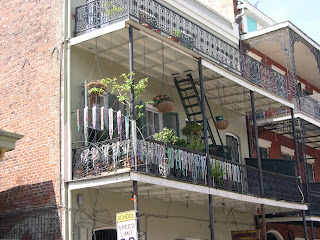
But the French Quarter is different. The trolleys operate. Bourbon and Canal and Decatur Streets are alive and serving locals and tourists. There was a huge convention at the Marriott and I walked down the street finishing my beer from lunch—it was in the obligatory plastic cup. Life seemed normal. And we saw French Quarter balconies and St. Charles Avenue trees decked out with Mardi gras beads.
We can’t speak to how far the city has come, but it still has a long way to go and it is better than we expected or imagined.
As we drove in, we did see that. FEMA trailers in the front yards of damaged houses, blue tarps covering damaged roofs and walls. That is what we had seen on the news and it still exists.
In our highly rated KOA in Kenner/River Ridge, near the Mississippi River, nearly two-thirds of the units were FEMA trailers—with steel bands tying them down to the concrete, cinder blocks supporting them instead of metal leveling devices, pvc sewer lines and metal stairways. This is 18 months after the hurricane.
We hear periodically about conditions in New Orleans on the national news. Monday night at least 10 minutes of the local New Orleans news concerned Katrina reconstruction and deadlines for removal of FEMA trailers from Jefferson Parish.

But the French Quarter is different. The trolleys operate. Bourbon and Canal and Decatur Streets are alive and serving locals and tourists. There was a huge convention at the Marriott and I walked down the street finishing my beer from lunch—it was in the obligatory plastic cup. Life seemed normal. And we saw French Quarter balconies and St. Charles Avenue trees decked out with Mardi gras beads.
We can’t speak to how far the city has come, but it still has a long way to go and it is better than we expected or imagined.
When in need
Most of the time, RVers want their privacy and respect the privacy of others. When we encounter our neighbors, we say hi and may ask where they are from or where they are headed. If it looks like someone is new to this activity and needs some help, we might go out and offer some advice. But when your yard if only six feet wide and your patio is fully visible in the next RV’s dining room, it is important to keep some distance.
Sometimes, though, an event occurs that breaks down those privacy barriers. Sunday we were eating our steaks in the trailer when a woman came to our front door and asked, “Is anyone in there? Are you home?” I went to the door as I said, “Yes, we’re here.” She told me a woman across the driveway had fallen and she wasn’t able to help her get up.
John quickly went out with her and told me to bring the cell phone. We crossed the drive to find a woman, probably in her 70s, lying on the ground at the base of the steps into her RV. She was confused and unable to sit up. John talked to her. The woman who had summoned us asked her if she was diabetic. She said she was, and the first woman said she was, too, and they discussed her blood sugar levels, medication and food intake.
I got a glass of orange juice for the fallen woman. After John ascertained that she didn’t feel she had hurt herself, she thought she had just fainted, we helped her sit up. By then the husband of the woman who had found her on the ground and a man from another trailer also had gathered. The woman who fell used her own cell phone to call her husband. We helped her up into a lawn chair. And then we stayed with her till her husband returned.
This incident broke down our privacy barriers. The next morning the woman who had found the fallen woman came out to talk to John before they left for their day’s activities. And the man from the neighboring trailer came over to see if we knew how the woman was doing. We discussed how important it is to help each other out when needed.
What we saw was that we need our privacy. But we also aren’t alone and others are there to help when someone needs it. That gives us a sense of security.
Sometimes, though, an event occurs that breaks down those privacy barriers. Sunday we were eating our steaks in the trailer when a woman came to our front door and asked, “Is anyone in there? Are you home?” I went to the door as I said, “Yes, we’re here.” She told me a woman across the driveway had fallen and she wasn’t able to help her get up.
John quickly went out with her and told me to bring the cell phone. We crossed the drive to find a woman, probably in her 70s, lying on the ground at the base of the steps into her RV. She was confused and unable to sit up. John talked to her. The woman who had summoned us asked her if she was diabetic. She said she was, and the first woman said she was, too, and they discussed her blood sugar levels, medication and food intake.
I got a glass of orange juice for the fallen woman. After John ascertained that she didn’t feel she had hurt herself, she thought she had just fainted, we helped her sit up. By then the husband of the woman who had found her on the ground and a man from another trailer also had gathered. The woman who fell used her own cell phone to call her husband. We helped her up into a lawn chair. And then we stayed with her till her husband returned.
This incident broke down our privacy barriers. The next morning the woman who had found the fallen woman came out to talk to John before they left for their day’s activities. And the man from the neighboring trailer came over to see if we knew how the woman was doing. We discussed how important it is to help each other out when needed.
What we saw was that we need our privacy. But we also aren’t alone and others are there to help when someone needs it. That gives us a sense of security.
Texas and Louisiana
“Dorothy, we’re not in Kansas any more” is our response to new surroundings. We’ve sure found new surroundings in Louisiana as we visit for the first time. We see azaleas blooming in the wild and in most yards here in Lafayette. It’s green—meaning spring has arrived. And the accents are quite distinctive.
We toured the Tabasco bottling plant on Avery Island—who would have thought the chili mash had to ferment for three years before the hot sauce in that little bottle could be made? Mr. McIlhenny was quite a Renaissance man, with interests in hot sauce, the snowy egret, and cultivating camellias, among other things.

The Jungle Gardens on Avery Island, laid out by McIlhenny, were amazing. There we saw small alligators living in the wild, turtles, a Buddha in a temple, an oak tree used as a survey marker almost 200 years ago and still growing. And there are azaleas, wisteria, camellias, bamboo and holly growing in abundance. Another feature was Bird Island, a breeding place for snowy egrets fo r nearly a century. The once nearly extinct birds are flourishing and amazing to watch in such large numbers.
We also went on a swamp tour on the Atchafalaya Basin south of Lafayett e. There we saw cypress trees and houseboats and got a little feel for living in bayou country. For two days we also sampled local foods—ettouffee, gumbo, deep-fried catfish, alligator, crawfish, oysters and shrimp, boudain and sausage. We think we will pass the next time such things are offered. We are pretty set in our eating habits. But we did give them a try.
Our last day in Lafayette, we drove to New Iberia on Bayou Teche to tour a plantation owner’s home that was built in the 1830s. We have spent a lot of time in two Colorado Historical Association historic houses in Trinidad and know that much of the furniture and appointments are not really associated with the house. But Shadows on the Teche is operated by the National Trust for Historic Preservation and about 80 percent of the furnishings actu ally belonged to the Weeks family that built the house. We had a great tour, given by a teenage boy, Matthew, who really knew his stuff, and the house is wonderfully maintained and fascinating. The gardens and the views from the house are wonderful.
We spent two nights in Beaumont, Texas, before coming to Lafayette, Louisiana. There it rained for hours at a time over a 24-hour period. No severe storms, but in Houston, about 90 miles southwest, there was flooding. We were glad to be in Beaumont.
Beaumont was not a planned stop. But Tuesday was a day for changed plans. We were headed out for a run. On the way, we stopped at the RV park office to find a local park to run in and to sign up for another day in Houston. We were told we could only stay if we moved to another site—there was a rodeo in town and our site was reserved for the next 10 days. Even though we planned to visit the Museum of Funeral Service in the afternoon, we decided it wasn’t worth spending an hour moving the trailer first.
So, instead of going for a run, we returned to the trailer, prepared to leave and were on the road by 9:45 am. We called the Louisiana state park we were planning to stay in and they had vacancies. But as we drove east on I-10, I suggested we could stay in Beaumont, Texas. After looking in the Trailer Life Directory, I called the Gulf Coast RV Resort and made reservations. As luck would have it, they accept Passport America, so we would be staying two nights for $30, instead of one night in Houston for $25.50.
Wednesday we went running in the Beaumont RV park. We dodged and ran through puddles, but it was good to get the exercise. This was our second run at sea level and it’s great. I can run for 3 miles and not be out of breath—tired, maybe, but not out of breath. There is so much oxygen.
We toured the Tabasco bottling plant on Avery Island—who would have thought the chili mash had to ferment for three years before the hot sauce in that little bottle could be made? Mr. McIlhenny was quite a Renaissance man, with interests in hot sauce, the snowy egret, and cultivating camellias, among other things.

The Jungle Gardens on Avery Island, laid out by McIlhenny, were amazing. There we saw small alligators living in the wild, turtles, a Buddha in a temple, an oak tree used as a survey marker almost 200 years ago and still growing. And there are azaleas, wisteria, camellias, bamboo and holly growing in abundance. Another feature was Bird Island, a breeding place for snowy egrets fo
 r nearly a century. The once nearly extinct birds are flourishing and amazing to watch in such large numbers.
We also went on a swamp tour on the Atchafalaya Basin south of Lafayett
 e. There we saw cypress trees and houseboats and got a little feel for living in bayou country. For two days we also sampled local foods—ettouffee, gumbo, deep-fried catfish, alligator, crawfish, oysters and shrimp, boudain and sausage. We think we will pass the next time such things are offered. We are pretty set in our eating habits. But we did give them a try.
Our last day in Lafayette, we drove to New Iberia on Bayou Teche to tour a plantation owner’s home that was built in the 1830s. We have spent a lot of time in two Colorado Historical Association historic houses in Trinidad and know that much of the furniture and appointments are not really associated with the house. But Shadows on the Teche is operated by the National Trust for Historic Preservation and about 80 percent of the furnishings actu
 ally belonged to the Weeks family that built the house. We had a great tour, given by a teenage boy, Matthew, who really knew his stuff, and the house is wonderfully maintained and fascinating. The gardens and the views from the house are wonderful.
We spent two nights in Beaumont, Texas, before coming to Lafayette, Louisiana. There it rained for hours at a time over a 24-hour period. No severe storms, but in Houston, about 90 miles southwest, there was flooding. We were glad to be in Beaumont.
Beaumont was not a planned stop. But Tuesday was a day for changed plans. We were headed out for a run. On the way, we stopped at the RV park office to find a local park to run in and to sign up for another day in Houston. We were told we could only stay if we moved to another site—there was a rodeo in town and our site was reserved for the next 10 days. Even though we planned to visit the Museum of Funeral Service in the afternoon, we decided it wasn’t worth spending an hour moving the trailer first.
So, instead of going for a run, we returned to the trailer, prepared to leave and were on the road by 9:45 am. We called the Louisiana state park we were planning to stay in and they had vacancies. But as we drove east on I-10, I suggested we could stay in Beaumont, Texas. After looking in the Trailer Life Directory, I called the Gulf Coast RV Resort and made reservations. As luck would have it, they accept Passport America, so we would be staying two nights for $30, instead of one night in Houston for $25.50.
Wednesday we went running in the Beaumont RV park. We dodged and ran through puddles, but it was good to get the exercise. This was our second run at sea level and it’s great. I can run for 3 miles and not be out of breath—tired, maybe, but not out of breath. There is so much oxygen.
Tuesday, March 06, 2007
On the Road Again
The day we took to the road again was long and a lot of work. We weren’t sure if we would leave that day or not. All day Monday we had been busy picking up the trailer from RV Interiors, then waiting at Camping World while a Shur-flo fan was installed. Tuesday morning we did our workout, went for a run, and then said, yes, we will leave today. That meant spending nearly three hours loading personal belongings and food for the seven-month trip, then driving 150 miles to Lathrop State Park in Walsenburg, Colorado.
We have camped at Lathrop numerous times, but never this early in the year. Other than the camp host, we were the only unit in the campground. It was cold and windy, but we were relatively snug and warm inside, once the furnace worked for a while. Because of the cold, we didn’t de-winterize. We had three gallon jugs of water—one to flush the toilet, one for washing and cooking, one for drinking water. We would have liked to go on after one night, but we knew that the Texas Panhandle had high wind and wildfire warnings and we didn’t want to face that. So we settled in the three nights. Part of the good news was that this year John turned 64 and is eligible for an Aspen Leaf Pass to the Colorado State Parks. That means we get half-price camping Sunday through Thursday, so we were only paying $9 a night. The savings for three nights paid for the cost of the pass.
By day two at Lathrop, we had water dripping out from the covering on the trailer underbody. We thought that must mean the holding tanks were leaking. After talking to Montana dealers in Loveland, Colorado, and Amarillo, Texas, we decided to go on to Texas to have the problem fixed.
The overnight low had been 14 degrees Tuesday to Wednesday, 19 Wednesday to Thursday, and 20 Thursday to Friday. When we broke camp on Friday, the slides stuck three times before all the ice fell off. But that morning we left early and drove to Amarillo, stopping at Jack Sisemore RV on our way into town. They couldn’t look at the RV till Monday, but said we should go ahead and de-winterize. After setting up at the Amarillo KOA, that is what we did. And for three days, we saw no dripping. Whatever the problem, it wasn’t our water or sewer system, so we left on Monday for points south.
This is the third spring we have come to Texas. The last two years we volunteered in state parks here. This year we are passing through on our way to volunteering at Hot Springs National Park in Arkansas. We know we are in Texas because we’ve seen cotton fields, long-horned cattle, oil rigs and jack rabbits. We’ve also had our first meal of bar-b-cue.
We have camped at Lathrop numerous times, but never this early in the year. Other than the camp host, we were the only unit in the campground. It was cold and windy, but we were relatively snug and warm inside, once the furnace worked for a while. Because of the cold, we didn’t de-winterize. We had three gallon jugs of water—one to flush the toilet, one for washing and cooking, one for drinking water. We would have liked to go on after one night, but we knew that the Texas Panhandle had high wind and wildfire warnings and we didn’t want to face that. So we settled in the three nights. Part of the good news was that this year John turned 64 and is eligible for an Aspen Leaf Pass to the Colorado State Parks. That means we get half-price camping Sunday through Thursday, so we were only paying $9 a night. The savings for three nights paid for the cost of the pass.
By day two at Lathrop, we had water dripping out from the covering on the trailer underbody. We thought that must mean the holding tanks were leaking. After talking to Montana dealers in Loveland, Colorado, and Amarillo, Texas, we decided to go on to Texas to have the problem fixed.
The overnight low had been 14 degrees Tuesday to Wednesday, 19 Wednesday to Thursday, and 20 Thursday to Friday. When we broke camp on Friday, the slides stuck three times before all the ice fell off. But that morning we left early and drove to Amarillo, stopping at Jack Sisemore RV on our way into town. They couldn’t look at the RV till Monday, but said we should go ahead and de-winterize. After setting up at the Amarillo KOA, that is what we did. And for three days, we saw no dripping. Whatever the problem, it wasn’t our water or sewer system, so we left on Monday for points south.
This is the third spring we have come to Texas. The last two years we volunteered in state parks here. This year we are passing through on our way to volunteering at Hot Springs National Park in Arkansas. We know we are in Texas because we’ve seen cotton fields, long-horned cattle, oil rigs and jack rabbits. We’ve also had our first meal of bar-b-cue.
RV Makeover Complete
It’s wonderful! We love the colors we chose for the carpet, vinyl and day/night shades. And the workmanship of the installation is great. The color of the carpet, vinyl and sofa pick up the light background of the floral print already in the RV. And the n ew, lighter colors really brighten up the area. It seems larger inside the living/dining area. The previous green carpet, floral couch and wood flooring were darker. The new sofa is also much more comfortable.
We had been searching the yellow pages and the internet for someone to do this work. When we met Bob and Donna of RV Interiors by Donna at the RV show, we were excited to know it could be done before we left on our travels. But, since we didn’t know them, we didn’t know how it would turn out. And we weren’t sure about our choice of materials. But when we walked inside the day we picked up the trailer, we knew everything had turned out well. We are so pleased.

We loved this trailer from the minute we walked into it. We don’t understand why it had sat in the lot for months and no one bought it. But that meant we got a really good deal in 2003. We still love it. We haven’t seen another unit we like better—meaning we have never been tempted to buy something new. But it was getting a bit shabby after five to seven months of use each year. And the sofa was sagging. Now it is renewed and beautiful. We can set out for seven months in a fresh, attractive 5th wheel trailer.
 ew, lighter colors really brighten up the area. It seems larger inside the living/dining area. The previous green carpet, floral couch and wood flooring were darker. The new sofa is also much more comfortable.
We had been searching the yellow pages and the internet for someone to do this work. When we met Bob and Donna of RV Interiors by Donna at the RV show, we were excited to know it could be done before we left on our travels. But, since we didn’t know them, we didn’t know how it would turn out. And we weren’t sure about our choice of materials. But when we walked inside the day we picked up the trailer, we knew everything had turned out well. We are so pleased.

We loved this trailer from the minute we walked into it. We don’t understand why it had sat in the lot for months and no one bought it. But that meant we got a really good deal in 2003. We still love it. We haven’t seen another unit we like better—meaning we have never been tempted to buy something new. But it was getting a bit shabby after five to seven months of use each year. And the sofa was sagging. Now it is renewed and beautiful. We can set out for seven months in a fresh, attractive 5th wheel trailer.
Thursday, February 15, 2007
RV Makeover
This year we have taken a step in a new direction with our 5th-wheel trailer. Since we bought it in July 2003, we’ve taken it on an extended trip through New Mexico and Texas, on a five-month trip through Canada to Alaska in 2004, and lived in it as we volunteered in Texas and Utah for 6 ½ months in 2005. In 2006, we spent nearly 6 months in the trailer, volunteering in Texas and traveling to the Maritime Provinces of Canada. Our home on the road is getting a little shoddy and bedraggled inside. But we’ve never seen another model we like better. So this year we decided it needed a little work.
In the years we have owned the RV, John has added shelves beside the front door and built them into cabinets, we made removable plexiglass panels for the front door, opening that view of the outside while keeping out the heat and cold. We cut swimming noodles to protect our heads from the slide corners and installed shelves in the basement. But now we wanted to do something even bigger—redecorate the living/dining room.
In January, we attended an RV show at the Colorado Convention Center and discovered RV Interiors by Donna, a local company that does RV makeovers. After discussion with the folks there, we arranged to get a new sofa, picked out new carpet and vinyl for the living/dining area, and bought new day/night shades. Obviously, many RVers would do the installation work themselves, but we aren’t interested. We’ll let others do the work and we will enjoy the results.
Monday we will take it to the shop to be redone. Then it’s on to Camping World for a new high-tech ceiling/exhaust fan for the kitchen before we begin our travels about March 1. It will be exciting to enjoy our newly decorated home on wheels.
In the years we have owned the RV, John has added shelves beside the front door and built them into cabinets, we made removable plexiglass panels for the front door, opening that view of the outside while keeping out the heat and cold. We cut swimming noodles to protect our heads from the slide corners and installed shelves in the basement. But now we wanted to do something even bigger—redecorate the living/dining room.
In January, we attended an RV show at the Colorado Convention Center and discovered RV Interiors by Donna, a local company that does RV makeovers. After discussion with the folks there, we arranged to get a new sofa, picked out new carpet and vinyl for the living/dining area, and bought new day/night shades. Obviously, many RVers would do the installation work themselves, but we aren’t interested. We’ll let others do the work and we will enjoy the results.
Monday we will take it to the shop to be redone. Then it’s on to Camping World for a new high-tech ceiling/exhaust fan for the kitchen before we begin our travels about March 1. It will be exciting to enjoy our newly decorated home on wheels.
Friday, December 29, 2006
Planning for Next Year
Planning is a quarter to a half of the fun of our life style. Even before we returned to the Colorado house, we had been talking about what we would do in 2007. We knew for sure we wanted to spend most of our time earning a free RV site by volunteering, to make up for how much we spent traveling this year. Our first thoughts were to go to Texas for two months in the spring, and then spend a little time in Colorado, visiting state parks we haven’t camped in for years, before going to either Acadia National Park in September and October, or perhaps volunteering in a New England state park.
We have always found openings immediately in Texas, but after contacting Fort Davis, Inks Lake, Guadalupe River, Cedar Hill, Balmoreah and Nails Creek, we were unable to line up anything for March and April. We also contacted New Mexico State Parks and Utah State Parks. New Mexico uses mainly long-term (three-month or longer) volunteers in their southern parks. We weren’t interested in that. So we went onto the Volunteer.gov web site and found that Hot Springs National Park in Arkansas was looking for volunteers. We sent an on-line application and were soon contacted by a Ranger who conducted a preliminary interview by phone. Within several weeks we arranged to spend April and May working on the information desk and the bookstore, putting in three eight-hour days a week. We have spent very little time in Arkansas, and so we are excited about spending quality time exploring that state on our days off.
While working out the details with Hot Springs, we received a call from a Ranger at Kodachrome State Park in southern Utah. We arranged to spend six weeks there in August and September. Kodachrome is just south of Bryce Canyon National Park, where we spent three great months in 2005. We look forward to more time in Utah and having time to hike Bryce Canyon again. Utah is a beautiful state.
So now we know where we will volunteer in 2007. The rest of the planning will involve where to visit during March on our way to Arkansas and where to visit as we travel from Arkansas to Utah. We do know that our son, Eric, and his children, will meet us in Arkansas in late March during his spring break and we will spend time with them before beginning our work at Hot Springs.
Planning is such fun. It allows us to consider a host of options with different opportunities to experience this beautiful and interesting country we so enjoy traveling through.
Subscribe to:
Posts (Atom)