Thursday, May 19, 2011

Santa Fe

Santa Fe is another New Mexico town we have visited a number of times. It is fun and interesting. This is a market that has probably existed here for centuries--after all, this city was established in 1610.


And here is the other end of the spectrum, a shopping area that is new and modern and shiny--but many of the shops inside were empty.


I know the altitude in Santa Fe is pretty high for a lot of visitors, but is this really necessary?


We almost never go out to eat, but we did that four times during out stay in New Mexico. In Santa Fe we went to the La Fonda Hotel.


John enjoyed a chicken burrito and my chile rellenos were excellent.


Several of the major hotels had these neat shuttles for their customers.


Several statues surround the Cathedral of St. Francis. This one depicts Don Diego de Vargas Zapata, who reestablished the town of Santa Fe after the 1680 Pueblo revolt.


This one shows the various groups of people and the livestock that are important to New Mexico.


And this is St. Francis Dancing on Water.


We explored a delightful courtyard that contained a restaurant and a wonderful garden.


The courtyard was inside this very old building.


We had heard on the evening TV news that Santa Fe has a real problem with street people and panhandlers. Here are a few hanging out on the plaza.


Look at the top of this building!


Even the manhole covers in Santa Fe are interesting.


We passed a store that sells old doors. I really wonder where they found all of them. They aren't your typical household doors.


For a different perspective, look at this motorcycle.

Tuesday, May 17, 2011

Bandelier

Speaking of Frijoles Canyon and the Ancestral Puebloan homes he found there, archaeologist Adolph F. A. Bandelier called it "The Grandest thing I Ever Saw." In 1916 the area was established as Bandelier National Monument in 1916. The natural environment of the area is beautiful and the pueblo structures are fascinating. The visitor center and other buildings were constructed by the Civilian Conservation Corps during the 1930s.


The Visitor Center is newly remodeled and updated inside and a brand new introductory video, five years in the making, is outstanding. If you visit, don't miss it.

The canyon and mesa country is part of the Pajarito Plateau, formed by violent eruptions of the Jemez Volcano more than one million years ago. The eruptions covered the 400-square-mile area with a layer of volcanic ash up to 1,000 thousand feet thick. The pink rock of the canyon is volcanic ash that compacted over time into a soft, crumbly rock called tuff. This is easily eroded by wind and rain, taking on a "Swiss Cheese" appearance. (This paragraph was written especially for you, Eric.)[Our son Eric teaches earth science to middle school students.]


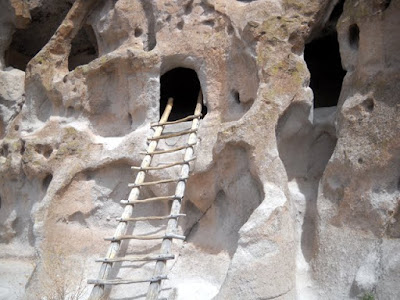
The Ancestral Pueblo people built structures against the canyon walls, where they could enlarge the small holes, carving out "cavates" to use as additional rooms and storage areas for their buildings.


This reconstruction shows the rock and masonry walls of the buildings and the ceiling beams.


They built fires in the cavates to harden the ceiling surface.


Today some of the cavates are open to the public via these ladders.


There was a surprisingly large number of visitors at Bandelier this week.


In addition to the buildings against the canyon walls, the ancient people built a large circular pueblo on the canyon floor. Here you can see remaining first-floor walls of the pueblo.


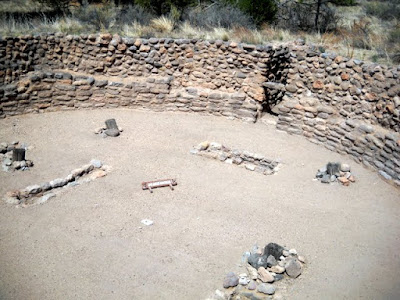
This Kiva is located outside the confines of the pueblo.


Farther up the canyon they built an 800-foot-long stretch of canyon wall structures called Long House. Here you can see some of the cavates (rooms), as well as the rows of holes in the canyon wall that show where beams for ceilings were placed. You can see two rows of holes for two stories here.


This shows both the lower walls of the buildings and the canyon wall rooms.


In this area, we could see some faint petroglyphs.


Archaeologists also discovered this picture, which had been painted on the canyon wall then covered over by plaster.


Frijoles Creek is the year-round source of water that probably attracted the ancestral Puebloans to this canyon.


We walked another half mile up the canyon to see Alcove House. To reach it, we had to climb stairs and ladders 140 feet up the canyon wall. I wondered if we had wandered back to Picacho Peak in Arizona.


It really wasn't as bad as it looks here.

Monday, May 16, 2011

Images from Taos

We saw lots of interesting things on our trip up the High Road to Taos. First was this highway sign.


I think it is the name of a community on one of the numerous Indian reservations north of Santa Fe. When we first saw the word, we confused it with "cowabunga." In case you thought the same thing, here is information on that word.

This sign is for a clothing store in Taos. I knew the name came from The Lone Ranger radio and TV program.


We have been to Taos several times, the first time 45 years ago during spring vacation the first year we were married. Boy were we dumb. We were driving down from Boulder, Colorado, and thought, since we were going south, it would be warm in Taos. Little did we realize there is a ski area not far from the town. We spent our first day there buying something warm to wear over our shorts and t-shirts!

There are lots of cool images around the town square, like these ristras.


A wagon of dried flowers in an alley.


A flowering tree--is it an apple tree?


Large metal flower sculptures.


A pedicab.


Boys playing in a fountain--have you ever seen a young boy who could stay out of a puddle of water?


In the same area two groups of musicians were entertaining passers-by.


Would you look at this fancy motorcycle (tricycle?) with flowering trees in the background.


Every time we visit Taos, I have to take pictures of the interesting park benches. Somehow I think the medallions have been repainted since we last visited.


You can't go to Taos without eating Mexican food. The first two restaurants we checked out that we had been to before, no longer serve this wonderful food. So we went to brunch at Doc Martin's Restaurant. Would you look at this breakfast burrito!


Our last stop before returning to Santa Fe was the bridge over the Royal Gorge of the Rio Grande River. It seems to be a much larger tourist attraction than in previous years. There is a parking lot where people were selling handmade items. Unfortunately, few if any of them were local Native American artists.


And look at this food truck on the other side of the highway. I think we saw more people taking pictures of the bus than buying something to eat.


This is a view of the gorge from the bridge.


These rafters were enjoying the Rio Grande further down stream. It's not white water rafting, but it looks like a nice float.


You may find this hard to believe, but on the way back to Santa Fe we bought diesel fuel at the Nambe Travel Center near the Buffalo Thunder Casino and Resort, for $3.88 cents a gallon. Yes, that is correct--$3.88 a gallon. Today we drove by the same station and topped off our tank. The cost now is $3.99. A big jump, but still the cheapest fuel we've seen in months.

Sunday, May 15, 2011

Chimayo

El Santuario de Chimayo is a small Catholic church in the village of Chimayo on New Mexico Highway 76 (part of the High Road to Taos). This is a view from the highway before driving down into the town. A mural on the wall of one of the buildings in the church complex shows the church and pilgrims coming for prayer and healing. We are still in the Easter season, as the three crosses to the right indicate. The church sees about 300,000 pilgrims a year, including 30,000 during Holy Week. There are crosses and shrines in many places on the grounds. To learn more about Chimayo and the history of the shrine, click here. This shows the entrance to the church. No photography is allowed inside. Many people believe the dirt found in the floor of one room of the church has healing properties. Many people come, seeking healing for themselves or others. They often take a small amount of dirt home. We both felt the presence of God in that place and were aware of the many prayers of faith that are offered there. We offered our own prayers for the healing of our son, Doug. The village of Chimayo is in a beautiful area of the Santa Fe National Forest. As we drove north from the village, we saw these logs supported by a trestle. As we passed by, we saw they were a simple aqueduct, carrying water across the small arroyo.