Wednesday, August 17, 2016
Hiking in Glacier National Park
It felt like we were hiking in a rain forest, everything was so green. And dark.
As you can tell if you look closely at the above photo, the trail is very muddy. It goes right by the horse rental facility and is used daily for trail rides. That is probably the activity that brought so many people to the tram stop.
We enjoyed our 4 to 5 mile hike, especially since we didn't see any bears. Would you believe we even saw a sign offering to rent bear spray? They must feel the odds are pretty good the renter won't have to use it.
Wednesday, August 15, 2012
Alaska–Day 91
Yukon Territory is huge. On a provincial park sign we saw the slogan, “Yukon, Larger than Life.” We spent seven days in Yukon on our way to Alaska and we will drive through the province for three days on our way to Haines. There is a vast expanse of wilderness, covered with forest and lakes. We tried very hard to take it all in today. After our drive tomorrow, we may never come through here again.
This is a long and daunting journey with a 36-foot 5th wheel trailer, especially at our age. I don’t know that I would want to go through it again. In addition, we both feel we have seen and experienced everything we ever wanted to see here. It has been wonderful. But we are full, and tired, and ready for the familiar and for staying in one place for weeks at a time.
What did we relish during our trip today? There were numerous ponds and small lakes. This country, which often sits on permafrost, has innumerable such ponds. Often they are smooth and reflect the surroundings. This first picture shows a trumpeter swan floating on the lake, though I don’t know if you can make it out. A little later, we saw two of these swans flying overhead. How cool is that? Where else could we see that?
The road today was rugged most of the way, with frost heave and pot holes. But the ride was worth it. We saw the beautiful St. Elias Mountains. We had seen the other side of this range three days ago, driving north from Glennallen to Tok. These mountains are part of the Wrangell and St. Elias National Park in Alaska and Kluane National Park in Canada.
We saw colorful mountains that make us wonder what the early settlers could mine there.
And our eyes feasted on Kluane Lake with its miles of shoreline and many acres of deep blue water.
We have seen 30 bear during this trip, 14 in Canada on our way to Alaska, 16 in Alaska. We hoped to see more today. We did. Number 31. As we drove along Kluane Lake, we saw this fat grizzly bear crossing the road. I took several pictures, including this one as he walked down to the lake’s shore. It was icing on the cake as we savored our last days in Canada.
This photograph shows you what I mean when I talk about a vast wilderness. It seems to go on and on, almost forever.
Finally, the valley spread out to include these open fields with pretty yellow flowers and rail fences. We wondered where the cattle or wheat fields were. Do they have them here?
We have been so blessed to have the time, the finances, the proper transportation and the good health to make this trip. We have seen such beauty. And I have over 5,000 pictures on my computer to help us remember it in the years to come.
Wednesday, July 11, 2012
Denali Natiional Park
With all that said, our driver, Mike, said that close-up views of wildlife were unusual. We saw no wildlife for the first 15+ miles and the first animal was a porcupine. I don't think either of us have every seen one in the wild, so it was fun. But not what we came for. This is what we wanted to see--grizzly bears.
Then we saw three individual bears followed by two sows with twin cubs. The first set was fairly close to the road. How cool.
Later, we saw a mother bear and a yearly cub that had been swimming. They were right next to the road, then decided to really give us a treat and walked across the road, then next to the bus before going down on the other side.
Several times we saw small herds of caribou a long distance from the road. Twice there were several close by.
They even provided us with a closer look by slowly walking in front of the bus. This bull led the way.
At one of the rest stops, there were several sets of antlers visitors could handle. This woman wanted to see what she would look like as a caribou.
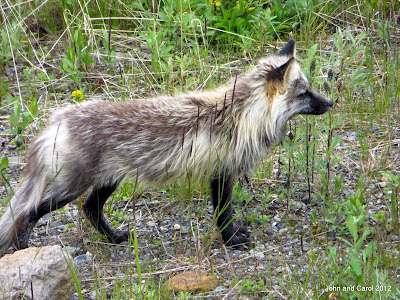
At the Eielson VC, we saw this red fox. I know it isn't red, but one of the Alaska Geographic staff told me it truly was a red fox, but in a different color phase. John took this picture.
He also took a picture of me with my camera. You can tell it was a cloudy and cold day. But we didn't have any rain during our stops.
There were lots and lots of buses on the road. I think the shuttle runs every 15 to 45 minutes with turn-arounds at 53, 66, 85 and 90 miles. The 90-mile bus takes 12 hours, round trip. We were tired after 8 hours. That was enough for us. There are also four types of narrated tours, ranging from 5 to 12 hours. Those are more expensive and don't stop as often or as long when wildlife is spotted. Our main objective was to view wildlife and we certainly were rewarded on the shuttle bus.
We were due back where we had parked at 2 pm. The one large animal we hadn't seen during the trip was a moose. But even that animal came into view about 1:40. We have seen cow moose before, but never a bull with a large rack. But look at what we spotted along the road!
We watched this magnificent animal eating plants for at least 10 minutes. Sometimes he would lift his head so we could see his face and not just his antlers. What a treat!
Tuesday, June 19, 2012
Alaska–Day 34
Wow, what a beautiful day! Our drive from Fort nelson to Liard River Hot Springs Provincial Park may have been the most spectacular yet in terms of both scenery and wildlife. We saw eight black bear, including one mama and baby. The baby was so small, it was hidden in the tall grass, except when it stood up to look around. Unfortunately, it never stood up when the camera was clicking. Early in the day, one ran across the road in front of us.
Just before we reached the park, we saw two bears quietly browsing in the tall grass and dandelions.
We drove through incredible mountain areas.
One business along the way took lessons from Wall Drug or Burma Shave, I believe. We kept seeing signs advertising fresh hot cinnamon rolls. We couldn’t resist stopping at Testa River Services to get some. We weren’t the only rvers attracted by the signs.
Canadians are serious about warning drivers about wildlife along the roads. These are just a few of the signs we have seen in the last couple of weeks. To date, we have seen all the animals except bison.
We got our first good look at some caribou. Their horns weren’t very developed.
Later, we saw several on the road. They grudgingly moved so we and the 18-wheeler could move on.
We also saw stone sheep along and on the road. In fact, we probably saw two dozen of them, at least. Their horns are like those of big horn sheep, but that species doesn’t live this far north.
This baby was the smallest we saw. Even after we stopped right next to it, then drove away, it didn’t move. We sure hope it made it safely through the day.
Seven-mile long Muncho Lake, known for its deep green and blue waters, is amazing. We had seen it eight years ago when it was cloudy and windy, so we weren’t too impressed. But Tuesday there was no breeze blowing, so the reflections were amazing. Honestly, these are photos we took, with only very minor tuning in Picasa.
Monday, September 05, 2011
Bears, Bears Everywhere
Over the weekend, a mother bear and two cubs were wandering around the LaVeta cemetery. The local marshall determined that they weren't headed on into town. He was afraid that if he tried to get them to move away, they just might head for main street, so he left them alone. There are almost daily bear sightings in the LaVeta area.
Our campsite here in the state park is along a road that goes to the Department of Wildlife's facility. Some days we have seen three or four wildlife trucks going up and down the road with bear traps on the back end. We finally asked if they were releasing trapped bears nearby. No. When the move a trapped bear, they take it to a nearby wildlife area where they tag it, then spray it down with water. That keeps the bear cool as they transport it to another part of the state.
Today we saw a bear in the campground while we were cleaning fire pits. Fortunately, it was in one of those bear traps. We stopped by to take a picture. If you click on the photo, you may be able to see the bear's head behind the bars. It had already been tagged and watered down. In fact, it was sloshing in water inside that trap. But it was pretty calm--looking out through the bars and sticking its nose out another opening, but not growling.
Since the campground was full for the Labor Day weekend, we had an awful lot of ashes and wood to clean out of the fire pits. And a number of campers were gatherers--not hunter gatherers, but gatherers. That means they scoured the open areas in the park for firewood--which is not permitted. When they do that, often it needs splitting to burn properly. But since the gatherers don't come equipped to do that, they attempt to burn 12-foot long branches and stumps that are 12 inches in diameter. Happily, the park's maintenance crew helped John unload those huge pieces.
Tomorrow we will prepare our RV so we can drive to Denver on Wednesday. We will spend three and a half weeks at Cherry Creek and Chatfield state parks while we take care of medical and dental appointments, spend time with Eric, Liz, Kylie and John and with friends, and try to whittle down even more what we have in storage. It will be a busy time.