On Christmas Day in 1902 my grandparents, George E. Polhill and Lydia M. Doolin, were married in Weston, Colorado, by the groom's father, George W. Polhill, the local Justice of the Peace. George was a mason, working for CF&I Steel Co. and living in Segundo. I began looking into these facts more than a decade ago when it became possible to get specialty license plates if you were from a pioneer family--meaning a family that had come to Colorado before 1900. Weston and Segundo are on Colorado Hwy 12, the Scenic Highway of Legends, that runs from LaVeta over to Trinidad. As we have done before, today John and I drove that beautiful highway.
As we drove through LaVeta, we saw this doe mule deer and her triplets, right in town. I wasn't able to get mother and all three babies on one photo, but you can see two of the fawns.
Here is one of the many stone dikes visible along Hwy 12 through the Sangre de Cristo Mountains.
Our first stop was in Cuchara, a small tourist town, that has a few shops and restaurants and the Timbers lodge and restaurant. John is standing on the covered porch in front of the Timbers. I just love the pine bark slabs that decorate the building.
There was more beautiful vistas as we drove over Cuchara Pass, where my great-grandfather had homesteaded in July 1885.
We spotted this tiny cemetery along the road and pulled off to take a look. There were two headstones with names--neither of them my family.
This is the steeple on an old church in Weston. I don't where my great-grandparents' home was. Perhaps they lived on the homestead north of here.
Another picture of a church steeple, this one in Segundo, I think. CF&I (Colorado Fuel and Iron) had a steel mill in Pueblo and a number of coal mines up what is now Hwy 12 north of Trinidad. The first coal mine was named Primero, the next Segundo, the next Tercio (Spanish for 1, 2 and 3). When the mines were operating, the company ran a train up the valley each day to pick up children and take them to school. You can read more about the early coal mining in this area here.
This is what is left of coke ovens at Cokedale, a town just outside Trinidad. It was here that local coal was made into coke. For more information about Cokedale, click here.
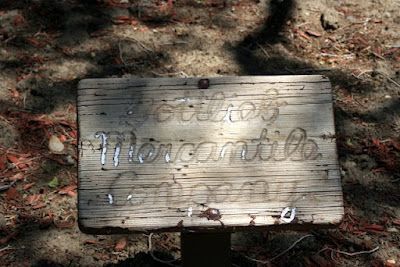
Now the Post Office and Cokedale Town Hall, this building was originally the Gottlieb Mercantile Company.
We drove on to Trinidad, where we had great meatball sandwiches at Nana and Nano's Montleones Pasta and Deli, then we drove back home to Lathrop. It was a scenic and fun day.
I finally feel like I can be useful again here at Lathrop. Since June 15, when I realized that doing a lot of walking had made my knee and lower leg swell, I have really limited my activity. But each day since my surgery last Wednesday, I have been able to do more walking.
For the past month I have worked in the camp store and driven the truck while John cleared out Russian Olive trees and cleaned fire pits. But I haven't done any of the physical labor. Yesterday, however, I was able to help drag out some of the tree limbs. And today I picked up litter and helped remove fire wood that had been left in the campground. I feel useful again. And capable. I have hated having to limit my activity.
I am grateful to God for the healing I have experienced. And to John for all his help and care before, during and since the surgery. Thanks to all who have been praying for me. I appreciate all the emails and blog comments of good wishes and support.
This is a view of our RV and yard here at Lathrop State Park.
When I go inside and look out that large front window, this is my view of Martin Lake first thing in the morning.
There are lots of other things to see, as well. When we first parked the rig and saw this big hole, we wondered if it belonged to a badger or a coyote.
When I asked some of the folks in the Visitor Center, Karen told me at their place, they usually find rabbits living in holes like this. And we sure have a lot of cotton tail rabbits in our yard. They are small and so cute.
That is, until they start looking at our tomato plant as a source of breakfast.
The rabbits are still here, but unfortunately, the tomato died. And it wasn't the fault of the bunnies. We aren't sure if we over watered it, under watered it, or left it in the sun and wind too often. But it shriveled up and died.
We put out a hummingbird feeder and now we get to watch these beautiful birds all day. I have to fill it every two days.
The sky is often very pretty late in the evening.
Because of the smoke from forest fires in New Mexico and southern Colorado, our sunrises have been dramatic many mornings.
I may have posted a picture of this Bullocks Oriole before.
This buck Mule Deer spent most of one day browsing and sleeping in our yard.
From the bird songs we hear around us, I believe this is a Meadowlark.
That is really what it was to have my knee surgery yesterday. Hope it continues this way. We woke up at 3:15, left at 4 and arrived at the hospital at 5:30 am. By 10:30 we were headed out the door. I used crutches to get in and out of the wheel chair--you never get to walk out of a hospital--and to get in the truck and into our RV. When I stood on my right leg, it felt better than it had when I woke up in the morning.
We both slept well and I am doing fine today. Able to removed the ace bandage and gauze wrapping, take a shower, and put on band aides over the two small incisions. I will take it easy today and tomorrow. No crutches are necessary and I can put my full weight on the leg.
This is probably more than anyone wanted to know, but the blog is a record of our life so I am saving this for my own benefit, if not for posterity.
What more could I need as I sit recuperating in my recliner? Water, cell phone, i-pad, pain pills, blood pressure cuff and a great husband taking care of me. You can't see him because he took the picture.
Sunday we rode the San Luis and Rio Grande Scenic Railroad from La Veta to Fir, near the top of La Veta Pass, where we attended a great concert. Fir is the location of a abandoned town that once served mining activity in the area. The SLRG has created a concert venue there. The first wow was our travel in the dome car. This car gave us a better view of the surrounding scenery, as well as uncrowded seating and great food options.
I started the morning with a crepe topped with berries and cream. It was very good.
We were entertained by Jim Garling, a country western singer from Oklahoma. He wasn't one of the headliners at the concert, but he was a passenger on the train, knew some of the performers, and had an evening concert scheduled in La Veta.
The scenery as we headed out of La Veta is great--and we were able to see it better than ever from our dome car. This is called Glimers (I think) Butte, really it is a volcanic plug.
And this is Mount Maestas.
Fred Hargrove, who lives in the San Luis Valley, was MC for the concert. He is a country western singer.
Not only is the scenery at the concert site great, it is a wonderful place to take children. They can explore the country-side while their watching parents can hear the music.
Folk singer Ann Hills was the opening act for the concert. We really enjoyed her and her music. Doesn't she have a great smile?
John McCutcheon was the main act. He is a singer and storyteller who plays the hammer dulcimer, banjo, guitar, piano and probably many other instruments as well.
He was great. Every song he sang and story he told touched me and made me either laugh or cry. We would definitely go to see him again.
The concert ended with Fred Hargrove, John McCutcheon, Ann Hills and folk singer Ed Ellis singing together. Ellis happens to be president of the San Luis and Rio Grande Scenic Railroad and responsible for creating this great concert series.
John and I aren't the only people having 50th high school reunions this summer. This is Sylvia J. Lobato, editor of Valley Publishing in Alamosa. She was part of the 1961 Alamosa High School graduating class that attended the concert, as well.
This young lady--maybe six or seven years old, caught the attention of many of the concert growers. She did gymnastics and danced to most of the music. She is really good!
John even took a video of her dancing to John McCutcheon on the hammer dulcimer.
About half of the people attending the concert rode our train from La Veta. The other half came up from Alamosa on a stream train. That train continued on to La Veta with other passengers, then returned about 3:30 to pick up the concert goers who were returning to La Veta. We could hear the steam train chug-chug-chugging up the track for nearly 30 minutes before it arrived. Here you see it arriving and our train on the back track.
At Fir, the Whistle Stop Cafe was serving BBQ and sides to concert goers. The food was very good. We both had pulled pork.
We were eating at tables set up along the train tracks, looking down on the concert area. Here you can see the stage to the left, with hay bales and benches for people to sit on, a shaded seating area to the right, and a restroom building.
All power for the concert area is provided by solar panels
and a wind turbine.
See the bulldozer on the hill? The story goes that a couple living in the area were going through a nasty divorce. They fought over every single bit of property. One of them wanted this bulldozer. The other finally said, "OK, if you want it, come and get it." They drove it up this road on the mountain side. Apparently, the spouse decided it wasn't worth going there to get it.
One big highlight of the trip was sighting bears along the track. Several years ago, a freight train dumped a load of barley here. After a winter of rain and snow, the barley began to ferment--that means beer. The local bears found this very attractive and they still come here to eat. Both directions we saw bears--one black bear and one large cinnamon-colored bear. In fact, on the way down the hill, the train passed the bears, stopped, backed up to the site so we could see them again, then continued to La Veta. Since the only way to reach the concert location is by train, we guessed Ed Ellis, the president of the railroad, told the engineer to give us a better look. The photo of the black bear is blurry, sorry. The brown bear came out better.
Yesterday we went for a 4 hour train ride from Alamosa to Antonito and back. The small San Luis and Rio Grande Scenic Railroad train was pulled by this oil-fired steam engine.
We had to be in Alamosa by 7:30 for the 8:15 departure, so we left Lathrop State Park at 6:15 am for the 70 mile drive. Most of southern Colorado has hazy skies from the forest fire burning near Los Alamos, NM. This was our first view of the San Luis Valley as we drove west.
Last year John won a photo contest with one of the pictures he took on the photographers special trip in August. His prize was a free pass on the SLRG and that is one of the reasons we are spending our summer here. I wrote two blogs about that trip, one on the photographers and the other about the trip
Our train car manager for yesterday's trip was Ted. We enjoyed meeting him.
The last car on the train was open and we could see back down the tracks during the trip to Antonito. This view reminded me of this stage of life. We can see back a long way and there are lots of good memories. But the further back we look, the more blurry the picture becomes.
Sometimes our path in life isn't entirely clear. I'm glad the engineer or brakeman and switchman knew which track we needed to go on yesterday.
These horses didn't like the noise of the train and galloped away.
In another field, the cattle were unconcerned as we went by.
Somebody went to a lot of work to build this elaborate gateway. But notice, it doesn't go anywhere--the road doesn't go through it.
We often see evidence of early recycling efforts. Abandoned railroad cars frequently show up in farm yards as ready-built storage sheds.
Silos provide a canvas for local artists.
This small ladder sure makes it easy to cross the barbed wire fence.
The San Luis Valley is an alpine valley covering approximately 8,000 square miles in Colorado and New Mexico. It provides excellent land for farming. A lot of hay is grown there.
But only if there is water. So we saw lots of irrigation canals and ditches.
And large sprinklers irrigating crops.
Some of the irrigation water comes from rivers and some from deep wells. In this arid place, it is easy to see where water flows or is close to the surface. Willows and cottonwood trees grow in abundance.
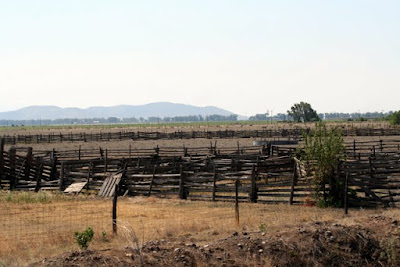
I'm not sure these corrals would hold cattle these days.
About half of the passengers on our train were going to Antonito to ride the Cumbres and Toltec Scenic Railway train over Cumbres Pass down into Chama, NM. This flag draped the rear platform on that train.
It was pulled by a coal-fired steam engine. Look at all that coal. I was glad I didn't have to shovel it.
But this guy did. By the way, when John can't sleep at night, he sometimes pictures himself shoveling coal into the fire box. Hard work, but boring I guess.