Monday, July 11, 2011

Wow! What a day

Sunday we rode the San Luis and Rio Grande Scenic Railroad from La Veta to Fir, near the top of La Veta Pass, where we attended a great concert. Fir is the location of a abandoned town that once served mining activity in the area. The SLRG has created a concert venue there.
The first wow was our travel in the dome car. This car gave us a better view of the surrounding scenery, as well as uncrowded seating and great food options.


I started the morning with a crepe topped with berries and cream. It was very good.


We were entertained by Jim Garling, a country western singer from Oklahoma. He wasn't one of the headliners at the concert, but he was a passenger on the train, knew some of the performers, and had an evening concert scheduled in La Veta.


The scenery as we headed out of La Veta is great--and we were able to see it better than ever from our dome car. This is called Glimers (I think) Butte, really it is a volcanic plug.


And this is Mount Maestas.


Fred Hargrove, who lives in the San Luis Valley, was MC for the concert. He is a country western singer.


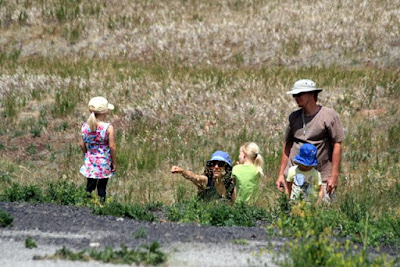
Not only is the scenery at the concert site great, it is a wonderful place to take children. They can explore the country-side while their watching parents can hear the music.


Folk singer Ann Hills was the opening act for the concert. We really enjoyed her and her music. Doesn't she have a great smile?


John McCutcheon was the main act. He is a singer and storyteller who plays the hammer dulcimer, banjo, guitar, piano and probably many other instruments as well.


He was great. Every song he sang and story he told touched me and made me either laugh or cry. We would definitely go to see him again.

The concert ended with Fred Hargrove, John McCutcheon, Ann Hills and folk singer Ed Ellis singing together. Ellis happens to be president of the San Luis and Rio Grande Scenic Railroad and responsible for creating this great concert series.


John and I aren't the only people having 50th high school reunions this summer. This is Sylvia J. Lobato, editor of Valley Publishing in Alamosa. She was part of the 1961 Alamosa High School graduating class that attended the concert, as well.


This young lady--maybe six or seven years old, caught the attention of many of the concert growers. She did gymnastics and danced to most of the music. She is really good!


John even took a video of her dancing to John McCutcheon on the hammer dulcimer.


About half of the people attending the concert rode our train from La Veta. The other half came up from Alamosa on a stream train. That train continued on to La Veta with other passengers, then returned about 3:30 to pick up the concert goers who were returning to La Veta. We could hear the steam train chug-chug-chugging up the track for nearly 30 minutes before it arrived. Here you see it arriving and our train on the back track.


At Fir, the Whistle Stop Cafe was serving BBQ and sides to concert goers. The food was very good. We both had pulled pork.


We were eating at tables set up along the train tracks, looking down on the concert area. Here you can see the stage to the left, with hay bales and benches for people to sit on, a shaded seating area to the right, and a restroom building.


All power for the concert area is provided by solar panels


and a wind turbine.


See the bulldozer on the hill? The story goes that a couple living in the area were going through a nasty divorce. They fought over every single bit of property. One of them wanted this bulldozer. The other finally said, "OK, if you want it, come and get it." They drove it up this road on the mountain side. Apparently, the spouse decided it wasn't worth going there to get it.


One big highlight of the trip was sighting bears along the track. Several years ago, a freight train dumped a load of barley here. After a winter of rain and snow, the barley began to ferment--that means beer. The local bears found this very attractive and they still come here to eat. Both directions we saw bears--one black bear and one large cinnamon-colored bear. In fact, on the way down the hill, the train passed the bears, stopped, backed up to the site so we could see them again, then continued to La Veta. Since the only way to reach the concert location is by train, we guessed Ed Ellis, the president of the railroad, told the engineer to give us a better look. The photo of the black bear is blurry, sorry. The brown bear came out better.


Thursday, July 07, 2011

Views from the Train

Yesterday we went for a 4 hour train ride from Alamosa to Antonito and back. The small San Luis and Rio Grande Scenic Railroad train was pulled by this oil-fired steam engine.


We had to be in Alamosa by 7:30 for the 8:15 departure, so we left Lathrop State Park at 6:15 am for the 70 mile drive. Most of southern Colorado has hazy skies from the forest fire burning near Los Alamos, NM. This was our first view of the San Luis Valley as we drove west.


Last year John won a photo contest with one of the pictures he took on the photographers special trip in August. His prize was a free pass on the SLRG and that is one of the reasons we are spending our summer here. I wrote two blogs about that trip, one on the photographers and the other about the trip

Our train car manager for yesterday's trip was Ted. We enjoyed meeting him.

The last car on the train was open and we could see back down the tracks during the trip to Antonito. This view reminded me of this stage of life. We can see back a long way and there are lots of good memories. But the further back we look, the more blurry the picture becomes.


Sometimes our path in life isn't entirely clear. I'm glad the engineer or brakeman and switchman knew which track we needed to go on yesterday.


These horses didn't like the noise of the train and galloped away.


In another field, the cattle were unconcerned as we went by.


Somebody went to a lot of work to build this elaborate gateway. But notice, it doesn't go anywhere--the road doesn't go through it.


We often see evidence of early recycling efforts. Abandoned railroad cars frequently show up in farm yards as ready-built storage sheds.


Silos provide a canvas for local artists.


This small ladder sure makes it easy to cross the barbed wire fence.


The San Luis Valley
is an alpine valley covering approximately 8,000 square miles in Colorado and New Mexico. It provides excellent land for farming. A lot of hay is grown there.


But only if there is water. So we saw lots of irrigation canals and ditches.


And large sprinklers irrigating crops.


Some of the irrigation water comes from rivers and some from deep wells. In this arid place, it is easy to see where water flows or is close to the surface. Willows and cottonwood trees grow in abundance.


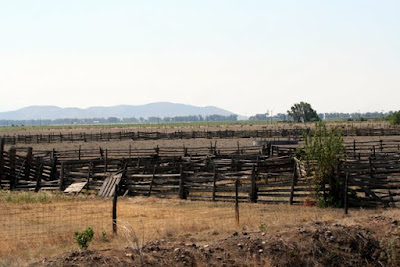
I'm not sure these corrals would hold cattle these days.


About half of the passengers on our train were going to Antonito to ride the Cumbres and Toltec Scenic Railway train over Cumbres Pass down into Chama, NM. This flag draped the rear platform on that train.


It was pulled by a coal-fired steam engine. Look at all that coal. I was glad I didn't have to shovel it.


But this guy did. By the way, when John can't sleep at night, he sometimes pictures himself shoveling coal into the fire box. Hard work, but boring I guess.

Tuesday, July 05, 2011

The Road to Healing

Today we sat at the doctor's office for over 2 1/2 hours--mainly just waiting. I had a noon appointment with an orthopedic surgeon about my injured knee. We arrived about 11:45 since I knew I would have to fill out a lot of paperwork. Somewhere close to 12:45 I was finally called. John continued to sit in the waiting room. My first stop was X-ray--3 pictures of my knee. Second stop was an exam room.

As the time approached 2 pm, I was about ready to open the door and ask if the doctor had forgotten me. But he did come in before 2. It only took 10 to 15 minutes to decide I did need surgery and it could be scheduled as soon as possible. Then we walked down the hall and I met the surgery scheduler. While we working out the details, I heard someone say, "Carol Andrews. Yes she is here." John had been waiting so long--it was 2:20 pm--he wondered if I had gotten lost or something.

I will have arthroscopic surgery Wednesday next week. Yea! I have been dealing with this since late May. I am ready to begin the road to healing. I may need to use crutches for a couple of days. But he said I could be walking well in a couple of weeks and maybe running in six. I am so looking forward to that.

The tough part will be checking in for surgery at 5:30 am, 100 miles from where we are in Walsenburg. But otherwise, I would have to be awake for hours without eating or drinking. We won't have to get up any earlier than we did for our airline flights to and from New Hampshire.

Saturday, July 02, 2011

4th of July

It is shaping up to be quite a holiday weekend at Lathrop State Park. Busy, busy, busy. As I sit having my morning coffee, I can look out the window and see Martin Lake here in the park. I spotted the first boat out on the water at 6:10 am. And the boat ramp only opens at 5:30 am. It is hot all over the state, so I imagine every lake in Colorado will be busy this weekend. I saw the first water skier at 7:35 am.

The staff here at the park began the weekend with an ice cream social at 3 yesterday afternoon. I saw RVs still moving in at 8:30 last evening. Every campsite is full. And John, park manager, said he could rent 50 more camp sites if we had them.

Three evening programs are planned. Then Monday night, on the 4th, there will be a fireworks display across the road in the hospital parking lot. Many, many locals come to Lathrop to watch the display. And each one pays for a day pass--good income for the park, which needs it in these tight-budget times, especially.

John and I won't see much of each other for two days. Since he works outdoors, he goes to work as early as possible, trying to avoid the heat in the afternoon. Meanwhile, I work till 7 pm, selling ice cream and popcorn up until the evening programs. We'll get back together on Monday, working together a few hours and taking the rest of the day off.

Happy Independence Day to everyone. We must remember to be thankful for our freedom and all the people who have sacrificed to make it possible.

Tuesday, June 28, 2011

Tale of the Disappearing Tree

One of John's assignments this summer is to remove Russian olive trees. Why? you ask. The tree is native to western Asia and was introduced into the central and western area of the United States. Today it is defined as an invasive species:

The Russian olive, with its tendency to spread quickly, is a menace to riparian woodlands, threatening strong, native species like cottonwood and willow trees. They are responsible for out competing a lot of native vegetation, interfering with natural plant succession and nutrient cycling and choking irrigation canals and marshlands in the western United States. This displacement of native plant species and critical wildlife habitats has undoubtedly affected native birds and other species. The heavy, dense shade of the Russian olive is also responsible for blocking out sunlight needed for other trees and plants in fields, open woodlands and forest edges. Overall, areas dominated by the Russian olive do not represent a high concentration of wildlife. (http://www.columbia.edu/itc/cerc/danoff-burg/invasion_bio/inv_spp_summ/Elaeagnus_angustifolia.htm)


What does it take to remove a tree? This is what it looked like as John began working Monday.


The nearby wildlife pond is surrounded by these trees.


John used a chain saw to removed branches and hauled them away from the tree.


If the branches were fairly large, he had to cut them up.


Slowly, the olive tree is cut up and pulled out, revealing a small willow tree and a cedar tree.


All the branches are loaded into a dump truck.


Five truck-loads of branches were hauled to the dump from the one tree and one more load of branches must be picked up Saturday.


Almost done! The original large tree has been removed. Another tree behind there is still standing. The small Russian olive on the left was removed before the end of the day.


And then there is the stump to remove.


It takes an awful lot of work to make just one tree disappear.

Sunday, June 26, 2011

Hot HOT!

Did I say hot? We wonder why we bothered to come to Colorado from Arizona. Today it only reached 96 here at Lathrop. The last 3 days or so it has hit 100 or 101. Is that much different from 110 in Phoenix?

We have two air conditioners, so it is pretty cool in the RV. And if you can stay out of the sun, with the breeze (or is it wind?) that we have had for days, it isn't unbearable. But it sure is hot to work outside in the sun. Yesterday John was wearing a long-sleeved shirt, jeans and chaps to cut down Russian Olive trees with a chain saw. That was hot!


Saturday, June 25, 2011

Darn and Double Darn

A month ago I was climbing up into our pickup truck when I felt a “pop” in my right knee. I hobbled around that day. The next day I bought an elastic knee brace and that seemed to help. Two weeks later, I felt almost well, so I went running with John that morning. Not a good idea.

For the next few days, it seemed to get a little better. A week ago I walked a lot, helping with the work here at Lathrop. But by Wednesday, I could hardly put any weight on it. That meant a trip to the doctor’s office was in order. The Spanish Peaks Family Clinic and Regional Health Center are right across the highway from Lathrop. I was able to get an appointment with a nurse practitioner the same morning.

Now, a week and a half later, I have had an X-ray and an MRI. I have a torn meniscus. I am being referred to a sports orthopedic clinic in Colorado Springs and surgery is most likely on the agenda.

This sure puts a crimp in my running. No, it has brought it to a screeching halt. How long it will be before I can resume my exercise routine?

Wednesday, June 22, 2011

Pet Peeves

As volunteers in a number of state parks, we often find ourselves picking up litter left by others. What do we find that drives us nuts? To start with, there are the clear plastic straw covers from juice boxes and bags. I don't think anyone properly disposes them...they just drop them on the ground.

The next item is the foil seal from the top to fish powerbait. Anglers must pull that off the bottle, drop in on the ground and bait their hooks. Do you think the fish will get away if they take the time to put it in their pocket to place in the trash can later? Honestly, we think many anglers are just lazy and slobs. They leave empty fish hook packages, empty foam worm boxes, tangled fishing line, and empty snack bags wherever they happen to be fishing.

Beer bottles and cans are another pet peeve--specifically the ones crushed and left on the ground, those deposited upside down in the yucca plant right next to the trash can, broken on the rocks next to the lake, left for the next person to step on.

Two years we were in Texas state parks at Easter. There, the weather is warm enough to plan picnics. We really hated confetti-filled plastic Easter eggs! It is almost impossible to pick up the confetti with your hands or a trash grabber. And often the plastic eggs, not matter what they are filled with, are broken and we had to gather the pieces.

Many picnickers try to clean up their site, starting with tying a plastic bag to the grill or table to put their trash in. We appreciate that they then throw the bag in the trash can. But they often leave the bag ties on the grill or table and we have to untie them.

Why do people seem to think glass, aluminum, plastic and nails will burn in a campsite fire pit? Or do they just use it as the closest place to deposit trash? We (mainly John) clean those fire pits and let me tell you, they don't burn.

"Pack it in, pack it out" is the mantra for back-country camping. I wish everyone who enjoys the outdoors would follow that advice.